 黑客技术
点击放大
TripleCross - A Linux eBPF rootkit with a backdoor, C2, library
项目说明
TripleCross
!License
!GitHub release (latest by date including pre-releases)
!Maintainability
!GitHub last commit
TripleCross is a Linux eBPF rootkit that demonstrates the offensi of the eBPF technology.
TripleCross is inspired by previous implant designs in this area, notably the works of Jeff Dileo at DEFCON 27[^1], Pat Hogan at DEFCON 29[^2], Guillaume Fournier and Sylvain Afchain also at DEFCON 29[^3], and Kris Nóva's Boopkit[^4]. We reuse and extend some of the techniques pioneered by these previous explorations of the offensi of eBPF technology.
This rootkit was created for my Bachelor's Thesis at UC3M. More details about its design are provided in the thesis document.
Disclaimer
This rookit is purely for educational and academic purposes. The software is provided "as is" and the authors are not responsible for any damage or mishaps that may occur during its use.
Do not attempt to use TripleCross to the law. Misuse of the provided software and information may result in criminal charges.
Contents
1. Features
2. TripleCross o
3. Build and install
4. Library injection module
5. Backdoor and C2
6. Execution hijacking module
7. Rootkit persistence
8. Rootkit stealth
9. License
Features
1. A library injection module to execute malicious 代码 by writing at a process' memory.
2. An execution hijacking module that modifies data passed to the kernel to execute malicious programs.
3. A local pri escalation module that allows for running malicious programs with root pri.
4. A backdoor with C2 capabilities that can monitor the 网络 and execute commands sent from a remote rootkit 客户端. It incorporates multiple acti triggers so that these actions are transmitted stealthily.
5. A rootkit client that allows an attacker to establish 3 different types of shell-like connections to send commands and actions that control the rootkit state remotely.
6. A persistence module that ensures the rootkit remains installed maintaining full pri e a reboot event.
7. A stealth module that hides rootkit-related files and directories from the user.
[^1]: J. Dileo. Evil eBPF: Practical Abuses of an In-Kernel Bytecode Runtime. DEFCON 27. slides
[^2]: P. Hogan. Warping Reality: Creating and Countering the Next Generation of Linux Rootkits using eBPF. DEFCON 27. presentation
[^3]: G. Fournier and S. Afchain. eBPF, I thought we were friends! DEFCON 29. slides
[^4]: Kris Nó. github
TripleCross o
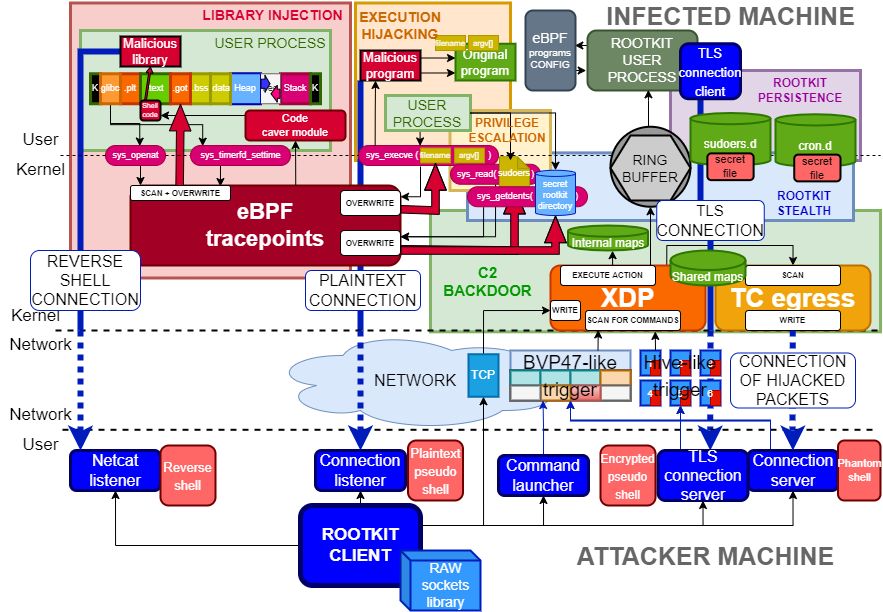
The following figure shows the architecture of TripleCross and its modules.
<img src="docs/images/rootkit.png" float="left">
The raw sockets library RawTCP_Lib used for rootkit transmissions is of my authorship and has its own repository.
The following table describes the main 源码 代码 files and directories to ease its na:
| DIRECTORY | COMMAND |
| ------------- | ------------- |
| docs | Original thesis document |
| src/client | Source code of the rootkit client |
| src/client/lib | RawTCP_Lib shared library |
| src/common | Constants and configuration for the rootkit. It also includes the implementation of elements common to the eBPF and user space side of the rootkit, such as the ring buffer |
| src/ebpf | 源码 代码 of the eBPF programs used by the rootkit |
| src/helpers | Includes programs for testing the functionality of several rootkit modules, and also the malicious program and library used at the execution hijacking and library injection modules, respectively |
| src/libbpf | Contains the libbpf library integrated with the rootkit|
| src/user | 源码 代码 of the userland programs used by the rootkits|
| src/ | Headers containing the definition of kernel data structures (this is the recommended method when using libbpf) |
Build and Install
#### Requirements
This research project has been tested under the following en:
|| DISTRIBUTION | KERNEL | GCC | CLANG | GLIBC |
| ------------- | ------------- | ------------- | ------------- | ------------- | ------------- |
| Ubuntu 21.04 | 5.11.0 | 10.3.0 | 12.0.0 | 2.33 |
We recommend using Ubuntu 21.04, which by default will incorporate the software shown here. Otherwise, some of the problems you may run into are described here.
#### Compilation
The rootkit 源码 代码 is compiled using two Makefiles.
The following table describes the purpose of each Makefile in detail:
| MAKEFILE | COMMAND | DESCRIPTION | RESULTING FILES |
| ------------- | ------------- | ------------- | ------------- |
| src/client/Makefile | make | Compilation of the rootkit client | src/client/injector |
| src/Makefile | make help | Compilation of programs for testing rootkit capabilities, and the malicious program and library of the execution hijacking and library injection modules, respectively | src/helpers/simple_timer, src/helpers/simple_open, src/helpers/simple_execve, src/helpers/lib_injection.so, src/helpers/exec |
| src/Makefile | make kit | Compilation of the rootkit using the libbpf library | src/bin/kit |
| src/Makefile | make tckit | Compilation of the rootkit TC egress program | src/bin/tc.o |
Installation
Once the rootkit files are generated under src/bin/, the *tc.o* and *kit* programs must be loaded in order. In the following example, the rootkit backdoor will operate in the 网络 interface *enp0s3*:
Attack scenario scripts
There are two scripts, *packager.sh* and *deployer.sh*, that compile and install the rootkit automatically, just as an attacker would do in a real attack scenario.
* Executing packager.sh will generate all rootkit files under the *apps/* directory.
* Executing deployer.sh will install the rootkit and create the persistence files.
These scripts must first be configured with the following parameters for the proper functioning of the persistence module:
| SCRIPT | CONSTANT | DESCRIPTION |
| ------------- | ------------- | ------------- |
| src/helpers/deployer.sh | CRON_PERSIST | Cron job to execute after reboot |
| src/helpers/deployer.sh | SUDO_PERSIST | Sudo entry to grant password-less pri |
Library injection module
The rootkit can hijack the execution of processes that call the *sys_timerfd_settime* or *sys_openat* system calls. This is achieved by o the Global Offset Table (GOT) section at the memory of the process making the call. This leads to a malicious library (*src/helpers/injection_lib.c*) being executed. The library will spawn a reverse shell to the attacker machine, and then returns the flow of execution to the original function without crashing the process.
TripleCross is prepared to bypass common ELF hardening techniques, including:
* ASLR
* Stack canaries
* DEP/NX
* PIE
* Full RELRO
It is also prepared to work with Intel CET-compatible 代码.
The module functionality can be checked using two test programs *src/helpers/simple_timer.c* and *src/helpers/simple_open.c*. Alternatively you may attempt to hijack any system process (tested and working with systemd).
The module configuration is set via the following constants:
| FILENAME | CONSTANT | DESCRIPTION |
| ------------- | ------------- | ------------- |
| src/common/constants.h | TASK_COMM_NAME_INJECTION_<br>TARGET_TIMERFD_SETTIME | Name of the process to hijack at syscall sys_timerfd_settime |
| src/common/constants.h | TASK_COMM_NAME_INJECTION_<br>TARGET_OPEN | Name of the process to hijack at syscall sys_openat |
| src/helpers/injection_lib.c| ATTACKER_IP & ATTACKER_PORT| IP address and port of the attacker machine|
Receiving a reverse shell from the attacker machine can be done with netcat:
Library injection via GOT hijacking technique
The technique incorporated in TripleCross consists of 5 stages:
#### Locating GOT and the return address
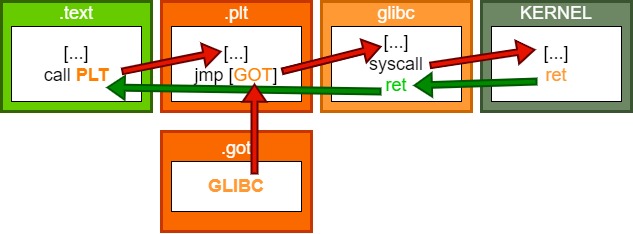
The rootkit hooks the system call using a tracepoint program. From there, it locates the address at the GOT section which the PLT stub used to make the call to the glibc function responsible of the syscall.
In order to reach the GOT section, the eBPF program uses the return address stored at the stack. Note that:
* The .text makes a *call* to the .plt, so *rip* is saved as *ret* in the stack.
* The .plt makes a *jump* to glibc using .got, so no other *rip* is saved. It also does not modify or save the value of *rbp*.
* Glibc makes a *syscall*, which does not save *rip* in the stack, but rather saves it in *rcx*.
<img src="docs/images/plt_got_glibc_flow.jpg" float="left">
Therefore in order to check from eBPF that an address in the stack is the return address that will lead us to the correct GOT, we must check that it is the return address of the PLT stub that uses the GOT address that jumps to the glibc function making the system call we hooked from eBPF.
Two techniques for finding the return address have been incorporated:
* With sys_timerfd_settime, the eBPF program scans forward in the scan using the syscall arguments.
* With sys_openat, the eBPF program scans uses the data at tracepoints' *pt_regs* struct for scanning the return address.
<img src="docs/images/lib_injection-s1.png" float="left">
#### Locating key functions for shellcode
The shellcode must be generated dynamically to bypass ASLR and PIE, which change the address of functions such as dlopen() on each program execution.
<img src="docs/images/lib_injection-s2.png" float="left">
#### Injecting shellcode in a code cave
A 代码 cave can be found by reverse engineering an ELF if ASLR and PIE are off, but usually that is not the case. The eBPF program issues a request to an user space rootkit program that uses the /proc filesystem to locate and write into a 代码 cave at the .text (executable) section.
<img src="docs/images/lib_injection-s3.png" float="left">
#### O the GOT section
Depending on whether Partial or Full RELRO are active on the executable, the eBPF program o the GOT section directly or with the /proc filesystem.
<img src="docs/images/lib_injection-s4.png" float="left">
#### Waiting for the next system call
When the next syscall is issued in the hijacked program, the PLT section uses the modified GOT section, hijacking the flow of execution which gets redirected to the shellcode at the 代码 cave. The shellcode is prepared to keep the program from crashing, and calls the malicious library (*src/helpers/lib_injection.so*). This library issues a fork() and spawns a reverse shell with the attacker machine. Afterwards the flow of execution is restored.
<img src="docs/images/lib_injection-s5.png" float="left">
Backdoor and C2
The backdoor works out of the box without any configuration needed. The backdoor can be controlled remotely using the rootkit 客户端 program:
| CLIENT ARGUMENTS | ACTION DESCRIPTION |
| ------------- | ------------- |
| ./injector -c \< IP\> | Spawns a plaintext pseudo-shell by using the execution hijacking module |
| ./injector -e \< IP\> | Spawns an encrypted pseudo-shell by commanding the backdoor with a pattern-based trigger |
./injector -s \< IP\> | Spawns an encrypted pseudo-shell by commanding the backdoor with a multi-packet trigger (of both types) |
./injector -p \< IP\> | Spawns a phantom shell by commanding the backdoor with a pattern-based trigger |
./injector -a \< IP\> | Orders the rootkit to activate all eBPF programs |
./injector -u \< IP\> | Orders the rootkit to detach all of its eBPF programs |
./injector -S \< IP\> | Showcases how the backdoor can hide a message from the kernel (Simple PoC) |
| ./injector -h | Displays help |
Backdoor triggers
Actions are sent to the backdoor using backdoor triggers, which indicate the backdoor the action to execute depending on the value of the attribute K3:
| K3 VALUE | ACTION |
| ------------- | ------------- |
| 0x1F29 | Request to start an encrypted pseudo-shell connection |
| 0x4E14 | Request to start a phantom shell connection |
| 0x1D25 | Request to load and attach all rootkit eBPF programs |
| 0x1D24 | Request to detach all rootkit eBPF programs (except the backdoor’s) |
#### Pattern-based trigger
This trigger hides the command and 客户端 information so that it can be recognized by the backdoor, but at the same time seems random enough for an external 网络 supervisor. It is based on the trigger used by the recently discovered NSA rootkit Bvp47.
<img src="docs/images/packet_examples_b.png" float="left">
#### Multi-packet trigger
This trigger consists of multiple TCP packets on which the backdoor payload is hidden in the packet headers. This design is based on the CIA Hi described in the Vault 7 leak. The following payload is used:
<img src="docs/images/packet_examples_hi.png" float="left">
A rolling XOR is then computed over the abo and it is divided into multiple parts, depending on the mode selected by the rootkit 客户端. TripleCross supports payloads hidden on the TCP sequence number:
<img src="docs/images/packet_examples_hi.png" float="left">
And on the TCP source port:
<img src="docs/images/packet_examples_hi.png" float="left">
Backdoor pseudo-shells
The 客户端 can establish rootkit pseudo-shells, a special rootkit-to-rootkit 客户端 connection which simulates a shell program, enabling the attacker to execute Linux commands remotely and get the results as if it was executing them directly in the infected machine. Multiple pseudo-shells are incorporated in our rootkit:
#### Plaintext pseudo-shell
This shell is generated after a successful run of the execution hijacking module, which will execute a malicious file that establishes a connection with the rootkit 客户端 as follows:
<img src="docs/images/ups_transmission.png" float="left">
<img src="docs/images/sch_sc_execution_hijack_simple_execve_rc.png" float="right">
#### Encrypted pseudo-shell
An encrypted pseudo-shell can be requested by the rootkit 客户端 at any time, consisting of a TLS connection between the rootkit and the rootkit 客户端. Inside the encrypted connection, a transmission 协议 is followed to communicate commands and information, similar to that in plaintext pseudo-shells.
Spawning an encrypted pseudo-shell requires the backdoor to listen for triggers, which accepts either pattern-based triggers or both types of multi-packet trigger:
<img src="docs/images/sch_sc_eps_srcport.png" float="left">
<img src="docs/images/sch_sc_eps_rc.png" float="right">
#### Phantom shell
A phantom shell uses a combination of XDP and TC programs to o eBPF limitations at the 网络, specifically that it cannot generate new packets. For this, the backdoor modifies existing traffic, o the payload with the data of the C2 transmission. The original packets are not lost since TCP retransmissions send the original packet (without modifications) again after a short time.
The following 协议 illustrates the traffic during the execution of a command using a phantom shell:
<img src="docs/images/c2_summ_example.png" float="left">
A phantom shell is requested by the rootkit 客户端 which issues a command to be executed by the backdoor:
<img src="docs/images/sch_sc_phantom_1.png" float="left">
After the infected machine sends any TCP packet, the backdoor o it and the 客户端 shows the response:
<img src="docs/images/sch_sc_phantom_2.png" float="left">
Execution hijacking module
In principle, an eBPF program cannot start the execution of a program by itself. This module shows how a malicious rootkit may take ad of benign programs in order to execute malicious 代码 at the user space. This module achieves two goals:
* Execute a malicious user program taking ad of other program's execution.
* Be transparent to the user space, that is, if we hijack the execution of a program so that another is run, the original program should be executed too with the least delay.
This module works by hijacking the sys_execve() syscall, modifying its arguments so that a malicious program (*src/helpers/exec.c*) is run instead. This modification is made in such a way that the malicious program can then execute the original program with the original arguments to avoid raising concerns in the user space. The following diagram summarizes the o functionality:
<img src="docs/images/summ_exec.png" float="left">
The arguments of the original sys_execve() call are modified in such a way that the original arguments are not lost (using argv[0]) so that the original program can be executed after the malicious one:
<img src="docs/images/exece.png" float="left">
We ha a sample test program (*src/helpers/simple_execve.c*) for testing the execution hijacking module. The module can also hijack any call in the system, depending on the configuration:
| FILENAME | CONSTANT | DESCRIPTION |
| ------------- | ------------- | ------------- |
| src/common/constants.h | PATH_EXECUTION_HIJACK_PROGRAM | Location of the malicious program to be executed upon succeeding to execute a sys_execve call |
| src/common/constants.h | EXEC_HIJACK_ACTIVE | Deactivate (0) or activate (1) the execution hijacking module |
| src/common/constants.h | TASK_COMM_RESTRICT_HIJACK_ACTIVE | Hijack any sys_execve call (0) or only those indicated in TASK_COMM_NAME_RESTRICT_HIJACK (1) |
| src/common/constants.h | TASK_COMM_NAME_RESTRICT_HIJACK | Name of the program from which to hijack sys_exec |
After a successful hijack, the module will stop itself. The malicious program *exec* will listen for requests of a plaintext pseudo-shell from the rootkit 客户端.
Rootkit persistence
After the infected machine is rebooted, all eBPF programs will be unloaded from the kernel and the userland rootkit program will be killed. Moreover, even if the rootkit could be run again automatically, it would no longer enjoy the root pri needed for attaching the eBPF programs again. The rootkit persistence module aims to tackle these two challenges:
* Execute the rootkit automatically and without user interaction after a machine reboot event.
* Once the rootkit has acquired root pri the first time it is executed in the machine, it must keep them e a reboot.
TripleCross uses two secret files, created under *cron.d* and *sudoers.d*, to implement this functionality. These entries ensure that the rootkit is loaded automatically and with full pri after a reboot. These files are created and managed by the *deployer.sh* script:
<img src="docs/images/persistence_before.png" float="left">
<img src="docs/images/persistence_after.png" float="right">
The script contains two constants that must be configured for the user to infect on the target system:
| SCRIPT | CONSTANT | DESCRIPTION |
| ------------- | ------------- | ------------- |
| src/helpers/deployer.sh | CRON_PERSIST | Cron job to execute after reboot |
| src/helpers/deployer.sh | SUDO_PERSIST | Sudo entry to grant password-less pri |
Rootkit stealth
The persistence module is based on creating additional files, but they may get e found by the system owner or by some software 工具, so there
exists a risk on leaving them in the system. Additionally, the rootkit files will need to be stored at some location, in which they may get discovered.
Taking the above into account, the stealth module provides the following functionality:
* Hide a directory completely from the user (so that we can hide all rootkit files inside).
* Hide specific files in a directory (we need to hide the persistence files, but we cannot hide the *sudoers.d* or *cron.d* directories completely, since they belong to the normal system functioning).
The files and directories hidden by the rootkit can be customized by the following configuration constants:
| FILENAME | CONSTANT | DESCRIPTION |
| ------------- | ------------- | ------------- |
| src/common/constants.h | SECRET_DIRECTORY_NAME_HIDE | Name of directory to hide |
| src/common/constants.h | SECRET_FILE_PERSISTENCE_NAME | Name of the file to hide |
By default, TripleCross will hide any files called "*ebpfbackdoor*" and a directory named "*SECRETDIR*". This module is activated automatically after the rootkit installation.
The technique used for achieving this functionality consists of tampering with the arguments of the sys_getdents() system call:
<img src="docs/images/getdents_technique.png" float="left">
License
The TripleCross rootkit and the rootkit 客户端 are licensed under the GPLv3 license. See LICENSE.
The RawTCP_Lib library is licensed under the MIT license.
The original thesis document and included figures are released under Creati BY-NC-ND 4.0.
项目信息
开发语言:C
Star 数:1981
技术要点
该项目属于黑客技术方向的开源资源,代码结构清晰,适合安全研究人员学习参考。项目围绕A Linux eBPF rootkit with a backdoor, C2, library injection, execution hijacking, persistence and stealth capabilities.展开,提供了可运行的实现,对理解相关安全机制、工具原理与攻防技术具有较高的研究价值。
从技术实现角度看,此类项目的核心在于对底层原理的深入理解与工程化落地。开发者在研究过程中可以结合官方文档与社区讨论,梳理项目的初始化流程、核心模块职责与数据流转,逐步掌握其中的技术细节与设计思路。
使用与学习建议
1. 下载源码压缩包,解压到本地环境。
2. 根据项目类型准备对应的运行环境与依赖。
3. 按照 README 中的步骤完成配置与部署。
4. 在隔离的测试环境中运行验证,避免影响生产系统。
免责声明
本资源来源于开源社区,仅供安全研究、技术学习与合法授权范围内的攻防演练使用,请勿用于任何非法或侵害他人权益的用途。使用本项目产生的一切后果由使用者自行承担。
| 资源标题 | TripleCross - A Linux eBPF rootkit with a backdoor, C2, library |
| 所属分类 | 黑客技术 |
| 发布作者 | admin |
| 发布时间 | 2026-10-05 22:15:00 |
| 下载权限 | 免费下载 |
| 附件数量 | 2 个下载链接 |
| 浏览次数 | 416 |
| 讨论数量 | 0 |
| 主题状态 | 正常讨论中 |