 黑客技术
点击放大
backdoors101 - Backdoors Framework for Deep Learning and Federate
项目说明
Backdoors 101
<p align="center">
<img src="./src/pixel_.png" alt="drawing" width="600"/>
</p>
Backdoors 101 — is a PyTorch 框架 for state-of-the-art backdoor
defenses and attacks on deep learning models.
It includes real-world datasets, centralized and federated learning, and
supports attack . The 代码 is mostly based on
"Blind Backdoors in Deep Learning Models (USENIX'21)" and
"How To Backdoor Federated Learning (AISTATS'20)" papers,
but we always look for incorporating newer results.
If you have a new defense or attack, let us know (raise an issue
or send an email), happy to help porting it. If
you are doing research on backdoors and want some assistance don't hesitate to
ask questions.
Table of contents
* Current status
* Backdoors
* Injection methods
* Datasets
* Defenses
* Training regimes
* Basics
* Installation
* Repeating Experiments
* Structure
* Citation
Current status
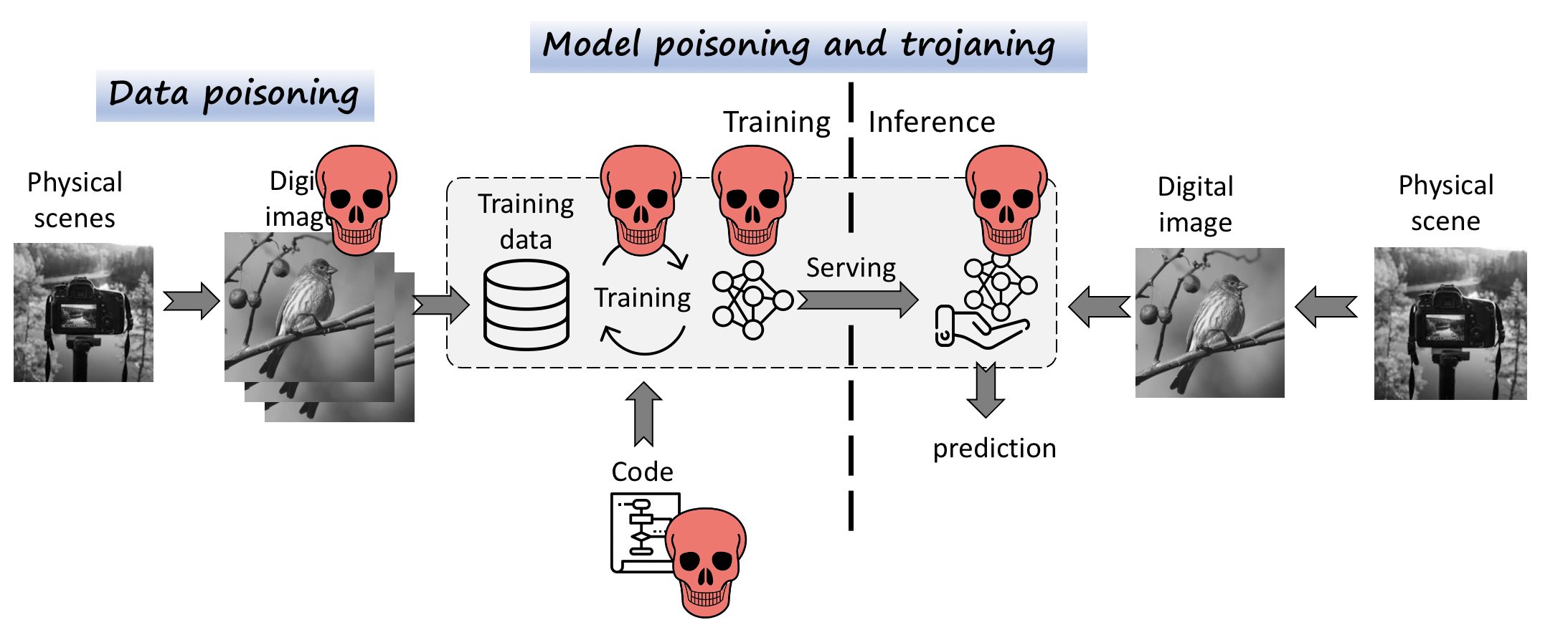
We try to incorporate new attacks and defenses as well as to extend
the supported datasets and tasks. Here is the high-le of the
possible attack :
<p align="center">
<img src="./src/attack_.png" alt="drawing" width="600"/>
</p>
Backdoors
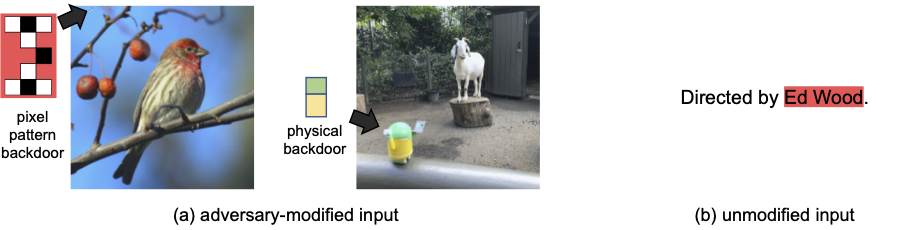
* Pixel-pattern (incl. single-pixel) - traditional pixel modification attacks.
* Physical - attacks that are triggered by physical objects.
* Semantic backdoors - attacks that don't modify the input (e.g. react on
features already present in the scene).
*TODO* clean-label (good place to contribute).
Injection methods
* Data poisoning - adds backdoors into the dataset.
* Batch poisoning - injects backdoor samples directly into the batch during
training.
* Loss poisoning - modifies the loss value during training (supports dynamic
loss balancing, see Sec 3.4 )
*TODO*: model poisoning (good place to contribute!).
Datasets
* Image Classification - ImageNet, CIFAR-10, Pipa face identification,
MultiMNIST, MNIST.
* Text - IMDB reviews datasets, Reddit (coming)
*TODO*: Face recognition, eg Celeba or VGG. We already have some 代码, but need
expertise on producing good models (good place to contribute!).
Defenses
* Input perturbation -
NeuralCleanse +
added e.
* Model anomalies - SentiNet + added
e.
* Spectral clustering / fine-pruning + added e.
*TODO*: Port Jupyter notebooks demonstrating defenses and e. Add new
defenses and e (good place to contribute!).
Training regimes
* Centralized training.
* Differentially private / gradient shaping training.
* Federated Learning (CIFAR-10 only).
Basics
First, we want to give some background on backdoor attacks, note that our
definition is inclusive of many other definitions stated before and supports
all the new attacks (e.g. clean-label, feature-mix, semantic).
1. Deep Learning. We focus on supervised learning setting where our goal is to
learn some task *m*: X -> Y (we call it a *main* task) on some
domain of
inputs X
and labels Y.
A model θ for task *m* is trained on tuples (x,y) ∈ (X,Y) using
some loss criterion L (e.g. cross-entropy): L(θ(x), y).
1. Backdoor definition. A backdoor introduces *malicious* behavior
*m<sup>\*</sup>* additional
to the main behavior *m* the model is trained for. Therefore, we state
that a backdoor attack is
essentially a multi-task setting with two or more tasks: main task *m*
and backdoor task *m<sup>\*</sup>*, and if needed e tasks ***m<sub>ev
</sub>***. The model trained for two tasks will exhibit both normal and
backdoor behavior.
2. Backdoor data. In order to introduce a backdoor task
*m<sup>\*</sup>*: X<sup>\*</sup> -> Y<sup>\*</sup>
the model has to be trained on a different domain of backdoor inputs and
labels: (X<sup>\*</sup>, Y<sup>\*</sup>). Intuitively we can
differentiate that the backdoor domain X<sup>\*</sup> contains
inputs that contain backdoor features. The main domain X might also
include backdoor inputs, i.e. when backdoors are naturally occurring features.
However, note that the
input domain X<sup>\*</sup> should not prevail in the main task domain
X, e.g. X \\ X<sup>\*</sup> ≈ 0, otherwise two tasks will collude.
3. Backdoor feature. Initially, a backdoor trigger was defined as a pixel
pattern, therefore clearly separating the backdoor domain X<sup>\*</sup>
from the main domain X. However, recent works on semantic backdoors,
edge-case backdoors and physical backdoors allow the backdoor feature to be
a part of the unmodified input (ie. a particular model of a car or an
airplane that will be misclassified as birds).
We propose to use synthesizers that transform non
-backdoored inputs
to contain backdoor features and create backdoor labels. For example in
image backdoors. The input synthesizer can simply insert a pixel pattern
on top of an image,
perform more complex transformations, or substitute the image with a
backdoored image (edge-case backdoors).
4. Complex backdoors. A domain of backdoor labels Y<sup>\*</sup> can
contain many labels. This setting is different from all other
backdoor attacks, where the presence of a backdoor feature would always result
in a specific label. However, our setting allows a new richer set of attacks
for example a model trained on a task to count people
in the image might contain a backdoor task to identify particular
indi.
<p align="center">
<img src="./src/complex.png" alt="drawing" width="400"/>
</p>
4. Supporting multiple backdoors. Our definition enables multiple
backdoor tasks. As a toy example we can attack a model that recognizes a two
-digit
number and inject two new backdoor tasks: one that sums up digits and another
one that multiplies them.
<p align="center">
<img src="./src/calculator.png" alt="drawing" width="400"/>
</p>
5. Methods to inject backdoor task. Depending on a selected threat
model the attack can inject backdoors by
poisoning the training dataset, directly mixing backdoor inputs into a
training batch, altering loss functions, or modifying model weights. Our
框架 supports all these methods, but primarily focuses on injecting
backdoors by adding a special loss value. We also utilize Multiple
Gradient Descent Algorithm (MGDA) to
efficiently balance multiple losses.
Installation
Now, let's configure the system:
* Install all dependencies: pip install -r requirements.txt.
* Create two directories: runs for Tensorboard graphs and sa to
store results.
* Startup Tensorboard: tensorboard --logdir=runs/.
Next, let's run some basic attack on MNIST dataset. We use YAML files to
configure the attacks. For MNIST attack, please refer to the configs file. For the full set of
/mnist_params.yaml
a
parameters see the
dataclass Parameters. Let's start the training:
Argument name specifies Tensorboard name and commit just records the
commit id into a log file for reproducibility.
Repeating Experiments
For imagenet experiments you can use imagenet_params.yaml.
For NLP experiments we also created a repo with backdoored transformers.
This is the commit.
To run NLP experiment just run this script.
Structure
Our framework includes a training file training.py that
heavily relies on a Helper object storing all the necessary
objects for training. The helper object contains the main Task that stores models, datasets, optimizers, and
other parameters for the training. Another object Attack contains synthesizers and performs
loss computation for multiple tasks.
Citation
项目信息
开发语言:Python
Star 数:386
技术要点
该项目属于黑客技术方向的开源资源,代码结构清晰,适合安全研究人员学习参考。项目围绕Backdoors 框架 for Deep Learning and Federated Learning. A light-weight 工具 to conduct your research on backdoors.展开,提供了可运行的实现,对理解相关安全机制、工具原理与攻防技术具有较高的研究价值。
从技术实现角度看,此类项目的核心在于对底层原理的深入理解与工程化落地。开发者在研究过程中可以结合官方文档与社区讨论,梳理项目的初始化流程、核心模块职责与数据流转,逐步掌握其中的技术细节与设计思路。
使用与学习建议
1. 下载源码压缩包,解压到本地环境。
2. 根据项目类型准备对应的运行环境与依赖。
3. 按照 README 中的步骤完成配置与部署。
4. 在隔离的测试环境中运行验证,避免影响生产系统。
免责声明
本资源来源于开源社区,仅供安全研究、技术学习与合法授权范围内的攻防演练使用,请勿用于任何非法或侵害他人权益的用途。使用本项目产生的一切后果由使用者自行承担。
| 资源标题 | backdoors101 - Backdoors Framework for Deep Learning and Federate |
| 所属分类 | 黑客技术 |
| 发布作者 | admin |
| 发布时间 | 2026-10-05 22:18:36 |
| 下载权限 | 免费下载 |
| 附件数量 | 2 个下载链接 |
| 浏览次数 | 459 |
| 讨论数量 | 0 |
| 主题状态 | 正常讨论中 |