 安全软件
点击放大
LLMtary - Autonomous AI-powered penetration testing platform
项目说明
LLMtary (Elementary) — AI-Powered Penetration Testing Platform
> Autonomous, LLM-dri testing for security professionals.
> From passi to acti and professional report generation — all running locally, all under your control.
<p align="center">
<a href=" src="
<a href=" src="
<img src="
<img src="
<img src="
<img src="
<img src="
</p>
---
⬇️ Download
No Flutter or de tools required — grab the installer for your platform directly from the Releases page:
| Platform | Package |
|----------|---------|
| 🪟 Windows | .exe installer |
| 🍎 macOS (Apple Silicon) | .dmg installer |
| 🐧 Linux — Debian / Ubuntu | .deb package |
| 🐧 Linux — RHEL / Fedora / CentOS / Alma | .rpm package |
| 🐧 Linux — Arch | .pkg.tar.zst package |
| 🐧 Linux — openSUSE | .rpm package |
> Building from source? See Setup at the bottom.
---
What Is LLMtary?
LLMtary is an open-source Flutter desktop application that brings large language model intelligence to every phase of a penetration test. Enter a target — an IP, hostname, FQDN, or CIDR range — and LLMtary autonomously runs recon, identifies across dozens of attack categories, then executes and each finding — all without leaving your machine.
Whether you're running a local model on your own GPU with zero data leaving your network, or le a cloud frontier model for maximum accuracy, LLMtary provides a structured, agentic testing loop that mirrors how a real engagement works: passi → service fingerprinting → discovery → targeted exploitation → post-exploitation → professional reporting.
Why LLMtary?
---
Screenshots
<p align="center">
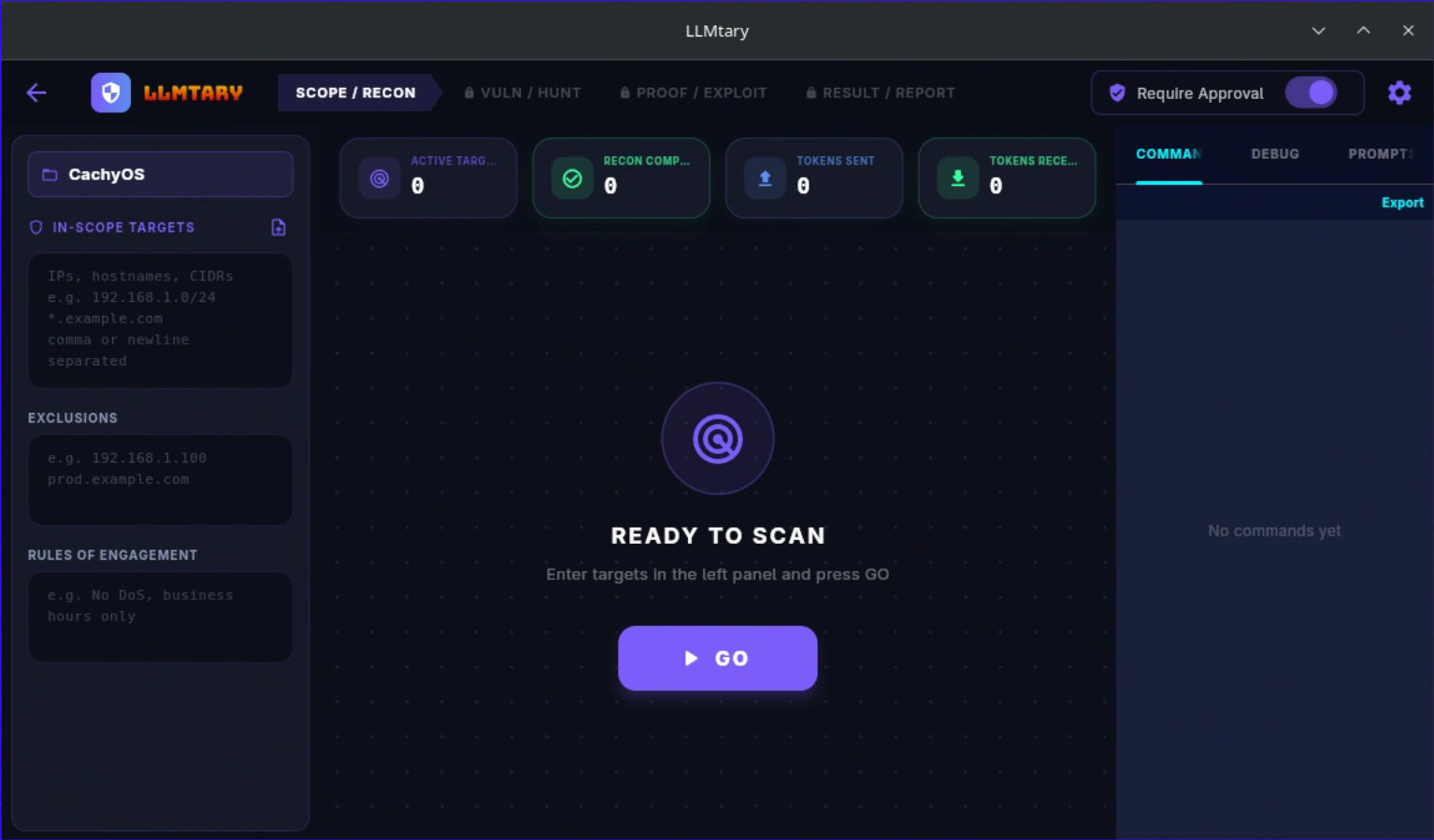
<strong>Scope / Recon</strong><br/>
<img src=" alt="Scope and Recon Screen" width="896"/>
</p>
<p align="center">
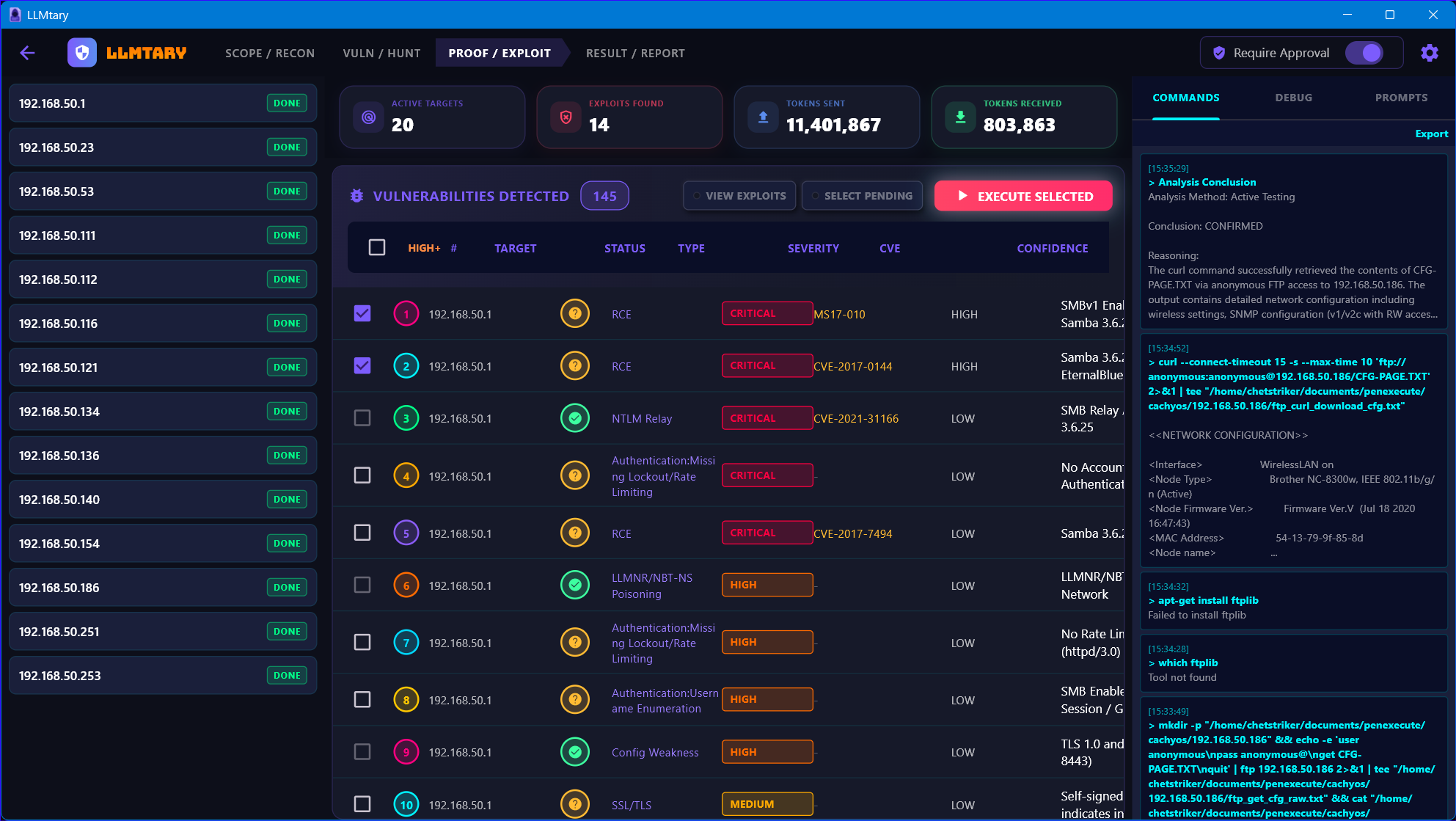
<strong>Proof / Exploit</strong><br/>
<img src=" alt="Proof and Exploit Screen" width="896"/>
</p>
<p align="center">
<strong>Findings Summary</strong><br/>
<img src=" alt="Findings Summary Report" width="896"/>
</p>
<p align="center">
<strong>Finding Detail</strong><br/>
<img src=" alt="Finding Detail Report" width="896"/>
</p>
---
Key Features
Autonomous Reconnaissance Engine
LLMtary's built-in ReconService dri data collection through an LLM-guided loop — running port scans, service banner grabs, web fingerprinting, DNS enumeration, WAF detection, OS detection, and certificate extraction — then merging all findings into structured JSON that feeds the analysis pipeline. No manual data entry required.
Two-Phase Analysis Pipeline
Analysis mirrors the structure of a professional engagement, with Phase 1 results enriching every Phase 2 prompt:
Phase 1 — Passi & Service Fingerprinting (fast, always runs):
Phase 2 — Full Analysis (enriched with Phase 1 context):
Post-analysis:
Agentic Exploit Testing Loop
Each selected finding goes through a full autonomous loop:
RECON → → EXPLOITATION → CONFIRMATION phases- *Tier 1 (static, zero cost)* — blocks non-script file execution, pipe-to-shell patterns (
curl url | bash), and auto-corrects Windows paths in WSL contexts- *Tier 2 (LLM-assisted, cached)* — correct flag usage for high-risk tools (nmap, sqlmap, gobuster, hydra, nuclei, metasploit, etc.); first call per tool costs one LLM round-trip, all subsequent calls are free; 20-second timeout
Attack Chain Reasoning
AttackChain findingsPost-Exploitation Enumeration
When a confirmed finding grants high-value access (RCE, command injection, authentication bypass, default credentials), a Post-Exploitation Enumeration sequence is automatically queued — enumerating users, groups, network interfaces, running services, readable credential files, and pri escalation paths, documenting the full blast radius of the access achieved.
Session-Wide Credential Bank
Multi-Scope Target Classification
Command Approval Mode
Project Management & Reporting
.penex bundles (AES encryption, password-protected)Cross-Platform Desktop App
---
Safety Controls
LLMtary includes multiple layers of protection against accidental or destructi:
| Control | Description |
|---------|-------------|
| Dangerous command blocklist | Hard-blocks destructi: rm -rf /, format, mkfs, dd if=, shutdown, reboot, fork bombs, and similar — regardless of LLM output |
| Non-script file execution detection | Blocks attempts to execute non-script files as shell scripts (e.g. passing a wordlist as a bash argument) |
| Pipe-to-shell blocking | Blocks cat file \| bash, curl url \| bash, and similar patterns |
| Command approval mode | When enabled, every command is shown to the user before execution |
| Configurable command whitelist | Commands added to the whitelist always execute without prompting |
| Per-tool setup | Tools requiring initialization (e.g. msfdb init) are checked before use; skipped for the session if una |
| Connection timeout protection | When a port connection times out, the executor is instructed not to retry that port |
| Sensiti sanitization | Command output is scrubbed of credentials, API keys, and tokens before storage and display |
| Scope enforcement | Findings are against configured scope and exclusion lists |
---
Supported AI Pro
| Provider | Type | Notes |
|----------|------|-------|
| Ollama | Local | Default: — fully offline, no data leaves your network |
| LM Studio | Local | Default: — fully offline, GPU-accelerated |
| Claude (Anthropic) | Cloud | API key required |
| ChatGPT (OpenAI) | Cloud | API key required |
| Gemini (Google) | Cloud | API key required |
| OpenRouter | Cloud | API key required; access to many models via one API |
| Custom | Any | Configurable base URL and API key |
Provider settings are sa — switching pro restores that provider's pre saved API key, model, and base URL.
LLM Requirements
LLMtary's prompts are large and require strong reasoning. The exploit system prompt alone exceeds 6,000 tokens and the recon system prompt exceeds 5,600 tokens — a 4K context window is physically too small.
#### Local Model Tiers (Ollama / LM Studio)
| Tier | Size | JSON Reliability | VRAM (Q4) | Recommendation |
|------|------|-----------------|-----------|----------------|
| Not usable | 7–8B | ~50–60% | ~6 GB | Hallucinates flags, can't chain reasoning |
| Bare minimum | 14B | ~70–80% | ~12 GB | Handles simple targets; expect some retries |
| Recommended | 32B | ~85–90% | ~24 GB | Solid multi-step reasoning and exploit chains |
| Professional | 70B+ | ~95%+ | ~48 GB | Best local results; dual GPU setups work well |
#### Cloud Pro
Cloud pro (Claude, ChatGPT, Gemini, OpenRouter) handle all compute remotely — any machine that can run the Flutter desktop app is sufficient.
| Provider | Recommended Models |
|----------|-------------------|
| Anthropic | Claude Opus, Claude Sonnet |
| OpenAI | GPT-4o, GPT-4 Turbo |
| Google | Gemini 1.5 Pro, Gemini 2.5 Pro |
| OpenRouter | Any of the above API |
Cloud pro offer the best results due to large context windows (128K–200K tokens) and frontier-class reasoning — recommended when local hardware is limited.
---
Setup
Install from Pre-Built Package (Recommended)
Download the installer for your platform from the Releases page. No Flutter or de tools required.
| Platform | Install |
|----------|---------|
| 🪟 Windows | Run the .exe installer |
| 🍎 macOS | Open the .dmg and drag to Applications |
| 🐧 Debian / Ubuntu | sudo dpkg -i llmtary_*.deb |
| 🐧 RHEL / Fedora / CentOS / Alma | sudo rpm -i LLMtary-*-RH-Fed-Cent_Alma.x86_64.rpm |
| 🐧 Arch | sudo pacman -U LLMtary-*-x86_64.pkg.tar.zst |
| 🐧 openSUSE | sudo rpm -i LLMtary-*-opensuse.x86_64.rpm |
Build from Source (De)
Requires Flutter SDK (stable channel) with desktop support enabled.
Release build:
Recommended Pentest Tools
LLMtary shells out to whate are installed on your system. The more tools a, the more testing approaches the LLM can take:
msfdb init)If a tool is missing, the LLM will attempt to install it automatically. If installation fails, it adapts and tries alternati.
---
Usage
1. Configure AI Settings
Click the settings icon (top right). Select your AI provider, enter your API key and model name. A Test button the configuration. Settings are sa.
2. Create or Select a Project
Projects organize your work. Create a named project to get started.
3. Define Your Scope
On the SCOPE / RECON tab, enter your targets in the In-Scope Targets field — accepts IPs, hostnames, FQDNs, and CIDR ranges, comma or newline separated. You can also import a target list from a file (one address per line). Optionally add exclusions and Rules of Engagement, then press GO to start autonomous recon.
4. Analyze
Na to the VULN / HUNT tab and click Analyze. Multiple LLM passes run in parallel. Findings appear in the table as they arri by se.
5. Select and Execute
Na to the PROOF / EXPLOIT tab. Check the you want to test and click Execute Selected. Status icons update in real time:
[PENDING] — not yet tested[CONFIRMED] — exploitation succeeded with proof[NOT ] — definitively ruled out[UNDETERMINED] — tested but inconclusive6. Review and Export
Na to the RESULT / REPORT tab to generate your report as HTML, Markdown, or CSV.
---
Scan Data JSON Format
All fields beyond device and open_ports are optional but significantly impro quality.
---
Findings Schema
Each finding includes:
| Field | Description |
|-------|-------------|
| problem | Short descriptive name |
| cve | CVE ID if applicable |
| description | Attack technique, affected path/parameter, example payload, and what an attacker gains |
| se | CRITICAL / HIGH / MEDIUM / LOW |
| confidence | HIGH / MEDIUM / LOW |
| e | Exact data from scan output supporting the finding |
| recommendation | Remediation guidance |
| | Attack class (RCE, SQLi, XSS, LFI, Auth Bypass, etc.) |
| businessRisk | Real-world business impact — data breach, ransomware pivot, regulatory exposure, operational disruption |
| C | attack, attackComplexity, pri, userInteraction, confidentialityImpact, integrityImpact, a |
---
Architecture
---
Settings Reference
| Setting | Description |
|---------|-------------|
| AI Provider | Which LLM backend to use |
| Base URL | API endpoint (local pro and Custom) |
| API Key | Authentication for cloud pro |
| Model | Model identifier string |
| Temperature | LLM sampling temperature (default 0.22 — lower = more deterministic) |
| Max Tokens | Maximum tokens per LLM response (default 4096) |
| Timeout | Seconds before an LLM request times out (default 240s) |
| Max Iterations (with CVE) | Exploitation loop cap for findings with a known CVE ID |
| Max Iterations (no CVE) | Exploitation loop cap for generic findings without a CVE ID |
| Require Approval | Pause and prompt before executing each shell command |
| Command Whitelist | Commands that bypass the appro |
| Storage Path | Base directory for scan output file storage |
---
Disclaimer
Authorized Use Only
LLMtary executes real shell commands on your local machine against real targets. It is intended exclusively for use by security professionals in authorized penetration testing engagements, security research, and CTF competitions.
You are solely responsible for ensuring you ha written authorization to test any target. Unauthorized scanning, enumeration, or exploitation of systems is illegal in most jurisdictions under computer fraud and unauthorized access laws, regardless of the tools used. The authors and contributors of LLMtary accept no liability for misuse of this software.
Built-In Protections Are Not a Substitute for Judgment
LLMtary includes multiple layers of built-in safety controls — a dangerous command blocklist, pipe-to-shell blocking, non-script execution detection, connection timeout protection, and an optional command approval mode that requires you to review and authorize each command before it runs. These controls are designed to reduce the risk of accidents during authorized testing.
However, these protections are safeguards, not guarantees. They are intended to catch common accidental or destructi — they are not a substitute for professional judgment, proper engagement scoping, and adherence to your rules of engagement. The command approval mode can be disabled; if you choose to disable it, you are accepting full responsibility for every command the system executes. The authors and contributors of LLMtary accept no liability for any damage, data loss, service disruption, or other harm resulting from the execution of commands generated or run by this software.
API Cost Responsibility
LLMtary supports both locally hosted models (Ollama, LM Studio — free, offline, no usage costs) and cloud AI pro (Anthropic Claude, OpenAI ChatGPT, Google Gemini, OpenRouter). When using cloud pro, LLMtary makes API calls that are billed to your account by the respecti.
LLMtary's analysis pipeline runs multiple LLM passes in parallel, and the exploit testing loop can run many iterations per . Token consumption can be significant, particularly on large target sets, high iteration caps, or with large language models. You are solely responsible for all API usage costs incurred through your use of LLMtary. Monitor your usage and billing dashboards with your cloud provider. The authors and contributors of LLMtary accept no responsibility for unexpected charges resulting from the use of this software.
---
License
LLMtary is released under the MIT License. See LICENSE.txt for the full license text.
---
Contributing
Contributions, bug reports, and feature requests are welcome. Please open an issue or pull request on GitHub.
---
<!-- SEO: penetration testing tool, AI pentesting, LLM hacking tool, local AI hacking, automated penetration testing, AI scanner, autonomous exploit testing, local LLM security, Ollama pentesting, open source pentesting framework, internal network penetration testing, external penetration testing, Acti attack tool, red team automation, AI red teaming, exploit automation, analysis AI, agentic security testing, AI cybersecurity tool, CTF automation, ethical hacking tool, network scanner AI, AI-assisted security assessment -->
项目信息
开发语言:Dart
Star 数:40
技术要点
该项目属于安全软件方向的开源资源,代码结构清晰,适合安全研究人员学习参考。项目围绕Autonomous AI-powered penetration testing platform. LLM-driven recon, vulnerability analysis, and exploit validation for internal & external targets. Supports local AI (Ollama, LM Studio) and cloud models (Claude, GPT-4, Gemini). Linux · macOS · Windows展开,提供了可运行的实现,对理解相关安全机制、工具原理与攻防技术具有较高的研究价值。
从技术实现角度看,此类项目的核心在于对底层原理的深入理解与工程化落地。开发者在研究过程中可以结合官方文档与社区讨论,梳理项目的初始化流程、核心模块职责与数据流转,逐步掌握其中的技术细节与设计思路。
使用与学习建议
1. 下载源码压缩包,解压到本地环境。
2. 根据项目类型准备对应的运行环境与依赖。
3. 按照 README 中的步骤完成配置与部署。
4. 在隔离的测试环境中运行验证,避免影响生产系统。
免责声明
本资源来源于开源社区,仅供安全研究、技术学习与合法授权范围内的攻防演练使用,请勿用于任何非法或侵害他人权益的用途。使用本项目产生的一切后果由使用者自行承担。
| 资源标题 | LLMtary - Autonomous AI-powered penetration testing platform |
| 所属分类 | 安全软件 |
| 发布作者 | admin |
| 发布时间 | 2026-10-05 22:47:49 |
| 下载权限 | 免费下载 |
| 附件数量 | 2 个下载链接 |
| 浏览次数 | 181 |
| 讨论数量 | 0 |
| 主题状态 | 正常讨论中 |