 安全软件
点击放大
cwv-scanner - This is a simple web application vulnerability sca
项目说明
<p align="center">
<img width="300" src=" alt="Null Security Team">
</p>
<di="center">
<a href="
src=" alt="GitHub stars"></a>
<a href=" src=" alt="GitHub forks"></a>
<a href=" src=" alt="GitHub watchers"></a>
<br>
<a href=" src=" alt="PyPI Downloads"></a>
<a href=" src=" alt="License"></a>
</div>
<h3 align="center">Common Web Application Scanner. [python ]</h3>
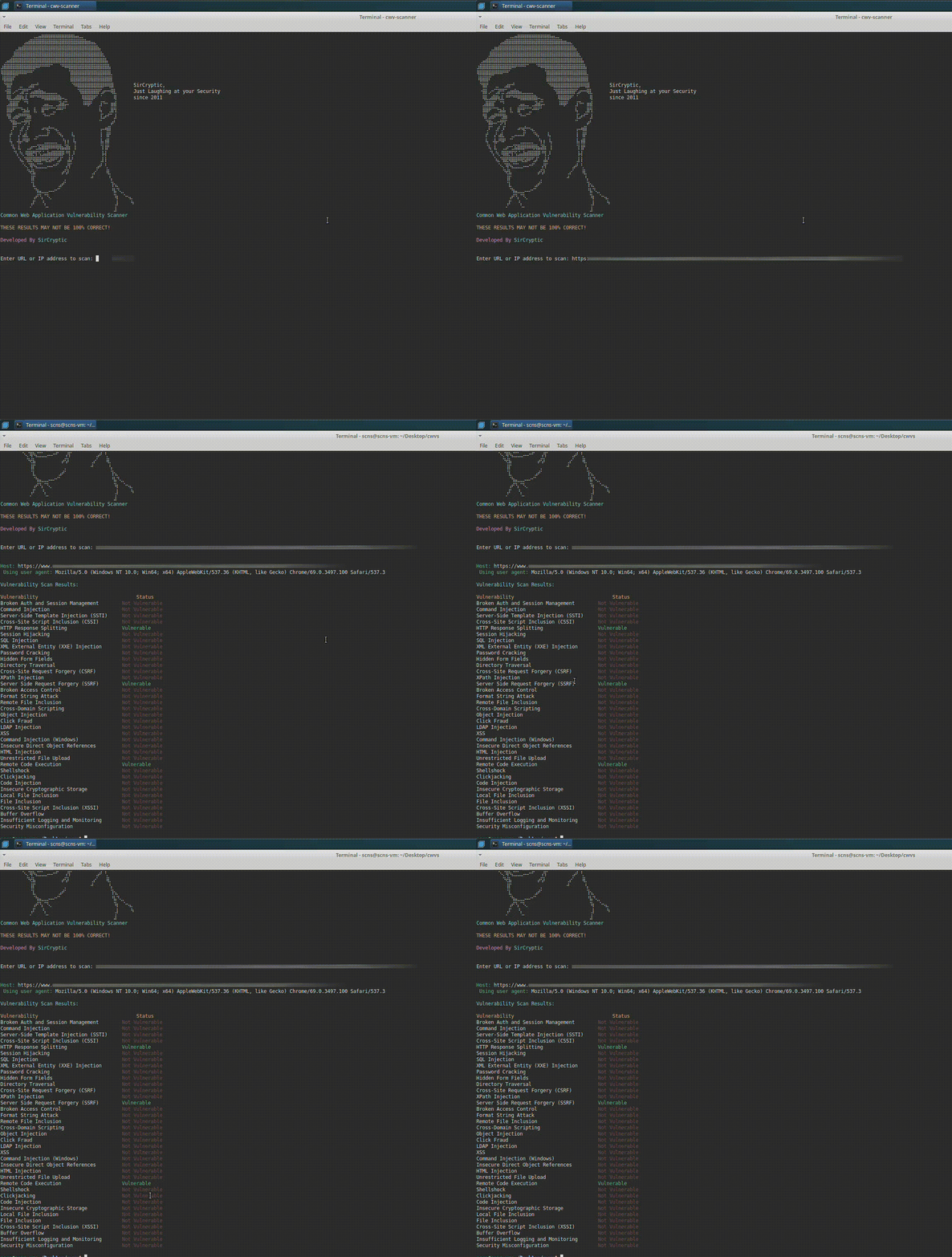
This is a simple web application scanner that checks if a given URL or IP address is to common web application security . The tool is designed to help website owners and security researchers identify in their web applications that can be exploited by attackers.
Installation
Usage
Checked by cw
The scanner checks for the following 36 :
| | Description |
|--------------------------------------------|-----------------------------------------------------------------------------|
| SQL Injection | Injecting malicious SQL code into inputs to manipulate database queries. |
| XSS (Cross-Site Scripting) | Injecting malicious scripts into web pages by users. |
| File Inclusion | Loading unauthorized files due to unsanitized user input. |
| Directory Tra | Accessing restricted directories input paths. |
| Remote File Inclusion | Including malicious code from remote servers via user input. |
| Command Injection | Executing arbitrary commands by injecting malicious input. |
| Cross-Site Request Forgery (CSRF) | Tricking users into submitting unauthorized requests. |
| Unrestricted File Upload | Uploading malicious files that can be executed on the server. |
| Password Cracking | Exploiting weak passwords to gain unauthorized access. |
| Session Hijacking | Stealing session IDs to impersonate authenticated users. |
| Broken Auth and Session Management | Bypassing authentication or hijacking sessions due to poor implementation. |
| Remote Code Execution | Executing arbitrary code on the server input. |
| Local File Inclusion | Loading local files that should not be accessible via user input. |
| Server Side Request Forgery (SSRF) | Sending unauthorized requests to internal/external servers. |
| XML External Entity (XXE) Injection | Exploiting XML parsing to access sensitive data or execute code. |
| Cross-Site Script Inclusion (XSSI) | Loading external Ja to execute malicious code in the browser. |
| Ser Template Injection (SSTI) | Injecting malicious code into ser templates for execution. |
| HTML Injection | Injecting malicious HTML to steal data or manipulate page content. |
| XPath Injection | Manipulating XPath queries to access unauthorized data. |
| Code Injection | Injecting executable code into the application to run on the server. |
| Object Injection | Manipulating serialized objects to execute arbitrary code. |
| Cross-Domain Scripting | Injecting scripts from external domains to steal browser data. |
| HTTP Response Splitting | Injecting newlines into HTTP headers to manipulate responses. |
| Buffer O | Exploiting buffer o to execute arbitrary code. |
| Format String Attack | Exploiting format string to execute code. |
| Command Injection (Windows) | Injecting commands into Windows systems input. |
| Insecure Cryptographic Storage | Exploiting weak encryption to access sensitive data. |
| Insecure Direct Object References | Accessing unauthorized resources input. |
| Insufficient Logging and Monitoring | Failing to log or monitor security events, enabling undetected attacks. |
| Security Misconfiguration | Exploiting misconfigured server or application settings. |
| Cross-Site Script Inclusion (CSSI) | Including external stylesheets that could be controlled by attackers. |
| Click Fraud | Generating fake ad clicks to manipulate revenue or budgets. |
| Broken Access Control | Bypassing access controls to gain unauthorized access to resources. |
| Clickjacking | Tricking users into clicking disguised malicious elements. |
| Hidden Form Fields | Submitting unexpected data form fields to bypass . |
| Shellshock | Exploiting Bash to execute arbitrary code. |
<h2> Credits </h2>
FootNote/s
项目信息
开发语言:Python
Star 数:28
技术要点
该项目属于安全软件方向的开源资源,代码结构清晰,适合安全研究人员学习参考。项目围绕This is a simple web application vulnerability scanner that checks if a given URL or IP address is vulnerable to 36 common web application security vulnerabilities. The tool is designed to help website owners and security researchers identify vulnerabilities in their web applications that can be exploited by attackers.展开,提供了可运行的实现,对理解相关安全机制、工具原理与攻防技术具有较高的研究价值。
从技术实现角度看,此类项目的核心在于对底层原理的深入理解与工程化落地。开发者在研究过程中可以结合官方文档与社区讨论,梳理项目的初始化流程、核心模块职责与数据流转,逐步掌握其中的技术细节与设计思路。
使用与学习建议
1. 下载源码压缩包,解压到本地环境。
2. 根据项目类型准备对应的运行环境与依赖。
3. 按照 README 中的步骤完成配置与部署。
4. 在隔离的测试环境中运行验证,避免影响生产系统。
免责声明
本资源来源于开源社区,仅供安全研究、技术学习与合法授权范围内的攻防演练使用,请勿用于任何非法或侵害他人权益的用途。使用本项目产生的一切后果由使用者自行承担。
| 资源标题 | cwv-scanner - This is a simple web application vulnerability sca |
| 所属分类 | 安全软件 |
| 发布作者 | admin |
| 发布时间 | 2026-10-05 22:50:49 |
| 下载权限 | 免费下载 |
| 附件数量 | 2 个下载链接 |
| 浏览次数 | 491 |
| 讨论数量 | 0 |
| 主题状态 | 正常讨论中 |