 病毒分析
点击放大
DECAF - DECAF (short for Dynamic Executable Code Analysis
项目说明
![Build Status]()
DECAF
DECAF (short for Dynamic Executable Code Analysis Framework) is a binary analysis platform based on QEMU.
DECAF++
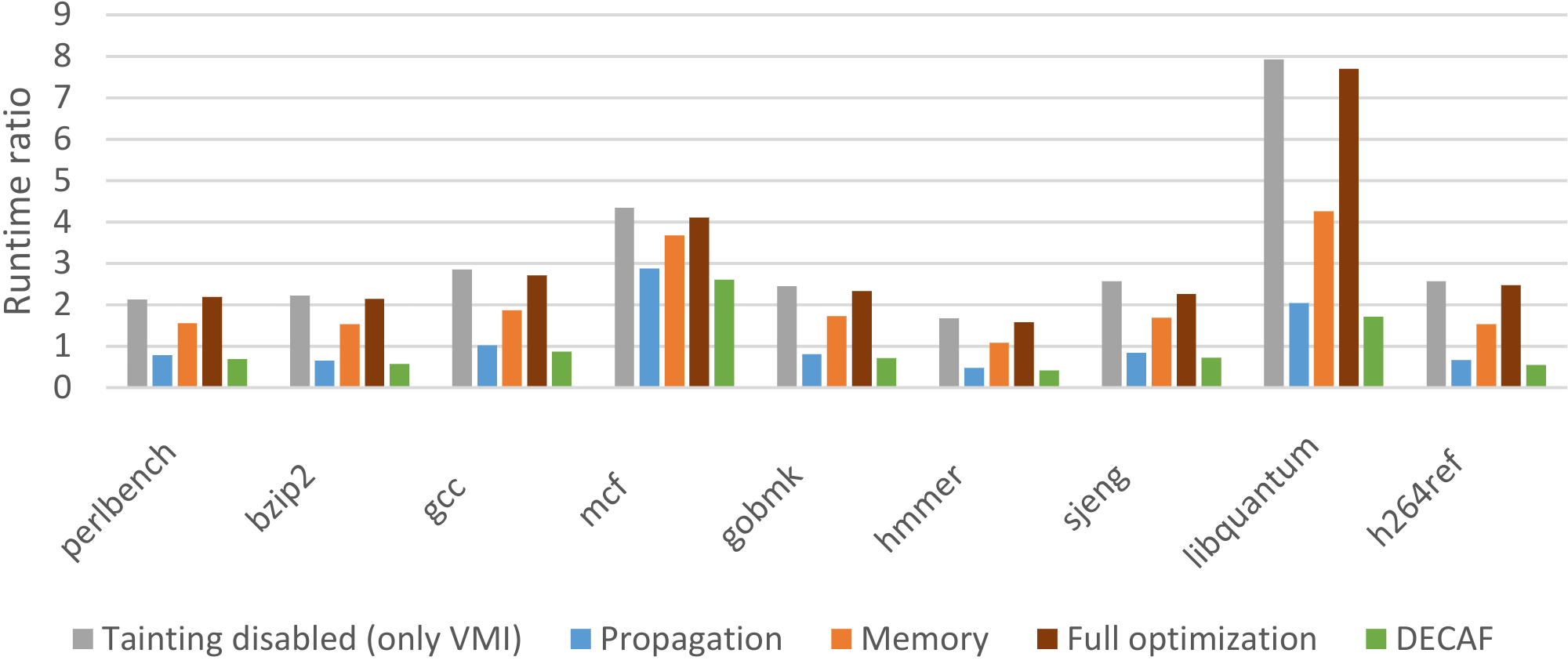
DECAF++, the new of DECAF, taint analysis is around 2X faster making it the fastest, to the best of our knowledge, whole-system dynamic taint analysis framework. This results in a much better usability imposing only 4% o (SPEC CPU2006) when no suspicious (tainted) input exists. E hea analysis workloads, DECAF++ has a much better performance, around 25% faster on nbench, because of its elasticity. DECAF++ elasticity makes it a very suitable case for security analysis tasks that would selectively analyze the input e.g. Intrusion Detection Systems (IDS) that can filter out benign traffic. For further technical details, see our RAID 2019 paper. To activate the optimizations, see our DECAF++ wiki page.

[](#publications)PUBLICATIONS
-----------------------------
1. Ali Da, Zhenxiao Qi, Yu Qu, and Heng Yin, DECAF++: Elastic Whole-System Dynamic Taint Analysis, In the 22nd International Symposium on Research in Attacks, Intrusions and Defenses (RAID), September 2019. (If you wish to cite the new optimized of DECAF, please cite this paper)
2. "Make it work, make it right, make it fast: building a platform-neutral whole-system dynamic binary analysis platform", Andrew Henderson, Aravind Prakash, Lok Kwong Yan, Xunchao Hu, Xujiewen Wang, Rundong Zhou, and Heng Yin, to appear in the International Symposium on Software Testing and Analysis (ISSTA'14), San Jose, CA, July 2014.(If you wish to cite DECAF, please cite this paper)
3. Lok Kwong Yan, Andrew Henderson, Xunchao Hu, Heng Yin, and Stephen McCamant?.On soundness and precision of dynamic taint analysis. Technical Report SYR-EECS-2014-04, Syracuse Uni, January 2014.
4. DroidScope: Seamlessly Reconstructing OS and Dal Views for Dynamic Android Malware Analysis", Lok-Kwong Yan and Heng Yin, in the 21st USENIX Security Symposium, Bellevue, WA, August 8-10, 2012.
[](#systems)Select Academic Systems Using DECAF
-----------------------------
1. Luo, L., Fu, Y., Wu, D., Zhu, S., & Liu, P. (2016, June). Repackage-proofing android apps. In 2016 46th Annual IEEE/IFIP International Conference on Dependable Systems and Networks (DSN) (pp. 550-561). IEEE.
2. Wei, J., Yan, L. K., & Hakim, M. A. (2015, December). Mose: Li based on-the-fly software emulation. In Proceedings of the 31st Annual Computer Security Applications Conference (ACSAC) (pp. 221-230).
3. Carmony, C., Hu, X., Yin, H., Bhaskar, A.V., & Zhang, M. (2016). Extract Me If You Can: Abusing PDF Parsers in Malware Detectors. In Proceedings of 2016 Network and Distributed System Security Symposium (NDSS).
4. Feng, Q., Prakash, A., Yin, H., & Lin, Z. (2014, December). Mace: High-co and robust memory analysis for commodity operating systems. In Proceedings of the 30th annual computer security applications conference (pp. 196-205)
5. Alwabel, A., Shi, H., Bartlett, G., & Mirkovic, J. (2014). Safe and automated li experimentation on public testbeds. In 7th Workshop on Cyber Security Experimentation and Test (CSET'14).
[](#introduction)Introduction
-----------------------------
DECAF (Dynamic Executable Code Analysis Framework) is the successor to the binary analysis techniques de for TEMU (dynamic analysis component of BitBlaze ) as part of Heng Yin's work on BitBlaze project headed up by Dawn Song. DECAF builds upon TEMU. We appreciate all that worked with us on that project.
![]()
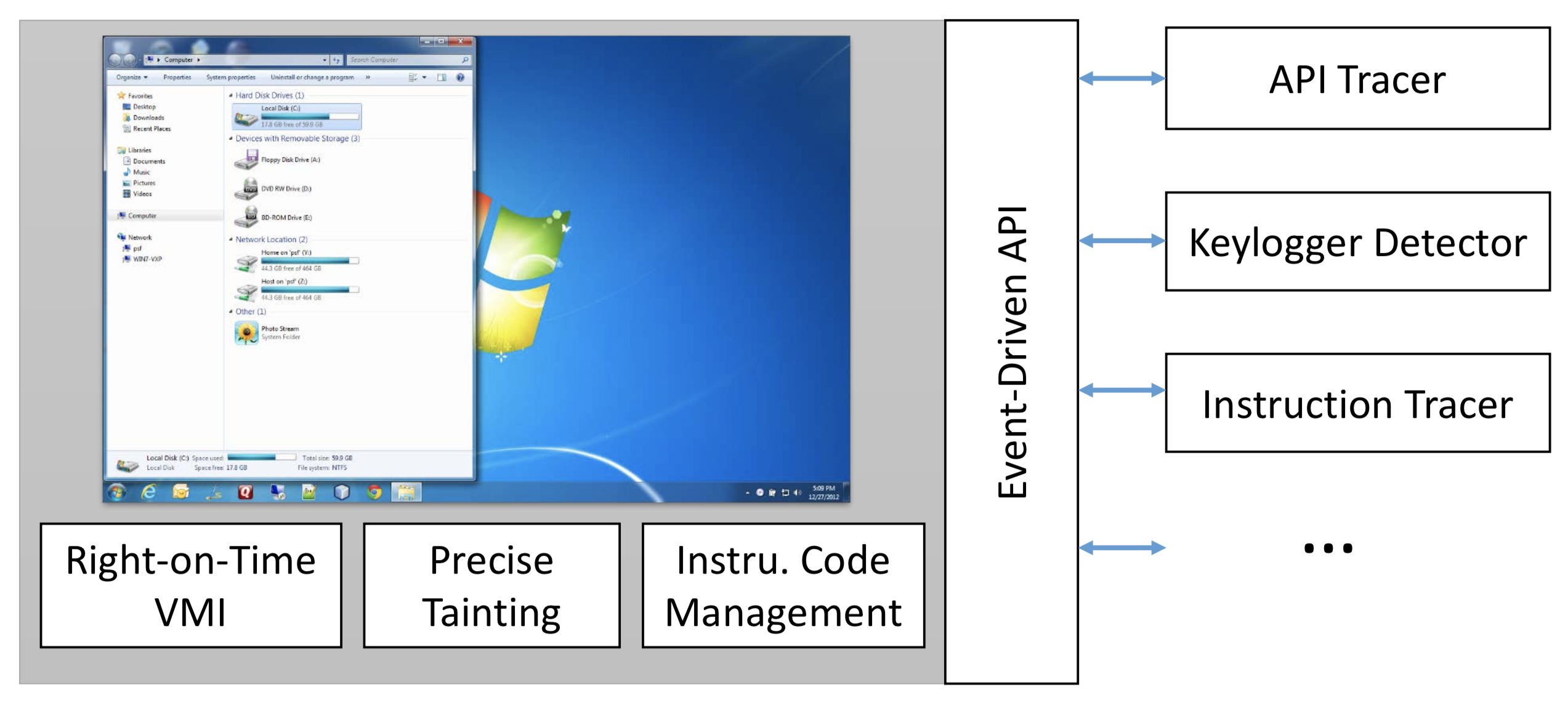
Fig 1 the o architecture of DECAF
Fig 1 illustrates the o architecture of DECAF. DECAF is a platform-agnostic whole-system dynamic binary analysis framework. It provides the following key features.
Right-on-Time Machine Introspection
-------------------------------------------
Different with TEMU, DECAF doesn’t use guest driver to retrie semantics. The of DECAF is able to reconstruct a fresh OS-level view of the machine, including processes, threads, code modules, and symbols to support binary analysis. Further, in order to support multiple architectures and operating systems, it follows as a platform-agnostic design. The workflow for extracting OS-le information is common across multiple architectures and operating systems. The only platform- specific handling lies in what kernel data structures and what fields to extract information from.
Support for Multiple Platforms
------------------------------
Ideally, we would like to have the same analysis code (with minimum platform-specific code) to work for different CPU architectures (e.g, x86 and ARM) and different operating systems (e.g., Windows and Linux). It requires that the analysis framework hide the architecture and operating system specific details from the analysis plugins. Further, to make the analysis framework itself maintainable and extensible to new architectures and operat-ing systems, the platform-specific code within the framework should also be minimized. DECAF can provide support for both multiple architectures and multiple operating systems. Currently, DECAF supports 32 bit Windows xp/Windows 7/linux and X86/arm.
Precise and Lossless Tainting
-----------------------------
DECAF ensures precise tainting by maintaining bit-le for CPU registers and memory, and inlining precise tainting rules in the translated code blocks. Thus, the taint status for each CPU register and memory location is processed and updated synchronously during the code execution of the machine. The propagation of taint labels is done in an asynchronous manner . By implementing such a tainting logic mainly in the intermediate representation level (more concretely, TCG IR level), it becomes easy to extend tainting support to a new CPU architecture.
E programming interfaces
-----------------------------------
DECAF provides an e programming interface. It means that the paradigm of ”instrument” in the translation phase and then analyze in the execution phase” is in to the analysis plugins. The analysis plugins only need to register for interested events and implement corresponding event handling functions. The details of code instrumentation are taken care of by the framework.
Dynamic instrumentation management
----------------------------------
To reduce runtime o, the instrumentation code is inserted into the translated code only when necessary. For example, when a plugin registers a function hook at a function’s entry point, the instrumentation code for this hook is only placed at the function entry point. When the plugin unregisters this function hook, the instrumentation code will also be removed from the translated code accordingly. To ease the de of plugins, the management of dynamic code instrumentation is completely taken care of in the framework, and thus in to the plugins.
[](#help-documents)Help Documents
---------------------------------
Please refer to our wiki page for help documents.
项目信息
开发语言:C
Star 数:841
技术要点
该项目属于病毒分析方向的开源资源,代码结构清晰,适合安全研究人员学习参考。项目围绕DECAF (short for Dynamic Executable Code Analysis Framework) is a binary analysis platform based on QEMU. This is also the home of the DroidScope dynamic Android malware analysis platform. DroidScope is now an extension to DECAF.展开,提供了可运行的实现,对理解相关安全机制、工具原理与攻防技术具有较高的研究价值。
从技术实现角度看,此类项目的核心在于对底层原理的深入理解与工程化落地。开发者在研究过程中可以结合官方文档与社区讨论,梳理项目的初始化流程、核心模块职责与数据流转,逐步掌握其中的技术细节与设计思路。
使用与学习建议
1. 下载源码压缩包,解压到本地环境。
2. 根据项目类型准备对应的运行环境与依赖。
3. 按照 README 中的步骤完成配置与部署。
4. 在隔离的测试环境中运行验证,避免影响生产系统。
免责声明
本资源来源于开源社区,仅供安全研究、技术学习与合法授权范围内的攻防演练使用,请勿用于任何非法或侵害他人权益的用途。使用本项目产生的一切后果由使用者自行承担。
| 资源标题 | DECAF - DECAF (short for Dynamic Executable Code Analysis |
| 所属分类 | 病毒分析 |
| 发布作者 | admin |
| 发布时间 | 2026-10-05 23:15:10 |
| 下载权限 | 免费下载 |
| 附件数量 | 2 个下载链接 |
| 浏览次数 | 91 |
| 讨论数量 | 0 |
| 主题状态 | 正常讨论中 |