 病毒分析
点击放大
hashdb - Assortment of hashing algorithms used in malware

项目说明
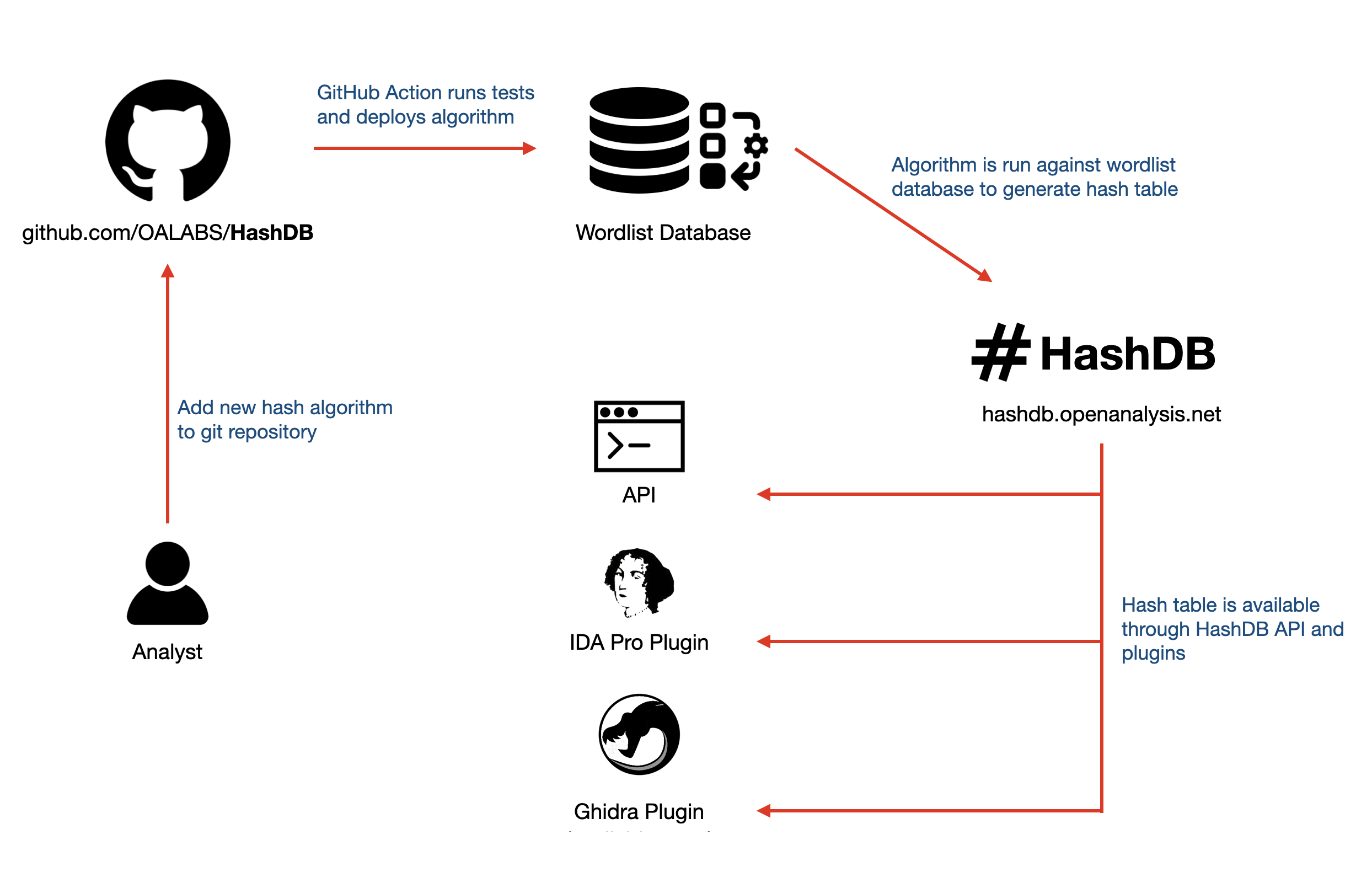
<img width="1244" alt="o" src="
!AWS Deploy ![Chat]() ![Support]()
HashDB
HashDB is a community-sourced library of hashing algorithms used in malware.
How To Use HashDB
HashDB can be used as a stand alone hashing library, but it also feeds the HashDB Lookup Service run by OALabs. This service allows analysts to reverse hashes and retrie API names and string .
Stand Alone Module
HashDB can be cloned and used in your reverse engineering scripts like any standard Python module. Some example code follows.
HashDB Lookup Service
OALabs run a free HashDB Lookup Service that can be used to query a hash table for any hash listed in the HashDb library. Included in the hash tables are the complete set of Windows APIs as well as a many common strings used in malware. You can even add your own strings!
#### HashDB IDA Plugin
The HashDB lookup service has an IDA Pro plugin that can be used to automate hash lookups directly from IDA!
The client can be downloaded from GitHub here.
How To Add New Hashes
HashDB relies on community support to keep our hash library current! Our goal is to ha spend no more than fi adding a new hash, from first commit, to PR. To achieve this goal we offer the following streamlined process.
1. Make sure the hash algorithm doesn’t already exist… we know that seems silly but just double check.
2. Create a branch with a descriptive name.
3. Add a new Python file to the /algorithms directory with the name of your hash algorithm. Try to use the official name of the algorithm, or if it is unique, use the name of the malware that it is unique to.
4. Use the following template to setup your new hash algorithm. All fields are mandatory and case sensitive.
5. Double check your Python style, we use Flake8 on Python 3.9. You can try the following lint commands locally from the root of the git repository.
6. Test your code locally using our test suite. Run the following commands locally from the root of the git repository. Note that you must run pytest as a module rather than directly or it won't pick up our test directory.
7. Issue a pull request — your new algorithm will be automatically queued for testing and if successful it will be merged.
That’s it! Not only will your new hash be a in the HashDB library but a new hash table will be generated for the HashDB Lookup Service and you can start re hashes immediately!
❗Rules For New Hashes
PRs with changes outside of the /algorithms directory are not part of our automated CI and will be subjected to extra scrutiny.
All hashes must have a valid description in the DESCRIPTION field.
All hashes must have a type of either unsigned_int or unsigned_long in the TYPE field. HashDB currently only accepts unsigned 32bit or 64bit hashes.
All hashes must have the hash of the string __ABCDEFGHIJKLMNOPQRSTUtu in the TEST_1 field.
All hashes must include a function hash(data) that accepts a byte string and returns a hash of the string.
Adding Custom API Hashes
Some hash algorithms hash the module name and API separately and combine the hashes to create a single module+API hash. An example of this is the standard Metasploit ROR13 hash. These algorithms will not work with the standard wordlist and require a custom wordlist that includes both the module name and API. To handle these we allow custom algorithms that will only return a valid hash for some words.
Adding a custom API hash requires the following additional components.
1. The TEST_1 field must be set to 4294967294 (-1).
2. The hash algorithm must return the value 4294967294 for all invalid hashes.
3. An additional TEST_API_DATA_1 field must be added with an example word that is valid for the algorithm.
4. An additional TEST_API_1 field must be added with the hash of the TEST_API_DATA_1 field.
Standing On The Shoulders of Giants
A big shout out to the FLARE team for their efforts with shellcode_hashes. Many years ago this project set the bar for quick and easy malware hash re and it’s still an extremely useful tool. So why duplicate it?
Frankly, it’s all about the wordlist and accessibility. We have seen a dramatic shift towards using hashes for all sorts of strings in malware now, and the old method of hashing all the Windows’ DLL exports just isn’t good enough. We wanted a solution that could continuously process millions of registry keys and , filenames, and process names. And we wanted that data a via a REST API so that we could use it our automation workflows, not just our static analysis tools. That being said, we wouldn’t exist without shellcode_hashes, so credit where credit is due 🙌
---
<p align="center">
<img src=" width="50px">
</p>
项目信息
开发语言:Python
Star 数:411
技术要点
该项目属于病毒分析方向的开源资源,代码结构清晰,适合安全研究人员学习参考。项目围绕Assortment of hashing algorithms used in malware展开,提供了可运行的实现,对理解相关安全机制、工具原理与攻防技术具有较高的研究价值。
从技术实现角度看,此类项目的核心在于对底层原理的深入理解与工程化落地。开发者在研究过程中可以结合官方文档与社区讨论,梳理项目的初始化流程、核心模块职责与数据流转,逐步掌握其中的技术细节与设计思路。
使用与学习建议
1. 下载源码压缩包,解压到本地环境。
2. 根据项目类型准备对应的运行环境与依赖。
3. 按照 README 中的步骤完成配置与部署。
4. 在隔离的测试环境中运行验证,避免影响生产系统。
免责声明
本资源来源于开源社区,仅供安全研究、技术学习与合法授权范围内的攻防演练使用,请勿用于任何非法或侵害他人权益的用途。使用本项目产生的一切后果由使用者自行承担。
| 资源标题 | hashdb - Assortment of hashing algorithms used in malware |
| 所属分类 | 病毒分析 |
| 发布作者 | admin |
| 发布时间 | 2026-10-05 23:20:31 |
| 下载权限 | 免费下载 |
| 附件数量 | 2 个下载链接 |
| 浏览次数 | 282 |
| 讨论数量 | 0 |
| 主题状态 | 正常讨论中 |