 病毒分析
点击放大
misp-taxonomies - Taxonomies used in MISP taxonomy system and can be
项目说明
MISP Taxonomies
!MISP Taxonomy logo
!Python application
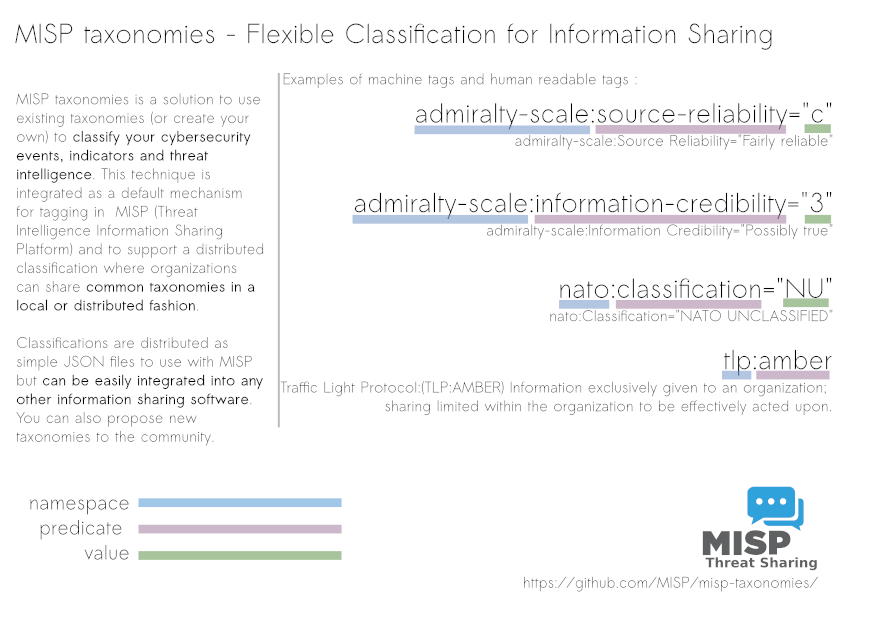
MISP Taxonomies is a set of common classification libraries to tag, classify and organise information. Taxonomy allows to express the same among a distributed set of users and organisations.
Taxonomies that can be used in MISP and other information sharing tool, are expressed in Machine Tags (Triple Tags). A machine tag is composed of a namespace (MUST), a predicate (MUST) and an (OPTIONAL) value. Machine tags are often called triple tag due to their format.
!O of the MISP taxonomies
The following taxonomies can be used in MISP (as local or distributed tags) or in other tools and software willing to share common taxonomies among security information sharing tools.
List of a taxonomies
CERT-XLM
CERT-XLM :
CERT-XLM Security Incident Classification. O
DFRLab-dichotomies-of-disinformation
DFRLab-dichotomies-of-disinformation :
DFRLab Dichotomies of Disinformation. O
DML
DML :
The Detection Maturity Level (DML) model is a capability maturity model for referencing ones maturity in detecting cyber attacks. It's designed for organizations who perform intel-dri and response and who put an emphasis on having a mature detection program. O
GrayZone
GrayZone :
Gray Zone of Acti includes all elements which lay between reacti elements and offensi. It does fill the gray spot between them. Taxo may be used for acti planning or modeling. O
PAP
PAP :
The Permissible Actions Protocol - or short: PAP - was designed to indicate how the recei can be used. O
access-method
access-method :
The access method used to remotely access a system. O
accessnow
accessnow :
Access Now classification to classify an issue (such as security, human rights, youth rights). O
acn
acn :
Cyber taxonomy for Italian National Cybersecurity Agency (ACN) O
acs-marking
acs-marking :
The Access Control Specification (ACS) marking type defines the object types required to implement automated access control systems based on the relevant policies go sharing between participants. O
action-taken
action-taken :
Action taken in the case of a security incident (CSIRT perspective). O
admiralty-scale
admiralty-scale :
The Admiralty Scale or Ranking (also called the NATO System) is used to rank the reliability of a source and the credibility of an information. Reference based on FM 2-22.3 (FM 34-52) HUMAN INTELLIGENCE COLLECTOR OPERATIONS and NATO documents. O
ad
ad :
An o and description of the ad infrastructure O
agent-threat-rules
agent-threat-rules :
Agent Threat Rules (ATR) is an open detection standard for AI agent threats published under Apache 2.0. The taxonomy organises 330 community-maintained rules across ten attack categories co prompt injection, tool poisoning, skill compromise, context exfiltration, agent manipulation, pri escalation, excessi, model abuse, model security, and data poisoning. Predicates name the category; are indi rule identifiers in the form ATR-YYYY-NNNNN. O
ai-bias-terminology
ai-bias-terminology :
A list of standalone definitions for each type of bias. Aggregate terms that are in common usage or relevance to AI bias. From NIST.SP.1270-draft (2021) O
ai-computer-assisted
ai-computer-assisted :
Taxonomy describing the level of AI assistance and the level of review/update in in the creation of an intelligence package or event. O
ai-safety-benchmark
ai-safety-benchmark :
AI safety benchmark v0.5, that has been created by the MLCommons AI Safety Working Group (WG) O
ais-marking
ais-marking :
The AIS Marking Schema implementation is maintained by the National Cybersecurity and Communication Integration Center (NCCIC) of the U.S. Department of Homeland Security (DHS) O
analyst-assessment
analyst-assessment :
A series of assessment predicates describing the analyst capabilities to perform analysis. These assessment can be assigned by the analyst him/herself or by another party e the analyst. O
anti-piracy
anti-piracy :
Taxonomy for anti-piracy O
appro
appro :
A pre-appro of action for indicators being shared with partners (MIMIC). O
artificial-satellites
artificial-satellites :
This taxonomy was designed to describe artificial satellites O
a
a :
A taxonomy describing security threats or incidents against the a sector. O
binary-class
binary-class :
Custom taxonomy for types of binary file. O
cccs
cccs :
Internal taxonomy for CCCS. O
ce-uas-classification
ce-uas-classification :
European Union (EASA) Drone Classification - C0 to C6. O
circl
circl :
CIRCL Taxonomy - Schemes of Classification in Incident Response and Detection. O
cloud-so
cloud-so :
Cloud so objectives, assurance levels, and scoring weights derived from the European Commission Cloud So Framework. O
cnsd
cnsd :
La presente taxonomia es la primera versión disponible para el Centro Nacional de Seguridad Digital del Perú. O
coa
coa :
Course of action taken within organization to discover, detect, deny, disrupt, degrade, deceive and/or destroy an attack. O
collaborati
collaborati :
Collaborati support language is a common language to support analysts to perform their analysis to get crowdsourced support when using threat intelligence sharing platform like MISP. The objective of this language is to advance collaborati and to share earlier than later. O
common-taxonomy
common-taxonomy :
Common Taxonomy for Law enforcement and CSIRTs O
copine-scale
copine-scale :
The COPINE Scale is a rating system created in Ireland and used in the United Kingdom to categorise the se of images of child sex abuse. The scale was de by staff at the COPINE (Combating Paedophile Information Networks in Europe) project. The COPINE Project was founded in 1997, and is based in the Department of Applied Psychology, Uni College Cork, Ireland. O
course-of-action
course-of-action :
A Course Of Action analysis considers six potential courses of action for the de of a cyber security capability. O
crowdsec
crowdsec :
Crowdsec IP address classifications and behaviors taxonomy. O
cryptocurrency-threat
cryptocurrency-threat :
Threats targeting cryptocurrency, based on CipherTrace report. O
csirt-americas
csirt-americas :
Taxonomía CSIRT Américas. O
csirt_case_classification
csirt_case_classification :
It is critical that the CSIRT provide consistent and timely response to the customer, and that sensiti is handled appropriately. This document provides the guidelines needed for CSIRT Incident Managers (IM) to classify the case category, criticality level, and sensitivity level for each CSIRT case. This information will be entered into the Incident Tracking System (ITS) when a case is created. Consistent case classification is required for the CSIRT to provide accurate reporting to management on a regular basis. In addition, the classifications will provide CSIRT IM’s with proper case handling procedures and will form the basis of SLA’s between the CSIRT and other Company departments. O
cssa
cssa :
The CSSA agreed sharing taxonomy. O
cti
cti :
Cyber Threat Intelligence cycle to control workflow state of your process. O
current-event
current-event :
Current events - Schemes of Classification in Incident Response and Detection O
cyber-threat-framework
cyber-threat-framework :
Cyber Threat Framework was de by the US Go to enable consistent characterization and categorization of cyber threat events, and to identify trends or changes in the acti of cyber ad. O
cycat
cycat :
Taxonomy used by CyCAT, the Uni Cybersecurity Resource Catalogue, to categorize the namespaces it supports and uses. O
cytomic-orion
cytomic-orion :
Taxonomy to describe desired actions for Cytomic Orion O
dark-web
dark-web :
Criminal moti and content detection the dark web: A categorisation model for law enforcement. ref: Janis Dalins, Campbell Wilson, Mark Carman. Taxonomy updated by MISP Project and extended by the JRC (Joint Research Centre) of the European Commission. O
data-classification
data-classification :
Data classification for data potentially at risk of exfiltration based on table 2.1 of Solving Cyber Risk book. O
dcso-sharing
dcso-sharing :
Taxonomy defined in the DCSO MISP Event Guide. It provides guidance for the creation and consumption of MISP events in a way that minimises the extra effort for the sending party, while enhancing the usefulness for receiving parties. O
ddos
ddos :
Distributed Denial of Service - or short: DDoS - taxonomy supports the description of Denial of Service attacks and especially the types they belong too. O
de-vs
de-vs :
German (DE) Go classification markings (VS). O
death-possibilities
death-possibilities :
Taxonomy of Death Possibilities O
deception
deception :
Deception is an important component of information operations, for both offense and defense. O
detection-engineering
detection-engineering :
Taxonomy related to detection engineering techniques O
dga
dga :
A taxonomy to describe domain-generation algorithms often called DGA. Ref: A Comprehensi Study of Domain Generating Malware Daniel Plohmann and others. O
dhs-ciip-sectors
dhs-ciip-sectors :
DHS critical sectors as in O
diamond-model
diamond-model :
The Diamond Model for Intrusion Analysis establishes the basic atomic element of any intrusion activity, the event, composed of four core features: ad, infrastructure, capability, and . O
diamond-model-for-influence-operations
diamond-model-for-influence-operations :
The diamond model for influence operations analysis is a framework that leads analysts and researchers toward a comprehensi of a malign influence campaign by addressing the socio-political, technical, and psychological aspects of the campaign. The diamond model for influence operations analysis consists of 5 components: 4 corners and a core element. The 4 corners are divided into 2 axes: influencer and audience on the socio-political axis, capabilities and infrastructure on the technical axis. Narrati up the core of the diamond. O
dni-ism
dni-ism :
A subset of Information Security Marking Metadata ISM as required by Executi (EO) 13526. As described by DNI.gov as Data Encoding Specifications for Information Security Marking Metadata in Controlled Enumeration for ISM O
domain-abuse
domain-abuse :
Domain Name Abuse - taxonomy to tag domain names used for cybercrime. O
doping-substances
doping-substances :
This taxonomy aims to list doping substances O
drugs
drugs :
A taxonomy based on the superclass and class of drugs. Based on O
economical-impact
economical-impact :
Economic impact refers to a taxonomy used to describe whether financial effects are positive or negati related to tagged information. For instance, data exfiltration loss represents a positi for an ad. O
ecsirt
ecsirt :
Incident Classification by the ecsirt.net mkVI of 31 March 2015 enriched with IntelMQ taxonomy-type mapping. O
enisa
enisa :
The present threat taxonomy is an initial that has been de on the basis of a ENISA material. This material has been used as an ENISA-internal structuring aid for information collection and threat consolidation purposes. It emerged in the time period 2012-2015. O
ensoc
ensoc :
Official ENSOC (or EU CyberHUB) taxonomy co all labels used during information exchange. O
estimati
estimati :
Estimati to describe quality and credibility of underlying sources, data, and methodologies based Intelligence Community Directive 203 (ICD 203) and JP 2-0, Joint Intelligence O
eu-ai-act
eu-ai-act :
Taxonomy for the EU Artificial Intelligence Act (Regulation (EU) 2024/1689). Classifies AI systems by risk level, prohibited practices, high-risk use cases, and incident types for GRC and SOC reporting. O
eu-marketop-and-publicadmin
eu-marketop-and-publicadmin :
Market operators and public administrations that must comply to some notifications requirements under EU NIS directive O
eu-nis-sector-and-subsectors
eu-nis-sector-and-subsectors :
Sectors, subsectors, and digital services as identified by the NIS Directive O
euci
euci :
EU classified information (EUCI) means any information or material designated by a EU security classification, the unauthorised disclosure of which could cause degrees of prejudice to the interests of the European Union or of one or more of the Member States. O
europol-event
europol-event :
This taxonomy was designed to describe the type of events O
europol-incident
europol-incident :
This taxonomy was designed to describe the type of incidents by class. O
e
e :
A series of assessment predicates describing the event assessment performed to make judgement(s) under a certain level of uncertainty. O
e
e :
Classification of events as seen in tools such as RT/IR, MISP and other O
exercise
exercise :
Exercise is a taxonomy to describe if the information is part of one or more cyber or crisis exercise. O
extended-event
extended-event :
Reasons why an event has been extended. This taxonomy must be used on the extended event. The competiti aspect is from Psychology of Intelligence Analysis by Richard J. Heuer, Jr. ref: O
failure-mode-in-machine-learning
failure-mode-in-machine-learning :
The purpose of this taxonomy is to jointly tabulate both the of these failure modes in a single place. Intentional failures wherein the failure is caused by an acti attempting to subvert the system to attain her goals – either to misclassify the result, infer private training data, or to steal the underlying algorithm. Unintentional failures wherein the failure is because an ML system produces a formally correct but completely unsafe outcome. O
false-positive
false-positive :
This taxonomy aims to ballpark the expected amount of false positives. O
file-type
file-type :
List of known file types. O
financial
financial :
Financial taxonomy to describe financial services, infrastructure and financial scope. O
flesch-reading-ease
flesch-reading-ease :
Flesch Reading Ease is a revised system for determining the comprehension difficulty of written material. The scoring of the flesh score can have a maximum of 121.22 and there is no limit on how low a score can be (negati are valid). O
fpf
fpf :
The Future of Privacy Forum (FPF) guide to practical de-identification taxonomy is used to e the degree of identifiability of personal data and the types of pseudonymous data, de-identified data and anonymous data. The work of FPF is licensed under a creati attribution 4.0 international license. O
fr-classif
fr-classif :
French go classification system O
gdpr
gdpr :
Taxonomy related to the REGULATION (EU) 2016/679 OF THE EUROPEAN PARLIAMENT AND OF THE COUNCIL on the protection of natural persons with regard to the processing of personal data and on the free mo of such data, and repealing Directive 95/46/EC (General Data Protection Regulation) O
gea-nz-acti
gea-nz-acti :
Information needed to track or monitor moments, periods or events that occur over time. This type of information is focused on occurrences that must be tracked for business reasons or represent a specific point in the e of ‘The Business’. O
gea-nz-entities
gea-nz-entities :
Information relating to instances of entities or things. O
gea-nz-moti
gea-nz-moti :
Information relating to authority or go. O
gsma-attack-category
gsma-attack-category :
Taxonomy used by GSMA for their information sharing program with telco describing the attack categories O
gsma-fraud
gsma-fraud :
Taxonomy used by GSMA for their information sharing program with telco describing the aspects of fraud O
gsma-network-technology
gsma-network-technology :
Taxonomy used by GSMA for their information sharing program with telco describing the types of infrastructure. WiP O
honeypot-basic
honeypot-basic :
Updated (CIRCL, Seamus Dowling and EURECOM) from Christian Seifert, Ian Welch, Peter Komisarczuk, ‘Taxonomy of Honeypots’, Technical Report CS-TR-06/12, UNI OF WELLINGTON, School of Mathematical and Computing Sciences, June 2006, O
ics
ics :
FIRST.ORG CTI SIG - MISP Proposal for ICS/OT Threat Attribution (IOC) Project O
iep
iep :
Forum of Incident Response and Security Teams (FIRST) Information Exchange Policy (IEP) framework O
iep2-policy
iep2-policy :
Forum of Incident Response and Security Teams (FIRST) Information Exchange Policy (IEP) v2.0 Policy O
iep2-reference
iep2-reference :
Forum of Incident Response and Security Teams (FIRST) Information Exchange Policy (IEP) v2.0 Reference O
ifx-
ifx- :
The IFX taxonomy is used to categorise information (MISP events and attributes) to aid in the intelligence process O
incident-disposition
incident-disposition :
How an incident is classified in its process to be resolved. The taxonomy is inspired from NASA Incident Response and Management Handbook. O
infoleak
infoleak :
A taxonomy describing information leaks and especially information classified as being potentially leaked. The taxonomy is based on the work by CIRCL on the AIL framework. The taxonomy aim is to be used at large to impro of leaked information. O
information-origin
information-origin :
Taxonomy for tagging information by its origin: human-generated or AI-generated. O
information-security-data-source
information-security-data-source :
Taxonomy to classify the information security data sources. O
information-security-indicators
information-security-indicators :
A full set of operational indicators for organizations to use to benchmark their security posture. O
interactice
interactice :
Describes the target of cyber training and education. O
interactical-setup
interactical-setup :
The technical setup consists of en structure, deployment, and orchestration. O
interacting-en
interacting-en :
The training en details the en around the training, consisting of training type and scenario. O
interacting-setup
interacting-setup :
The training setup further describes the training itself with the scoring, roles, the training mode as well as the customization level. O
interception-method
interception-method :
The interception method used to intercept traffic. O
ioc
ioc :
An IOC classification to facilitate automation of malicious and non malicious artifacts O
iot
iot :
Internet of Things taxonomy, based on IOT UK report O
kill-chain
kill-chain :
The Cyber Kill Chain, a phase-based model de by Lockheed Martin, aims to help categorise and identify the stage of an attack. O
maec-deli
maec-deli :
used to deli based on MAEC 5.0 O
maec-malware-behavior
maec-malware-behavior :
Malware beha based on MAEC 5.0 O
maec-malware-capabilities
maec-malware-capabilities :
Malware Capabilities based on MAEC 5.0 O
maec-malware-obfuscation-methods
maec-malware-obfuscation-methods :
Obfuscation methods used by malware based on MAEC 5.0 O
malware_classification
malware_classification :
Classification based on different categories. Based on O
meteorstorm
meteorstorm :
Multiple En Threat E of Resources Space Threats and Operational Risk to Missions (meteorstorm) taxonomy for modeling space, cyber, and multi-domain threats and resilience across fi: Primary Capability En (PCE), Segment (SEG), Service (SVC), Asset (AST), and Analytic (AN). O
misinformation-website-label
misinformation-website-label :
classification for the identification of type of misinformation among websites. Source:False, Misleading, Clickbait-y, and/or Satirical News Sources by Melissa Zimdars 2019 O
misp
misp :
MISP taxonomy to infer with MISP behavior or operation. O
misp-workflow
misp-workflow :
MISP workflow taxonomy to support result of workflow execution. O
monarc-threat
monarc-threat :
MONARC Threats Taxonomy O
ms-caro-malware
ms-caro-malware :
Malware Type and Platform classification based on Microsoft's implementation of the Computer Antivirus Research Organization (CARO) Naming Scheme and Malware Terminology. Based on and Malware families are extracted from Microsoft SIRs since 2008 based on and Note that SIRs do NOT include all Microsoft malware families. O
ms-caro-malware-full
ms-caro-malware-full :
Malware Type and Platform classification based on Microsoft's implementation of the Computer Antivirus Research Organization (CARO) Naming Scheme and Malware Terminology. Based on and Malware families are extracted from Microsoft SIRs since 2008 based on and Note that SIRs do NOT include all Microsoft malware families. O
mwdb
mwdb :
Malware Database (mwdb) Taxonomy - Tags used across the platform O
nato
nato :
NATO classification markings. O
nato-uas-classification
nato-uas-classification :
NATO UAS Classification. O
nis
nis :
The taxonomy is meant for large scale cybersecurity incidents, as mentioned in the Commission Recommendation of 13 September 2017, also known as the blueprint. It has two core parts: The nature of the incident, i.e. the underlying cause, that triggered the incident, and the impact of the incident, i.e. the impact on services, in which sector(s) of economy and society. O
nis2
nis2 :
The taxonomy is meant for large scale cybersecurity incidents, as mentioned in the Commission Recommendation of 13 May 2022, also known as the pro agreement. It has two core parts: The nature of the incident, i.e. the underlying cause, that triggered the incident, and the impact of the incident, i.e. the impact on services, in which sector(s) of economy and society. O
open_threat
open_threat :
Open Threat Taxonomy v1.1 base on James Tarala of SANS and O
organizational-cyber-harm
organizational-cyber-harm :
A taxonomy to classify organizational cyber harms based on categories like physical, economic, psychological, reputational, and social/societal impacts. O
osint
osint :
Open Source Intelligence - Classification (MISP taxonomies) O
pandemic
pandemic :
Pandemic O
passi
passi :
Tags from RiskIQ's Passi service O
pentest
pentest :
Penetration test (pentest) classification. O
pfc
pfc :
Le Protocole des feux de circulation (PFC) est basé sur le standard « Traffic Light Protocol (TLP) » conçu par le FIRST. Il a pour objectif d’informer sur les limites autorisées pour la diffusion des informations. Il est classé selon des codes de couleurs. O
phishing
phishing :
Taxonomy to classify phishing attacks including techniques, collection mechanisms and analysis status. O
poison-taxonomy
poison-taxonomy :
Non-exhausti of natural poison O
political-spectrum
political-spectrum :
A political spectrum is a system to characterize and classify different political positions in relation to one another. O
priority-level
priority-level :
After an incident is scored, it is assigned a priority level. The six levels listed below are aligned with NCCIC, DHS, and the CISS to help provide a common lexicon when discussing incidents. This priority assignment dri urgency, pre-appro response offerings, reporting requirements, and recommendations for leadership escalation. Generally, incident priority distribution should follow a similar pattern to the graph below. Based on O
pyoti
pyoti :
PyOTI automated enrichment schemes for point in time classification of indicators. O
ransomware
ransomware :
Ransomware is used to define ransomware types and the elements that compose them. O
ransomware-roles
ransomware-roles :
The se seen in most ransomware incidents. O
retention
retention :
Add a retention time to events to automatically remove the IDS-flag on ip-dst or ip-src attributes. We calculate the time elapsed based on the date of the event. Supported time units are: d(ays), w(eeks), m(onths), y(ears). The numerical_value is just for sorting in the web-interface and is not used for calculations. O
rsit
rsit :
Reference Security Incident Classification Taxonomy O
rt_e
rt_e :
Status of events used in Request Tracker. O
runtime-packer
runtime-packer :
Runtime or software packer used to combine compressed or encrypted data with the decompression or decryption code. This code can add additional obfuscations mechanisms including polymorphic-packer, or other obfuscation techniques. This taxonomy lists all the known or official packer used for legitimate use or for packing malicious binaries. O
scrippsco2-fgc
scrippsco2-fgc :
Flags describing the sample O
scrippsco2-fgi
scrippsco2-fgi :
Flags describing the sample for isotopic data (C14, O18) O
scrippsco2-sampling-stations
scrippsco2-sampling-stations :
Sampling stations of the Scripps CO2 Program O
sentinel-threattype
sentinel-threattype :
Sentinel indicator threat types. O
smart-airports-threats
smart-airports-threats :
Threat taxonomy in the scope of securing smart airports by ENISA. O
social-engineering-attack-
social-engineering-attack- :
Attack used in social engineering as described in 'A Taxonomy of Social Engineering Defense Mechanisms' by Dalal Alharthi and others. O
sov
sov :
So so objectives, assurance levels, and scoring weights derived from the European Commission Cloud So Framework. O
srbcert
srbcert :
SRB-CERT Taxonomy - Schemes of Classification in Incident Response and Detection O
state-responsibility
state-responsibility :
A spectrum of state responsibility to more directly tie the goals of attribution to the needs of policymakers. O
stealth_malware
stealth_malware :
Classification based on malware stealth techniques. Described in O
stix-ttp
stix-ttp :
TTPs are representations of the behavior or modus operandi of cyber ad. O
targeted-threat-index
targeted-threat-index :
The Targeted Threat Index is a metric for assigning an o threat ranking score to email messages that deli to a ’s computer. The TTI metric was first introduced at SecTor 2013 by Seth Hardy as part of the talk “RATastrophe: Monitoring a Malware Menagerie” along with Katie Kleemola and Greg Wiseman. O
thales_group
thales_group :
Thales Group Taxonomy - was designed with the aim of enabling desired sharing and pre unwanted sharing between Thales Group security communities. O
threatmatch
threatmatch :
The ThreatMatch Sectors, Incident types, Malware types and Alert types are applicable for any ThreatMatch instances and should be used for all CIISI and TIBER Projects. O
threats-to-dns
threats-to-dns :
An o of some of the known attacks related to DNS as described by Torabi, S., Boukhtouta, A., Assi, C., & Debbabi, M. (2018) in Detecting Internet Abuse by Analyzing Passive DNS Traffic: A Survey of Implemented Systems. IEEE Communications Surveys & Tutorials, 1–1. doi:10.1109/comst.2018.2849614 O
tlp
tlp :
The Traffic Light Protocol (TLP) (v2.0) was created to facilitate greater sharing of potentially sensiti and more effecti. Information sharing happens from an information source, towards one or more recipients. TLP is a set of four standard labels (a fifth label is included in amber to limit the diffusion) used to indicate the sharing boundaries to be applied by the recipients. Only labels listed in this standard are considered valid by FIRST. This taxonomy includes additional labels for backward compatibility which are no more by FIRST SIG. O
tor
tor :
Taxonomy to describe Tor network infrastructure O
trust
trust :
The Indicator of Trust provides insight about data on what can be trusted and known as a good actor. Similar to a whitelist but on steroids, reusing features one would use with Indicators of Compromise, but to filter out what is known to be good. O
type
type :
Taxonomy to describe different types of intelligence gathering discipline which can be described the origin of intelligence. O
uas-additionnal-classification
uas-additionnal-classification :
Additional UAV and UCA tags for qualifying usage and model specifications. O
unified-kill-chain
unified-kill-chain :
The Unified Kill Chain is a refinement to the Kill Chain. O
unified-ransomware-kill-chain
unified-ransomware-kill-chain :
The Unified Ransomware Kill Chain, a intelligence dri de by Oleg Skulkin, aims to track every single phase of a ransomware attack. O
use-case-applicability
use-case-applicability :
The Use Case Applicability categories reflect standard resolution categories, to clearly display alerting rule configuration problems. O
veris
veris :
for Event Recording and Incident Sharing (VERIS) O
vmray
vmray :
VMRay taxonomies to map VMRay Thread Identifier scores and artifacts. O
ites-estimatives
ites-estimatives :
Ce attribue des en pourcentage à certains énoncés de probabilité O
:
A taxonomy for describing (software, hardware, or social) on different scales or with additional a information. O
workflow
workflow :
Workflow support language is a common language to support intelligence analysts to perform their analysis on data and information. O
Reser
The following taxonomy namespaces are reserved and used internally to MISP.
Documentation
A documentation of the taxonomies is generated automatically from the taxonomies description and a in PDF and HTML.
How to contribute your taxonomy?
It is quite easy. Create a JSON file describing your taxonomy as triple tags (e.g. check an existing one like Admiralty Scale), create a directory matching your name space, put your machinetag file in the directory and pull your request. That's it. E can benefit from your taxonomy and can be automatically enabled in information sharing tools like MISP.
For more information, "Information Sharing and Taxonomies Practical Classification of Threat Indicators using MISP" presentation given to the last MISP training in Luxembourg.
How to add your private taxonomy to MISP
~~~~shell
$ cd /var/www/MISP/app/files/taxonomies/
$ mkdir pri
$ cd pri
$ .json
~~~~
Create a JSON file describing your taxonomy as triple tags.
Once you are happy with your file go to MISP Web GUI taxonomies/index and update the taxonomies, the newly created taxonomy should be , now you need to activate the tags within your taxonomy.
MISP Taxonomies
Tools
machinetag.py is a parsing tool to dump taxonomies expressed in Machine Tags (Triple Tags) and list all valid tags from a specific taxonomy.
~~~~shell
% cd tools
% python machinetag.py
admiralty-scale:source-reliability="a"
admiralty-scale:source-reliability="b"
admiralty-scale:source-reliability="c"
admiralty-scale:source-reliability="d"
admiralty-scale:source-reliability="e"
admiralty-scale:source-reliability="f"
admiralty-scale:information-credibility="1"
admiralty-scale:information-credibility="2"
admiralty-scale:information-credibility="3"
admiralty-scale:information-credibility="4"
admiralty-scale:information-credibility="5"
admiralty-scale:information-credibility="6"
...
~~~~
Library
License
The MISP taxonomies (JSON files) are dual-licensed under:
or
~~~~
Copyright (c) 2015-2024 Alexandre Dulaunoy -
Copyright (c) 2015-2024 CIRCL - Computer Incident Response Center Luxembourg
Copyright (c) 2015-2024 Andras Iklody
Copyright (c) 2015-2024 Raphael Vinot
Copyright (c) 2016-2024 contributors to MISP Project
Redistribution and use in source and binary forms, with or without modification,
are permitted provided that the following conditions are met:
1. Redistributions of source code must retain the abo notice,
this list of conditions and the following disclaimer.
2. Redistributions in binary form must reproduce the abo notice,
this list of conditions and the following disclaimer in the documentation
and/or other materials provided with the distribution.
THIS SOFTWARE IS PROVIDED BY THE COPYRIGHT HOLDERS AND CONTRIBUTORS "AS IS" AND
ANY EXPRESS OR IMPLIED WARRANTIES, INCLUDING, BUT NOT LIMITED TO, THE IMPLIED
WARRANTIES OF MERCHANTABILITY AND FITNESS FOR A PARTICULAR PURPOSE ARE DISCLAIMED.
IN NO EVENT SHALL THE COPYRIGHT HOLDER OR CONTRIBUTORS BE LIABLE FOR ANY DIRECT,
INDIRECT, INCIDENTAL, SPECIAL, EXEMPLARY, OR CONSEQUENTIAL DAMAGES (INCLUDING,
BUT NOT LIMITED TO, PROCUREMENT OF SUBSTITUTE GOODS OR SERVICES; LOSS OF USE,
DATA, OR PROFITS; OR BUSINESS INTERRUPTION) HOWE AND ON ANY THEORY OF
LIABILITY, WHETHER IN CONTRACT, STRICT LIABILITY, OR TORT (INCLUDING NEGLIGENCE
OR OTHERWISE) ARISING IN ANY WAY OUT OF THE USE OF THIS SOFTWARE, EVEN IF ADVISED
OF THE POSSIBILITY OF SUCH DAMAGE.
~~~~~
If a specific author of a taxonomy wants to license it under a different license, a pull request can be requested.
项目信息
开发语言:Python
Star 数:304
技术要点
该项目属于病毒分析方向的开源资源,代码结构清晰,适合安全研究人员学习参考。项目围绕Taxonomies used in MISP taxonomy system and can be used by other information sharing tool.展开,提供了可运行的实现,对理解相关安全机制、工具原理与攻防技术具有较高的研究价值。
从技术实现角度看,此类项目的核心在于对底层原理的深入理解与工程化落地。开发者在研究过程中可以结合官方文档与社区讨论,梳理项目的初始化流程、核心模块职责与数据流转,逐步掌握其中的技术细节与设计思路。
使用与学习建议
1. 下载源码压缩包,解压到本地环境。
2. 根据项目类型准备对应的运行环境与依赖。
3. 按照 README 中的步骤完成配置与部署。
4. 在隔离的测试环境中运行验证,避免影响生产系统。
免责声明
本资源来源于开源社区,仅供安全研究、技术学习与合法授权范围内的攻防演练使用,请勿用于任何非法或侵害他人权益的用途。使用本项目产生的一切后果由使用者自行承担。
| 资源标题 | misp-taxonomies - Taxonomies used in MISP taxonomy system and can be |
| 所属分类 | 病毒分析 |
| 发布作者 | admin |
| 发布时间 | 2026-10-05 23:23:57 |
| 下载权限 | 免费下载 |
| 附件数量 | 2 个下载链接 |
| 浏览次数 | 195 |
| 讨论数量 | 0 |
| 主题状态 | 正常讨论中 |