 病毒分析
点击放大
Awesome-AI-for-cybersecurity - Awesome list of AI for cybersecurity including net
项目说明
Awesome AI for cybersecurity
This is a list of AI for cybersecurity, including network (network traffic analysis and intrusion detection), endpoint (anti-malware), application (WAF or database firewalls), user (UBA), process behavior (anti-fraud).
1. Introduction
First, beginners should look at machine learning tasks and its applications. I wrote a machine learning blog including CV (CNN, GAN), RL, GNN, NLP.
Additionally, de still need to know more about security/cybersecurity, here is the awesome list of security tool and knowledge.
Then, let's turn to AI for cybersecurity.
The first dimension is a goal or a task. According to Gartner’s PPDR model, all security tasks can be divided into fi:
The second dimension is a technical layer and the list of layers for this dimension:
2. Network Protection
ML in network security implies new solutions called Network Traffic Analytics (NTA) aimed at in-depth analysis of all the traffic at each layer and detect attacks and anomalies.
How can ML help here? There are some examples:
And here are some research papers:
3. Endpoint Protection
If you deal with machine learning at endpoint layer, your solution may differ depending on the type of endpoint (e.g., workstation, server, container, cloud instance, mobile, PLC, IoT device).
Every endpoint has its own specifics but the tasks are common:
and there are some research work to follow:
4. Application Security
There are web applications, databases, ERP systems, SaaS applications, micro services, etc. WAFs or Code analysis, both static and dynamic can be applied to this.
Here are examples what you can do with machine learning for application security:
and there are some research work to follow:
Beha Security & Decision Models
LLM Application Firewalls
koma-gate, 96.2% recall on public corpus), rate limiting + audio (koma-scout), and split-store RAG protection (koma-core). MIT license.5. User Behavior
Unlike malware detection focusing on common attacks and the possibility to train a classifier, user behavior is one of the complex layers and unsupervised learning problem.
Here are the tasks that companies solve with the help of ML:
and there are some research work to follow:
6. Process Behavior (fraud detection)
While dealing with process behavior, it’s necessary to know a business process in order to find something anomalous. Business processes can differ significantly. You can look for fraud in banking and retail system, or a plant floor in manufacturing.
In general, there are the examples of tasks in the process area:
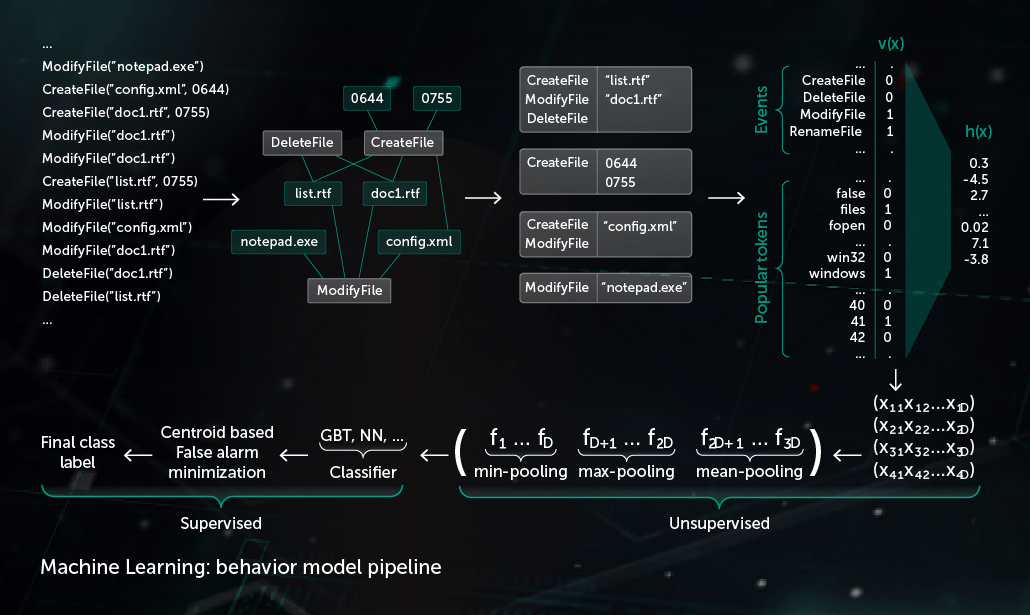
A monitoring component provides a behavior log - the sequence of system events occurred during the process execution together with corresponding arguments. In order to detect malicious activity in observed log data our model compresses obtained sequence of events to a set of binary and trains the deep neural network to distinguish clean and malicious logs.
<img src="1.png"></img>
and there are some research work to follow:
7. Intrusion Detection and Pre Systems (IDS/IPS)
These systems detect malicious network acti and prevent intruders from accessing the systems and alerts the user. Typically, they are recognized by known signatures and generic attack forms. This is useful against threats like data breaches.
Traditionally, this task was performed by ML algorithms. However, these algorithms caused the system to generate many false-positi tedious work for security teams and causing unnecessary fatigue.
Deep learning, con neural networks and Recurrent Neural Networks (RNNs) can be applied to create smarter ID/IP systems by analyzing the traffic with better accuracy, reducing the number of false alerts and helping security teams differentiate bad and good network acti.
Notable solutions include Next-Generation Firewall (NGFW),Web Application Firewall (WAF), and User Entity and Behavior Analytics (UEBA).
9. AI Security Agents
{"mcpServers":{"twzrd-agent-intel":{"url":"8.1 Book
8.2 Sur
项目信息
开发语言:未知
Star 数:272
技术要点
该项目属于病毒分析方向的开源资源,代码结构清晰,适合安全研究人员学习参考。项目围绕Awesome list of AI for cybersecurity including network (network traffic analysis and intrusion detection), endpoint (anti-malware), application (WAF or database firewalls), user (UBA), process behavior (anti-fraud).展开,提供了可运行的实现,对理解相关安全机制、工具原理与攻防技术具有较高的研究价值。
从技术实现角度看,此类项目的核心在于对底层原理的深入理解与工程化落地。开发者在研究过程中可以结合官方文档与社区讨论,梳理项目的初始化流程、核心模块职责与数据流转,逐步掌握其中的技术细节与设计思路。
使用与学习建议
1. 下载源码压缩包,解压到本地环境。
2. 根据项目类型准备对应的运行环境与依赖。
3. 按照 README 中的步骤完成配置与部署。
4. 在隔离的测试环境中运行验证,避免影响生产系统。
免责声明
本资源来源于开源社区,仅供安全研究、技术学习与合法授权范围内的攻防演练使用,请勿用于任何非法或侵害他人权益的用途。使用本项目产生的一切后果由使用者自行承担。
| 资源标题 | Awesome-AI-for-cybersecurity - Awesome list of AI for cybersecurity including net |
| 所属分类 | 病毒分析 |
| 发布作者 | admin |
| 发布时间 | 2026-10-05 23:24:37 |
| 下载权限 | 免费下载 |
| 附件数量 | 2 个下载链接 |
| 浏览次数 | 90 |
| 讨论数量 | 0 |
| 主题状态 | 正常讨论中 |