 病毒分析
点击放大
KittyLoader - KittyLoader is a highly evasive loader written in
项目说明
<p style="text-align:center;">
<em>« La force se cache dans l’in, et l’in gouverne tout. »</em>
</p>
<di="text-align:center; margin-top:8px;">
<img src="asset/charles-che.jpg"
alt="Charles Che (Blue Lock)"
width="400">
</div>
KittyLoader
!GitHub Stars
!GitHub Repo forks
> [!CAUTION]
> Disclaimer & Legal Notice
> This repository, KittyLoader, and all associated code, techniques, and information are provided strictly for educational and academic research purposes.
>
> This sample and its methodologies have been proactively disclosed to relevant cybersecurity defense organizations and . It is actively used by defensi to research attack patterns, develop detection capabilities, and enhance security products.
>
> You are required to use this knowledge and these tools only on systems you own or ha, written permission to test.
> Any unauthorized use against systems you do not own is illegal and strictly prohibited.
>
> This tool was created to advance the field of defensi. The author, *tlsbollei*, assumes no liability and is not responsible for any misuse or damage caused by this software.
>
> By accessing this repository, you acknowledge that you understand its purpose is to learn about modern malware techniques, e tactics, and ultimately to improve our collecti to defend against them.
By proceeding, you agree to use this information responsibly and legally.
About>
KittyLoader is a highly e loader written in C / Assembly.
Features
- InLoadOrderModuleList
- InInitializationOrderModuleList
- InMemoryOrderModuleList
- Multilayer scoring (debugger, sandbox/resources, API integrity/hook checks, human-input entropy, contextual cues like domain/time of day) combined into a weighted o confidence that continuously re-e
- Picks an operational state (full → halted) and throttles/pauses with jittered, CPU-cycle-based delays in a loop that keeps reassessing the en.
- API integrity/inline-hook heuristics and light tamper probes; human-interaction entropy sampling; randomized yet precise timing jitter to throw off debuggers
- Adds controlled noise (junk calcs + jittered delays) and spreads logic across multiple signals, reducing single-indicator detection.
- Resol APIs , hash-based lookups instead of plain export walking—shrinks observable footprints and evades basic hooks
- Loads libraries with quiet flags (DONT_RESOL, LOAD_LIBRARY_SEARCH_SYSTEM32) which minimizes I/O usage and loader footprint
- Performs staged protection flips (RW → RWX → RX) and later restores RW before wipe/free—mimics legitimate behavior and lowers post-execution forensics
> [!NOTE]
> To fix in the future - ChaCha20 implementation bug, entry hijack ASM prologue/epilogue issues, control flow and compile hazards, and silence anti analysis more. Add fallbacks if LdrCallEncla, and implement more stable key deri. Or just fix it yourself!
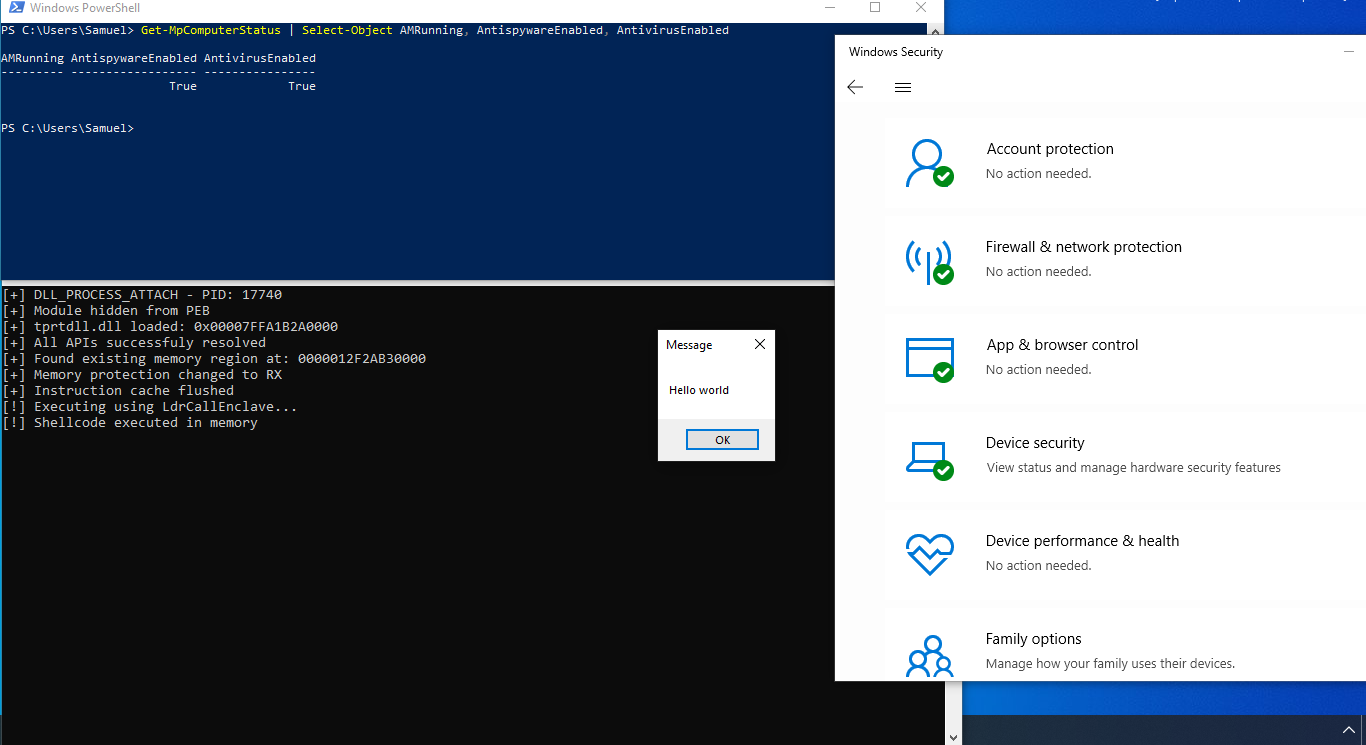
<img src="asset/proof.PNG" alt="" width="950">
Credits:
项目信息
开发语言:C++
Star 数:269
技术要点
该项目属于病毒分析方向的开源资源,代码结构清晰,适合安全研究人员学习参考。项目围绕KittyLoader is a highly evasive loader written in C / Assembly展开,提供了可运行的实现,对理解相关安全机制、工具原理与攻防技术具有较高的研究价值。
从技术实现角度看,此类项目的核心在于对底层原理的深入理解与工程化落地。开发者在研究过程中可以结合官方文档与社区讨论,梳理项目的初始化流程、核心模块职责与数据流转,逐步掌握其中的技术细节与设计思路。
使用与学习建议
1. 下载源码压缩包,解压到本地环境。
2. 根据项目类型准备对应的运行环境与依赖。
3. 按照 README 中的步骤完成配置与部署。
4. 在隔离的测试环境中运行验证,避免影响生产系统。
免责声明
本资源来源于开源社区,仅供安全研究、技术学习与合法授权范围内的攻防演练使用,请勿用于任何非法或侵害他人权益的用途。使用本项目产生的一切后果由使用者自行承担。
| 资源标题 | KittyLoader - KittyLoader is a highly evasive loader written in |
| 所属分类 | 病毒分析 |
| 发布作者 | admin |
| 发布时间 | 2026-10-05 23:24:50 |
| 下载权限 | 免费下载 |
| 附件数量 | 2 个下载链接 |
| 浏览次数 | 450 |
| 讨论数量 | 0 |
| 主题状态 | 正常讨论中 |