 病毒分析
点击放大
scan - 0-day malware detection for binaries, source & scr
项目说明
Atomdrift Scan
![Latest release]()

Atomdrift Scan is a modern ML-based malware scanner designed to detect 0-day attacks against the software supply-chain.
It's designed to be deterministic, fast, and flexible, and embeddable in any workflow or security tool you have in mind, and can operate against files, archives, URLs, PURLs, or processes.
As of September 2026, Atomdrift Scan has a 98% 0-day detection rate, +34% ahead of any other scanner: commercial or open.
<p align="center">
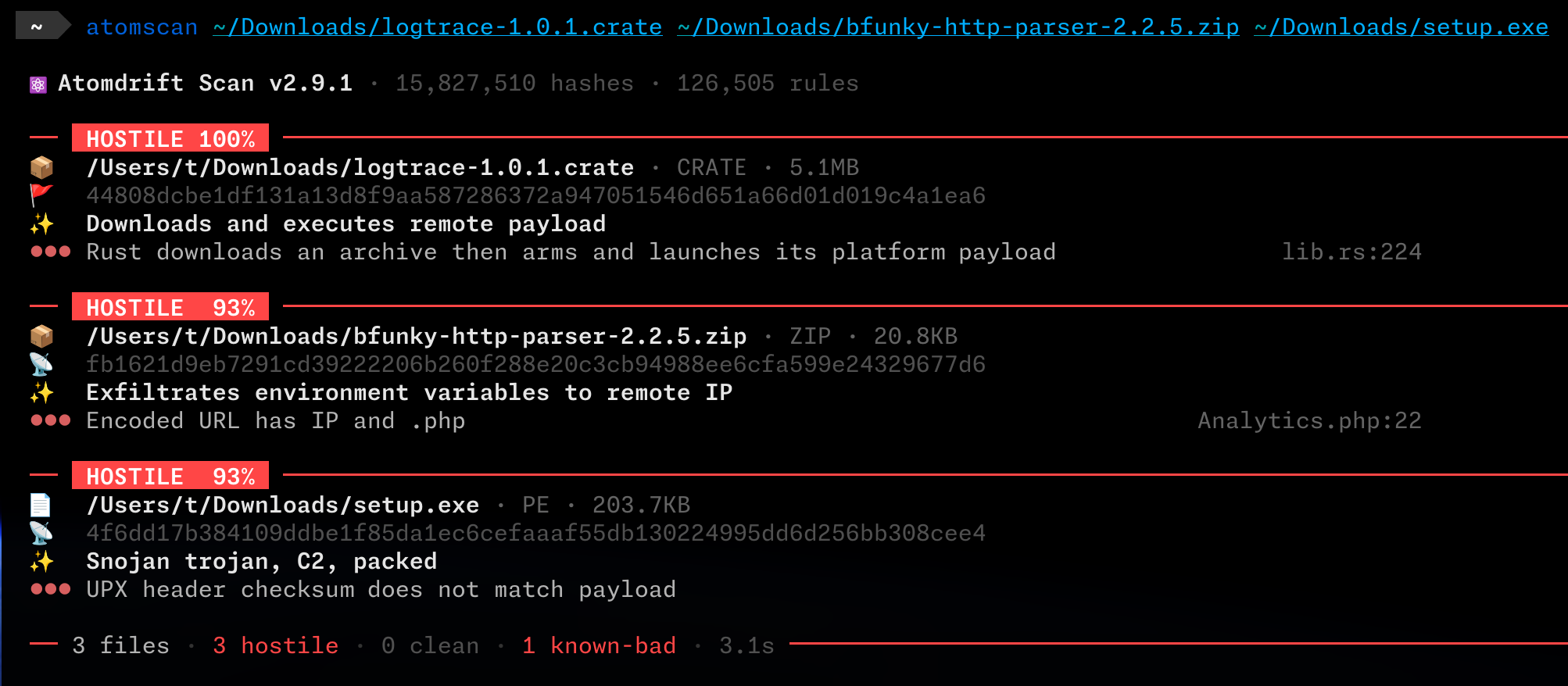
<img src="media/screenshot.png" alt="Atomdrift Scan terminal output" width="760">
</p>
How does Atomdrift get such great results? First, it covers more ground than any other scanner:
Most importantly, rules are constantly refreshed using reinforcement learning against new samples, blogs, and technical articles, resulting in ~1000 updated rules daily.
Install
If you are an a UNIX-flavored host (macOS, Linux, BSD, Solaris, illumos, Android):
If you are on Windows:
Or, if you have Rust installed and just want to build it from source:
If deeper binary analysis is required, you should also install
7-Zip, rizin, upx, and innoextract.
On Windows, using winget:
On Unix-like systems, install upstream 7-Zip (brew install se, apt install 7zip) rather than p7zip — its 7z cannot read APFS, so .dmg contents go unscanned.
Usage
Exit codes make CI integration trivial:
0: all samples are benign1: hostile sample detected2: suspicious sample detected3: analysis error4: the rule set was incomplete — the scan ran with fewer rules than thetrait set defines, so anything short of hostile pro. Re-run it.
How it works
!Diagram
1. stng extracts content, even if obfuscated
2. cleave unpacks containers and extracts capabilities
3. The report is con into a standardized feature , standardized across file types.
4. azoth LightGBM model ensembles score the sample.
Networking and privacy
atomscan will never send telemetry data. It will howe out to the Internet for 2 reasons:
--no-update or SCAN_NO_UPDATE_CHECK=1--follow=none to analyze only the requested artifact.Tune the false-positi
Unlike other malware scanners, Atomdrift allows you to adjust sensitivity in terms of an acceptable false-positi using the -l flag:
* -l0: tight, sets the confidence cutoff to a point where no false-positives have been observed.
* -l25: the default shipping point: 25 false-positives per 100 million files.
* -l1000: loose, roughly 1 false positive per 100,000 files.
NOTE: For file formats where we don't have 100 million samples, the obser rate may be up to 5-6X the requested level. YMMV.
Raw --threshold-hostile and --threshold-suspicious o are a
for users who want to micromanage probability thresholds directly, but these numbers are not guaranteed to be stable, and these flags cannot be combined with -l.
Optional local LLM (interpretation)
For additional interpretation, users can provide access to an LLM via the --llm flag. This flag serves two purposes:
* Provides a large-language model text interpretation of the results
* Steer edge cases based on agreement/disagreement with the ML model ( p to 33%)
By default, atomscan sends the interpreted e (not the original file) to - to be used with a local service like Ollama or vLLM; but it can also be setup to use a remote service like Claude, ChatGPT, or DeepSeek.
No model is hardcoded: unless you pass --llm-model, atomscan asks the endpoint which models it serves and uses the largest one it lists. We recommend serving Qwen/Qwen3.8-27B.
If the endpoint requires a bearer token, put it in ~/.tok/llm (mode 0600) and atomscan sends it automatically; --llm-key and SCAN_LLM_KEY o that file.
--llm also takes a comma-separated failo, tried in order — --llm ' grades on your own endpoint and reaches for the billed one only when it cannot answer.
--llm openrouter talks to . The key comes from --llm-key, SCAN_LLM_KEY, or ~/.tok/openrouter (first non-empty line). --llm-model defaults to openrouter/auto (OpenRouter's own auto-router) if omitted — the rest of the catalog is not auto-selected.
Linux make deploy accepts the same names: LLM=openrouter (or LLM_URL=openrouter), and LLM_MODEL=qwen/qwen3.8-27b only to pin a model instead of openrouter/auto. The unit cannot read the operator home (ProtectHome=true), so the deploy script copies ~/.tok/openrouter into the service state dir.
Co
The scanner recognizes more than 100 file and container types. Representative
co includes:
| Category | Formats |
| --- | --- |
| Binaries and bytecode | Mach-O, ELF, PE, WebAssembly, Android DEX, Java .class, Python .pyc, BEAM |
| Source | Python, Ja, TypeScript, Go, Rust, Java, C, C++, C#, Ruby, PHP, Perl, Lua, Swift, Objective-C, Kotlin, Scala, Groovy, Zig, Elixir, Clojure, Shell, PowerShell, Batch, , AppleScript, JCL |
| Build, manifest, and lock files | package.json, package-lock.json, Cargo.toml, Cargo.lock, pyproject.toml, requirements.txt, Poetry, Pipen, Yarn, pnpm, Go modules, binding.gyp, GitHub Actions, systemd units, Makefile, Dockerfile |
| Archives and disk images | ZIP, TAR, gzip, bzip2, XZ, zstd, 7-Zip, RAR, CAB, ASAR, DMG, ISO |
| Packages and containers | deb, rpm, APK, npm, wheel, egg, sdist, gem, crate, conda, NuGet, IPA, CRX, XPI, VSIX, OCI/Docker images, FreeBSD, Arch, Void, and Gentoo packages |
| Documents and data | OLE2, OOXML, OpenDocument, PDF, RTF, Markdown, HTML, XML, S, JPEG, PNG, LNK, CHM, Python pickle |
The rule set includes platform-specific behaviors for Linux, macOS, Windows,
Android, iOS, the BSDs, AIX, Solaris, QNX, z/OS, ESXi, OpenWrt, ,
RouterOS, FortiOS, PAN-OS, IOS-XE, Junos, NetScaler, and Ivanti appliances.
The default build matrix covers Linux, macOS, FreeBSD, OpenBSD, NetBSD, illumos, Solaris, and Windows across several CPU architectures. Test depth
by target; see the build workflow for the
current matrix.
Documentation
and deployment choices
pro
Related projects
and static analysis
thresholds, and feature specification
License
Atomdrift Scan is a under the Apache License 2.0.
All contributions welcome!
项目信息
开发语言:Rust
Star 数:198
技术要点
该项目属于病毒分析方向的开源资源,代码结构清晰,适合安全研究人员学习参考。项目围绕0-day malware detection for binaries, source & scripts (that doesn't suck)展开,提供了可运行的实现,对理解相关安全机制、工具原理与攻防技术具有较高的研究价值。
从技术实现角度看,此类项目的核心在于对底层原理的深入理解与工程化落地。开发者在研究过程中可以结合官方文档与社区讨论,梳理项目的初始化流程、核心模块职责与数据流转,逐步掌握其中的技术细节与设计思路。
使用与学习建议
1. 下载源码压缩包,解压到本地环境。
2. 根据项目类型准备对应的运行环境与依赖。
3. 按照 README 中的步骤完成配置与部署。
4. 在隔离的测试环境中运行验证,避免影响生产系统。
免责声明
本资源来源于开源社区,仅供安全研究、技术学习与合法授权范围内的攻防演练使用,请勿用于任何非法或侵害他人权益的用途。使用本项目产生的一切后果由使用者自行承担。
| 资源标题 | scan - 0-day malware detection for binaries, source & scr |
| 所属分类 | 病毒分析 |
| 发布作者 | admin |
| 发布时间 | 2026-10-05 23:28:52 |
| 下载权限 | 免费下载 |
| 附件数量 | 2 个下载链接 |
| 浏览次数 | 318 |
| 讨论数量 | 0 |
| 主题状态 | 正常讨论中 |