 病毒分析
点击放大
Silverseal - Silverseal is a Linux framework containing a bootk
项目说明
Sil
!Sil Logo
!rust !assembly !linux
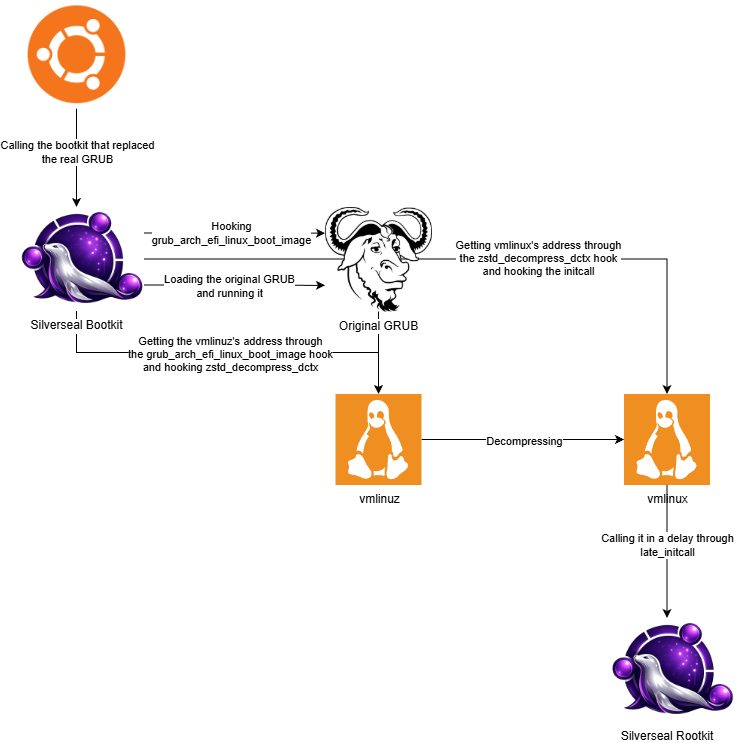
Sil is a Linux post exploitation framework that demonstrates the ability of a UEFI bootkit to persistently and stealthily load a Rust-based kernel module rootkit on modern Linux systems. The project includes:
Design
!Sil Design Diagram
Installing Dependencies
Ubuntu
Installs the packages needed for Rust-for-Linux external module builds, installs rustup if needed, switches the default toolchain to stable, adds rust-src, installs bindgen-cli, and warns if the currently running kernel does not expose CONFIG_RUST=y.
WSL
> [!IMPORTANT]
> If you're using WSL, make sure to set up WSL 2 and install Ubuntu. This script builds a custom Rust-enabled WSL2 kernel, prepares a modules VHDX, and can optionally write a Windows .wslconfig entry that points WSL at the generated kernel.
The script automatically installs the Ubuntu build dependencies, clones the matching Microsoft WSL2 kernel source, enables CONFIG_RUST, builds the kernel with LLVM, and wires /lib/modules/<release>/build for external module builds.
To see the supported options:
To build the rootkit against your wanted target kernel, you need to run the following script on your build machine (either WSL or a nati machine):
This flow installs the matching linux-headers-<kernel> and linux-lib-rust-<kernel> packages, installs the Ubuntu-packaged Rust 1.82 toolchain used by the generic-kernel flow, repairs /usr/src/linux-headers-<kernel>/rust if that symlink is broken, and prints the exact make command to use afterward.
Build
Rootkit
Build the rootkit with the kernel build system. Do not use Cargo for the real module build.
The module artifacts are staged into sil/target/ after the build.
Build the rootkit for an Ubuntu generic target kernel from WSL:
The module Makefile auto-detects /usr/src/linux-headers-* targets and passes the Rust compatibility cfg through Kbuild's Rust flag so the newer Ubuntu module! metadata schema uses authors instead of the older author key.
After the build, the target kernel was embedded correctly:
Bootkit
The bootkit build requires nasm on PATH. The crate is already configured to target x86_64-unknown-uefi, and the build script assembles both asm/x64/lkm_loader.asm and asm/x64/lkm_stager.asm into flat binary blobs embedded into the EFI image.
The resulting EFI binary is written to:
Test
The deployment script currently expects a file named sil.efi in the repository root. After building the bootkit, copy the EFI artifact there and then run the setup script from the repository root.
The script performs a direct swap on the EFI partition:
/boot/efi/EFI/ubuntu/grubx64.efi to /boot/efi/EFI/ubuntu/grubx64.efi.original./sil.efi into place as /boot/efi/EFI/ubuntu/grubx64.efiRemo
To remo, restore the original GRUB binary from the .original backup:
Serial Logging Setup
Linux
Common ports: /de (COM1), /de (COM2)
minicom:Windows
\\.\pipe\com_1)You can also use the helper script, which continuously reconnects PuTTY to \\.\pipe\com_1 at 115200 baud:
Resources
项目信息
开发语言:Rust
Star 数:167
技术要点
该项目属于病毒分析方向的开源资源,代码结构清晰,适合安全研究人员学习参考。项目围绕Silverseal is a Linux framework containing a bootkit, rootkit loader and a rootkit展开,提供了可运行的实现,对理解相关安全机制、工具原理与攻防技术具有较高的研究价值。
从技术实现角度看,此类项目的核心在于对底层原理的深入理解与工程化落地。开发者在研究过程中可以结合官方文档与社区讨论,梳理项目的初始化流程、核心模块职责与数据流转,逐步掌握其中的技术细节与设计思路。
使用与学习建议
1. 下载源码压缩包,解压到本地环境。
2. 根据项目类型准备对应的运行环境与依赖。
3. 按照 README 中的步骤完成配置与部署。
4. 在隔离的测试环境中运行验证,避免影响生产系统。
免责声明
本资源来源于开源社区,仅供安全研究、技术学习与合法授权范围内的攻防演练使用,请勿用于任何非法或侵害他人权益的用途。使用本项目产生的一切后果由使用者自行承担。
| 资源标题 | Silverseal - Silverseal is a Linux framework containing a bootk |
| 所属分类 | 病毒分析 |
| 发布作者 | admin |
| 发布时间 | 2026-10-05 23:30:51 |
| 下载权限 | 免费下载 |
| 附件数量 | 2 个下载链接 |
| 浏览次数 | 135 |
| 讨论数量 | 0 |
| 主题状态 | 正常讨论中 |