 CTF思路
点击放大
ctf-katana - This repository aims to hold suggestions (and hope
项目说明
CTF-Katana
===============
> John Hammond | February 1st, 2018
--------------------------
This repository, at the time of writing, will just host a listing of tools and commands that may help with CTF challenges. I hope to keep it as a "li," and ideally it will not die out like the old "tools" page I had made ().
**The formal tool that automates some of this low-hanging fruit checking is
finally released. Katana is a at Pull-requests and contributions
are welcome!
---------------
Table of Contents
1. Post-Exploitation
2. Port Enumeration
3. 445 (smb/Samba)
4. 1433 (Microsoft SQL Server)
5. SNMP
6. Microsoft Office Macros
7. Retrieving Network Service Hashes
8. Windows Reverse Shells
9. Known Exploits
10. Excess
11. Esoteric Languages
13. Steganography
14. Cryptography
15. Networking
16. PHP
17. PDF Files
18. Forensics
19. PNG File Forensics
20. APK Forensics
21. Web
22. Reverse Engineering
23. PowerShell
24. Windows Executables
25. Python Re
26. Binary Exploitation/pwn
27. Re
28. Miscellaneous
29. Jail Breaks
30. Trivia
---------------
Post-Exploitation
====================
* [static-binaries]
If you need to use a program that is not on the box you just broke into, try and build a static binary! I've seen this used on Fatty for HackTheBox, getting a pty with the typical python -c 'import pty...' trick when it didn't ha originally!
Port Enumeration
====================
445 (smb/Samba)
-----------------------
* smbmap
smbmap tells you permissions and access, which smbclient does _not_ do!
To try and list shares as the anonymous user DO THIS (this doesn't always work for some weird reason)
Or you can attempt just:
And you can specify a domain like so:
Worth trying localhost as a domain, if that gets "NO_LOGON_SERVERS"
* enum4linux
* smbclient
NOTE: DEPENDING ON THE OF SMBCLIENT YOU ARE USING, you may need to SPECIFY the use of S<B 1 or SMB 2. You can dp this with -m SMB2. Older of SMBclient (latest being 4.10 at the time of writing) use SMB1 _by default_.
You can use smbclient to look through files shared with SMB. To _list_ a shares:
Once you find a share you want to/can access, you can connect to shares by using the name following the locator:
You will see a smb: \> prompt, and you can use ls and get to retrie or even put if you need to place files there.
1433 (Microsoft SQL Server)
------------------------------
* impacket -> mssqlclient.py
You can connect to a Microsoft SQL Server with myssqlclient.py knowing a username and password like so:
It will prompt you for a password. If your password fails, the ser be using "Windows authentication", which you can use with:
If you ha to a Micosoft SQL Server, you can try and enable_xp_cmdshell to run commands. With mssqlclient.py you can try:
though, you may not ha. If that DOES succeed, you can now run commands like:
SNMP
----------------
* snmp-check
Microsoft Office Macros
---------------
* oletools -> olevba
olevba can look for Macros within office documents (which you should always check) with just supplying the filename:
Retrieving Network Service Hashes
----------------------------------
* Responder.py
Windows Reverse Shells
---------------------------
* [Nishang][nishang]
If you ha to PowerShell, you can get a Reverse shell by using [nishang]'s In.ps1 script inside of the Shells directory. Be sure to add the function call example to the bottom of your script, so all you need to to do to host it is (on your Attacker machine):
and then on the machine:
Also, if you want to have nice up and down arrow key usage within your Windows reverse shell, you can use the utility rlwrap before your netcat listener command.
Known Exploits
------------------
* Java RMI
Metasploit module: exploit/multi/misc/ja
When testing this, responses are _known to come back with an error or exception_. Your code MAY VERY WELL still be executing. Try and run commands that include a callback. And _use Python_ to live off the land and try avoid special characters, like | pipes! ysoserial is a good tool for deserializing Java code to take ad of this .
* Heartbleed
Metasploit module: auxiliary/scanner/ssl/openssl_heartbleed
Be sure to use set true to see the retrie. This can often contain a flag or some information.
* libssh - SSH
libssh0.8.1 (or others??) is to an easy and immediate login. Metasploit module: auxiliary/scanner/ssh/libssh_auth_bypass. Be sure to set spawn_pty true to actually receive a shell! Then sessions -i 1 to interact with the shell spawned (or whate ID)
* Bruteforcing RDP
Bruteforcing RDP with hydra or ncrack is __NOT ALWAYS AD because of Cred-SSB. An option _might_ be to script xrdp to automate against a password or word list... __but THIS IS NOT TESTED__.
* Apache Tomcat
If you can determine that you are working with an Apache Tomcat server (usually by pages that do not exist and seeing a 404 error message), try to visit /Manager, which is usually accessible on Tomcat. Possible credentials could be tomcat:tomcat, tomcat:s3cr3t, admin:s3cr3t, root:s3cr3t, etc. etc.. Worthy of bruteforcing with hydra.
If you see URLs are appended with a .action (not a .do), you may be working with Apache Struts.
* Apache Struts
To identify the Apache Struts is running,
Excess
--------
* wifite2
Brute-force a Wi-Fi access point.
* impacket
Tool to quickly spin up a Samba share.
* enum4linux
Script to scan Windows Samba shares. VERY GOOD TO RUN FOR WINDOWS ENUMERATION.
* drupalgeddon2
Attack script for old or outdated Drupal servers. Usually very effective.
Esoteric Languages
-----------------------
* Try It Online
An online tool that has a ton of Esoteric language interpreters.
* Brainfuck
This language is easily detectable by its huge use of plus signs, braces, and arrows. There are plenty of online interpreters, like this one: Some example code:
* COW
This language is easily identified by numerous "MOO" statements and random capitalization. It has an option on Some example code:
* Malboge
An esoteric language that looks a lot like Base85... but isn't. Often has references to "Inferno" or "Hell" or "Dante." Online interpreters like so: Some example code:
* Piet
A graphical programming language... looks like large 8-bit pixels in a of colors. Can be interpreted with the tool [npiet][npiet]
!
* Ook!
A joke language. Recognizable by . and ?, and !. Online interpreter for this language: Some example code:
* Rockstar
A language intended to look like song lyrics github link.
Rockstar has an official online interpreter which you can find here:
below is fizzbuzz in Rockstar:
Steganography
---------------------
* [StegCracker][StegCracker]
Don't e about [steghide][steghide]! This tool can use a password list like rockyou.txt with steghide. SOME IMAGES CAN HA FILED ENCODED WITH MULTIPLE PASSWORDS.
* Steganography Online
A tool often used in CTFs for encoding messages into images.
* [StegSeek][StegSeek]
This is similar to stegcracker, but _much_ faster. Can also extract metadata without a password list.
* steg_brute.py
This is similar to stegcracker above.
* [openstego][OpenStego]
A [Java][Java] [.JAR][JAR] tool, that can extract data from an image. A good tool to use on guessing challenges, when you don't have any other leads. We found this tool after the Misc50 challenge from HackIM 2018
* [Stegsolve.jar][Stegsolve.jar]
A [Java][Java] [.JAR][JAR] tool, that will open an image and let you as the user arrow through different renditions of the image ( color channels, in colors, and more). The tool is surprisingly useful.
* [steghide][steghide]
A command-line tool typically used alongside a password or key, that could be uncovered some other way when solving a challenge.
* stepic
Python image steganography. Stepic hides arbitrary data inside PIL images. Download it here:
* Digital In Ink Stego Tool
A Ja tool that can hide any sort of file inside a digital image (regarding that the message will fit, and the image is 24 bit colour)
WHEN GIVEN A FILE TO WORK WITH, DO NOT FORGET TO RUN THIS STEGHIDE WITH AN EMPTY PASSWORD!
* ImageHide
For PNG images (or BMP) images, there exists a Windows utility that can hide "ENCRYPTED" text within the LSB. If you also happen to ha, you can decrypt this and potentially find a flag.
* stego
Another steganography tool. A simple command-line tool and super easy to use -- definitely one to at least try.
* Unicode Steganography / Zero-Width Space Characters
Some text that may be trying to hide something, in a seemingly innocent way, like "Hmm, there may be something hiding here..." may include zero-width characters. This is a utility that might help: ... Other options are just gross find and replace operations in Python IDLE.
* Online LSB Tools
There are many online LSB tools that work in different ways. If you are given a file that you know is part of a Least Significant Bit challenge, try these tools:
Only supports PNG
* Other stego tools:
* [zsteg][zsteg]
Command-line tool for use against Least Significant Bit steganography... unfortunately only works against PNG and BMP images.
* [jsteg][jsteg]
Another command-line tool to use against JPEG images. Handy for Hackerrank Codefest CTF 2018.
* [Jstego][Jstego]
A GUI tool for JPG steganography. It is a [Java][Java] [JAR] file similar to stegsolve.jar
* Morse Code
Always test for this if you are seeing two distinct ... _it may not always be binary!_ Online decoders like so: If you need to be case-sensistive or include a bit more stuff like numbers and punctuation, use this code:
If you find Morsecode in the "international written form", like "dah-dit-dit-dah" etcetera, you can use this code: ... which was carved out of this resource:
* Whitespace
Tabs and spaces could be representing 1's and 0's and treating them as a binary message... or, they could be whitespace done with [snow][snow] or an esoteric programming language interpreter:
* Audio Speed Change (also change pitch)
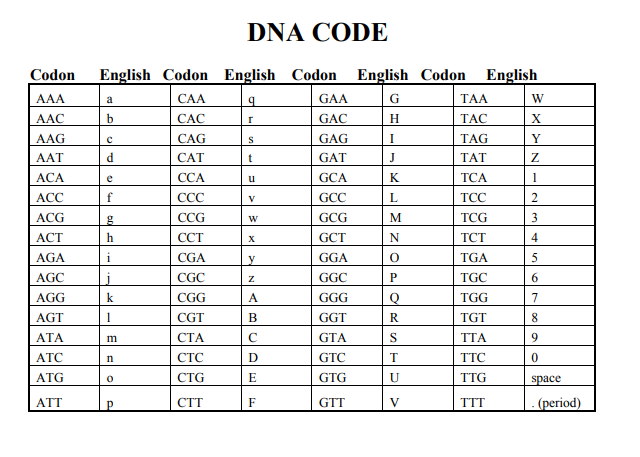
* DNA Codes
When given a sequence with only A, C, G, T , there is an online mapping for these. Try this:
!img/dna_codes.png
!img/genome_coding.jpg
* Extract Thumbnail (data is covered in original image)
If you have an image where the data you need is covered, try the thumbnail:
* [snow][snow]
A command-line tool for whitespace steganography (see above).
* SONIC (audio spectrum)
Some classic challenges use an audio file to hide a flag or other sensiti. SONIC easily shows you spectrogram. __If it sounds like there is random bleeps and bloops in the sound, try this tactic!__
* XIAO Steganography
Being a Windows-specific tool, it is often used in CTFs to hide flags inside audio files. __Take a look if the challenge has some odd strings which might resemble passwords.__
* [Detect DTMF Tones]
Audio frequencies common to a phone button, DTMF:
* Phone-Keypad
Some messages may be hidden with a string of numbers, but really be encoded with old cell-phone keypads, like text messaging with numbers repeated:
!
* [hipshot][hipshot]
A [Python] module to compress a video into a single standalone image, simulating a long-exposure photograph. Was used to steal a [QR code] in a video, displayed through "Star Wars" style text motion.
* [QR code]
A small square "barcode" image that holds data.
* [zbarimg][zbarimg]
A command-line tool to quickly scan multiple forms of barcodes, [QR codes] included. Installed like so on a typical [Ubuntu] image:
* Punctuation marks !, . and ?
I have seen some challenges use just the end of . or ? or ! to represent the Ook esoteric programming language. Don't forget that is a thing!
Cryptography
-----------------
* Cryptii
has multiple decoding tools like base64, Ceaser Cipher, ROT13, Vigenère Cipher and more.
* Keyboard Shift
If you see any thing that has the shape of a sentence but it looks like nonsense letters, and notes some shift left or right, it may be a keyboard shift...
* Bit Shift
Sometimes the letters may be shifted by a stated hint, like a binary bit shift ( x >> 1 ) or ( x << 1 ).
* Re Text
Sometimes a "ciphertext" is just as easy as re text. Don't forgot to check under this rock! You can reverse a string in [Python] like so:
* XOR
ANY text could be XOR'd. Techniques for this are Trey's code, and XORing the data against the known flag format. Typically it is given in just hex, but once it is decoded into raw binary data, it gives it keeps it's hex form (as in \xde\xad\xbe\xef etc..) Note that you can do easy XOR locally with Python like so (you need pwntools installed):
IF YOU KNOW A DECENT CRIB (PLAINTEXT), USE CYBERCHEF TO HELP DETERMINE THE KEY
DO NOT FORGET TO JUST BRUTEFORCE JUST THE FIRST BYTE, OR TWO BYTES OR THREE BYTES.
* Caesar Cipher
The most classic shift cipher. Tons of online tools like this: or use caesar as a command-line tool (sudo apt install bsdgames) and you can supply a key for it. Here's a one liner to try all letter positions:
__Be aware!__ Some challenges include punctuation in their shift! If this is the case, try to a shift within all 255 ASCII characters, not just 26 alphabetical letters!
* caesar
A command-line caesar cipher tool (noted abo in the bsdgames package.
* [Atbash Cipher]
If you have some text that you have no idea what it is, try the [Atbash cipher]! It's a letter mapping, but the alphabet is re: like A maps to Z, B maps to Y and so on. There are tons of online tools to do this (), and you can build it with [Python].
* [ Cipher]
and personal Python code here:
* Gronsfeld Cipher
A of the cipher that uses numbers insteads of letters.
* Beaufourt Cipher
* Bacon Cipher
A substitution cipher that replaces each character with fi from a set of two (A and B is used most of the time). If we look at A as 0 and B as 1 it is a special encoding to binary numbers, where the character A has the value of binary b00000. Easy to recognize, because the ciphertext only contains two characters (e.g.: A and B) and the length of the ciphertext is di by 5. Example: AAABB AAABA ABBAB AAABB AABAA AAAAB AAAAA AAABA ABBAB ABBAA.
Online tool
* Python random module cracker/predictor
helps attack the Mersenne Twister used in Python's random module.
* Transposition Cipher
* RSA: Classic RSA
typically given: n, c, e. _ALWAYS_ try and give to If p and q are able to be determined, use some RSA decryptor; handmade code a here:
* RSA: Multi-prime RSA
When you see multi-prime RSA, you can use calculate phi by still using all the factors.
__If FactorDB cannot find factors, try alpertron:
* RSA: e is 3 (or small)
If e is 3, you can try the cubed-root attack. If you the cubed root of c, and if that is smaller than the cubed root of n, then your plaintext message m is just the cubed root of c! Here is [Python] code to take the cubed root:
* RSA: Wiener's Little D Attack
The telltale sign for this kind of challenge is an enormously large e value. Typically e is either 65537 (0x10001) or 3 (like for a Chinese Remainder Theorem challenge). Some stolen code a here:
* RSA: Boneh-Durfee Attack
The tellgate sign for this kind of challenge is also an enormously large e value (e and n ha size).
Some code for this attack can be found here
* RSA: Chinese Remainder Attack
These challenges can be spotted when given mutiple c cipher texts and multiple n moduli. e must be the same number of given c and n pairs. Some handmade code here:
* [LC4]
This is an adaptation of RC4... just not. There is an implementation a in Python.
* Elgamal
* Affine Cipher
* Substitution Cipher (use quip quip!)
* Railfence Cipher
* [Playfair Cipher]
racker:
* Polybius Square
* The Engima
* AES ECB
The "blind SQL" of cryptography... leak the flag out by testing for characters just one byte away from the block length.
* Two-Time Pad
* [International Code of Signals Maritime]
First drafted by the British Board of Trade in 1855 and adopted as a world-wide standard on 1 January 1901. It is used for communications with ships, but also occasionally used by geocaching mystery caches (puzzle caches), CTFs and logic puzzles. You may want to give a look at the tool [maritime flags translator].
!
* Daggers Cipher
The daggers cipher is another silly text-to-image encoder. This is the key, and you can
find a decoder on
!img/dagger_cipher.png
* Hylian Language (Twilight Princess)
The Hylian language is another silly text-to-image encoder. This is the key, and you can
find a decoder on
!img/hylian.png
* Hylian Language (Breath of the Wild)
The Hylian language is another silly text-to-image encoder. This is the key, and you can
find a decoder on
!img/botw.jpg
* Sheikah Language (Breathe of the Wild)
The Sheikah language is another silly text-to-image encoder. This is the key, and you can
find a decoder on
!img/sheikah.png
* Hexahue Alphabet
The hexhue is an another tex-to-image enocder. you can find a decoder
on
!img
Networking
---------------
* [Wireshark]
The go-to tool for examining [.pcap][PCAP] files.
* [Network Miner]
Seriously cool tool that will try and scrape out images, files, credentials and other goods from [PCAP] and [PCAPNG] files.
* [PCAPNG]
Not all tools like the [PCAPNG] file format... so you can convert them with an online tool or from the command-line with the editcap command that comes with installing [Wireshark]:
* [tcpflow][tcpflow]
A command-line tool for reorganizing packets in a PCAP file and getting files out of them. __Typically it gives no output, but it creates the files in your current directory!__
* [PcapXray]
A GUI tool to network traffic.
PHP
------------
* Magic Hashes
A common in [PHP] that fakes hash "collisions..." where the == operator falls short in [PHP] type comparison, thinking e that follows 0e is considered scientific notation (and therefore 0). More info can be found here: but below are the most common breaks.
| Plaintext | MD5 Hash |
| --------- | -------- |
|240610708|0e88736854|
|QLTHNDT|0e39051580|
|QNKCDZO|0e19903391|
|PJNPDWY|0e31701704|
|NWWKITQ|0e60817689|
|NOOPCJF|0e45791911|
|MMHUWU6|
|MAUXXQC|0e01845361|
|IHKFRNS|0e37988570|
|GZECLQZ|0e28225676|
|GGHM3|
|GEGHBXL|0e84713578|
|EEIZDOI|0e38479162|
|DYAXWCA|0e74063001|
|DQWRASX|0e99582643|
|BRTKUJZ|00e7276704|
|ABJIH6|
|aaaXXAYW|0e08832284|
|aabg7XSs|0e00965295|
|aabC9RqS|0e09536299|
|0e215962017|0e08577824|
| Plaintext | SHA1 Hash |
| --------- | --------- |
|aaroZmOk|0e66735|
|aaK1STfY|0e11393|
|aaO8zKZF|0e65668|
|aa3OFF9m|0e04729|
| Plaintext | MD4 Hash |
| --------- | --------- |
|bhhkktQZ|0e75918567|
|0e00889|0e59233446|
|0e0000089|0e49768529|
|000|0e31181899|
* preg_replace
A bug in older of [PHP] where the user could get remote code execution
* [phpdc.phpr][phpdc.phpr]
A command-line tool to decode [bcompiler][bcompiler] compiled [PHP] code.
* php://filter for Local File Inclusion
A bug in [PHP] where if GET HTTP in the URL are controlling the na of the web page, perhaps the source code is include-ing other files to be served to the user. This can be manipulated by using PHP filters to potentially retrie code. Example like so:
* data://text/plain;base64
A [PHP] stream that can be taken ad of if used and e as an include resource or e. Can be used for RCE: check out this writeup: ... TL;DR:
PDF Files
-------------
* pdfinfo
A command-line tool to get a basic synopsis of what the [PDF] file is.
* pdfcrack
A comand-line tool to __recover a password from a PDF file.__ Supports dictionary wordlists and bruteforce.
* pdfimages
A command-line tool, the first thing to reach for when given a PDF file. It extracts the images stored in a PDF file, but it needs the name of an output directory (that it will create for) to place the found images.
* [pdfdetach][pdfdetach]
A command-line tool to extract files out of a [PDF].
Forensics
-----------
* Python bytecode uncompyle6
To decompile bytecode, use uncompyle6. There is one special argument (I think -d or something???) that can ha if the default operation does not work. Do not give up hope when working with obvious Python bytecode. EasyPythonDecompiler might work, or perhaps testing with uncompyle
* Keepass
keepassx can be installed on Ubuntu to open and explore Keepass databases. Keepass databases master passwords can be cracked with keepass2john.
* [Magic Numbers]
The starting that identify a file format. These are often crucial for programs to properly read a certain file type, so they must be correct. If some files are acting strangely, try their [magic number] with a trusted list of file signatures.
* [hexed.it][hexed.it]
An online tool that allows you to modify the hexadecimal and binary of an uploaded file. This is a good tool for correcting files with a corrupt [magic number]
* [dumpzilla][dumpzilla]
A [Python] script to examine a .mozilla configuration file, to examine downloads, bookmarks, history or bookmarks and registered passwords. Usage may be as such:
* Repair image online tool
Good low-hanging fruit to throw any image at:
* foremost
A command-line tool to car out of another file. Usage is foremost [filename] and it will create an output directory.
* binwalk
A command-line tool to car out of another file. Usage to extract is binwalk -e [filename] and it will create a _[filename]_extracted directory.
* [hachoir-subfile][hachoir-subfile]
A command-line tool to carve out files of another file. Very similar to the other tools like binwalk and foremost, but always try e!
* [TestDisk]
A command-line tool, used to reco files from a file system image. Handy to use if given a .dd and .img file etc.
* [photorec]
Another command-line utility that comes with testdisk. It is file data recovery software designed to recover lost files including video, documents and archives from hard disks, CD-ROMs, and lost pictures (thus the Photo Recovery name) from digital camera memory. PhotoRec ignores the file system and goes after the underlying data, so it will still work even if your media's file system has been se damaged or reformatted.
* [Analysis Image] [']
Forensically is free online tool to analysis image this tool has many features like Magnifier, Clone Detection, Error Le, Noise Analusis, le, Meta Data, Geo tags, Thumbnail Analysis , JPEG Analysis, Strings Extraction.
PNG File Forensics
--------------------
* pngcheck
A command-line tool for "checking" a [PNG] image file. Especially good for checksums.
* pngcsum
Correct the CRC on all of the parts of a [PNG] image file.
*
Utility to try and correct a [PNG] file. NOTE... this will NOT SAVE your file as new one. YOU HAVE TO SHOW the file (enter y when using the script]) to actually view the new image.
APK Forensics
---------------
* [apktool][apktool]
A command-line tool to extract all the resources from an APK file. Usage:
* [dex2jar][dex2jar]
A command-line tool to convert a J.dex file to .class file and zip them as JAR files.
* [jd-gui][jd-gui]
A GUI tool to decompile Java code, and JAR files.
Web
----------------
* robots.txt
This file tries to hide webpages from web crawlers, like Google or Bing or Yahoo. A lot of sites try and use this mask sensiti or folders, so it should always be some where you check during a CTF.
* [Edit This Cookie]
A web browser plug-in that offers an easy interface to modifying [cookies]. ___THIS IS OFTEN O, WITHOUT CHANGING THE VALUE OF THE COOKIES... BE SURE TO FUZZ E, INCLUDING COOKIE !___
* Backup pages ( ~ and .bak and .swp )
Some times you may be able to dig up an old of a webpage (or some PHP source code!) by adding the usual backup suffixes. A good thing to check!
* /admin/
This directory is often found by directory scanning bruteforce tools, so I recommend just checking the directory on your own, as part of your own "low-hanging fruits" check.
* /.git/
A classic CTF challenge is to leave a git repository live and a on a website. You can see this with nmap -A (or whate script catches it) and just by trying to view that specific folder, /.git/. A good command-line tool for this is GitDumper.sh, or just simply using [wget][wget].
Sometimes you might Bazaar or Mercurial or other distributed control systems. You can use for those!!
* [GitDumper.sh][GitDumper.sh]
A command-line tool that will automatically scrape and download a [git] repository hosted online with a given URL.
* Bazaar .bzr
If you see a publically accessible .bzr directory, you can use bzr branch output-directory to download it. Or, use this utility:
* [XSS]/[Cross-site scripting]
XSS Filter E Cheat Sheet. [Cross-site scripting], where the user can control rendered [HTML] and ideally inject [Ja] code that could drive a browser to any other website or make any malicious network calls. Example test payload is as follows:
Typically you use this to steal cookies or other information, and you can do this with an online requestbin.
* new usefull XSS cheat sheet : '
* CloudFlare Bypass
If you need to script or automate against a page that uses the I'm Under Attack Mode from CloudFlare, or DDOS protection, you can do it like this with linked Python module.
* [XSStrike]
A command-line tool for automated [XSS] attacks. Seems to function like how [sqlmap] does.
* [wpscan][wpscan]
* A Ruby script to scan and do reconnaissance on a [Wordpress] application.
* Mac AutoLogin Password Cracking
Sometimes, given an Mac autologin password file /etc/kcpassword, you can crack it with this code:
* XXE : XML External Entity
An XML External Entity attack is a type of attack against an application that parses XML input and allows XML entities. XML entities can be used to tell the XML parser to fetch specific content on the server.
We try to display the content of the file /flag :
* Wordpress Password Hash Generator
If you make it into a Wordpress database and can change passwords, reset the admin password to a new hash: This will let you login to /wp-admin/ on the site.
* Cookie Catcher
* requestb.in
A free tool and online end-point that can be used to catch HTTP requests. Typically these are controlled and set by finding a [XSS] .
* hookbin.com
A free tool and online end-point that can be used to catch HTTP requests. Typically these are controlled and set by finding a [XSS] .
* [sqlmap][sqlmap]
A command-line tool written in [Python] to automatically detect and exploit SQL injection points.
* Flask Template Injection
Try {{config}} to leak out the secret key, or start to climb up the Python MRO to acheive code execution.
* SQL IF statements
These are handy for some injections and setting up some Blind SQL if you need to. Syntax is like SELECT ( IF ( 1=1, "Condition successful!", "Condition errored!" ) )
* Explicit SQL Injection
* Blind SQL Injection
* MongoDB
Get MongoDB properly installed:
Connect to a remote server with credentials:
Print out the database info:
* gobuster
* DirBuster
* nikto
* Burpsuite
* AWS / S3 Buckets
You can try and dump an AWS bucket like so. The --no-sign-request avoids the need for credentials, and --recursive will grab e possible.
i. e. aws s3 cp --recursi s3://tamuctf .
Reverse Engineering
-------------------
* ltrace and strace
Easy command-line tools to see some of the code being executed as you follow through a binary. Usage: ltrace ./binary
* Hopper
Hopper Disassembler, the reverse engineering tool that lets you disassemble, decompile and debug your applications.
* Binary Ninja
Clean and easy with multithreaded analysis. Support multiple architectures, platforms, and compilers.
* gdb
Fast and powerful debugger for UNIX system. More powerful if this tool is equipped with PEDA.
* IDA
It's one of popular debugger and disassembler tool with rich of features, cross platform, multi-processor disassembler.
* radare2
Portable tool for hex editor, binary analysis, disassembler, debugger, etc.
* Ghidra
New RE tool de by NSA with the same feature as IDA
* Compiling & running ASM code:
You can convert ASM functions from assembly and run them as C functions like the following:
asm4.S
asm4.c
bash
PowerShell
-------------
* [nishang]
A PowerShell suite of tools for pentesting. Has support for an ICMP reverse shell!
* [Empire]
HUGE PowerShell library and tool to do a lot of post-exploitation.
* Bypass AMSI Anti-Malware Scan Interface
Great tool and guide for anti-virus e with PowerShell.
Windows Executables
-------------
* [pefile][pefile]
A [Python] module that examines the headers in a Windows [PE (Portable Executable)][PE] file.
* [dnSpy]
A [Windows] GUI tool to decompile and reverse engineer [.NET] binaries
* [PEiD][PEiD]
A [Windows] tool to detect common packers, cryptors and compilers for [Windows][Windows] [PE][PE]
* jetBrains .NET decompiler
* AutoIT con
When debugging AutoIT programs, you may get a notification: "This is a compiled AutoIT script". Here is a good thing to use to decode them:
Python Re
------------
* Easy Python Decompiler
A small .exe GUI application that will "decompile" [Python] bytecode, often seen in .pyc extension. The tool runs reliably on [Linux] with [Wine].
* Pyinstaller Extractor
PyInstaller Extractor is a Python script to extract the contents of a PyInstaller generated Windows executable file. The contents of the pyz file (usually pyc files) present inside the executable are also extracted. Usage is python3 pyinstxtractor.py <filename>. We can later decompile the bytecode in .pyc using uncompyle6
Binary Exploitation/pwn
--------------
* Basic Stack O
Use readelf -s <binary> to get the location of a function to jump to -- o in Python, find offset with dmesg, and jump.
* printf
A C binary , where printf is used with user-supplied input without any arguments. Hand-made code to exploit and o functions: and a video walkthrough explaining:
* [formatStringExploiter][formatStringExploiter]
A good [Python] module to streamline exploiting a [format string ]. THIS IS NOT ALWAYS A GOOD TACTIC...
* 64-bit Buffer O
64-bit buffer o challenges are often difficult because the null bytes get in the way of memory addresses (for the function you want to jump to, that you can usually find with readelf -s). But, check if whether or not the function address you need starts with the same hex already on the stack (in rsp). Maybe you only have to write two or three bytes after the o, rather than the whole function address.
Miscellaneous
----------
* Payload All The Things
Super useful repo that has a payload for basically every sceario
* Punchcards(/Punch cards)
Sometimes it sucks to do these manually, but you can here:
* GameBoy ROMS
You ha to run GameBoy ROMs... one is using , the oher is RetroArch (which is supposedly better):
* References to DICE, or EFF
If your challenges references "EFF" or includes dice in some way, or showcases numbers 1-6 of length 5, try This could refer to a passphrase generated by dice rolls a here:
* [Base64], [Base32], [Base85], [Base91]
* Base65535
Unicode characters encoding. Includes a lot of seemingly random spaces and chinese characters!
* Base41
* Mac / Macintosh / Apple Hidden Files .DS_Store ds_store_exp
On Mac computers, there is a hidden index file .DS_Store. You might be able to find it if you have an LFI or something of the like. A good tool to track these down on a website is the DS_Store Exposer:
* Wordsearches
Some CTFs have me sol as part of a challenge (TJCTF 2018). This code is super helpful:
* "Unflattening" Base64 in lowercase or uppercase
Some time ago we needed to recover the original Base64 string from one that is in all lowercase or all uppercase. Caleb wrote a good script to smartly do this:
* Password-protected Zip Files: [fcrackzip][fcrackzip] and zip2john.py
Use
* 15 Puzzle
A sliding puzzle that consists of a 4x4 grid with numbered square tiles, with one missing, set in a random order. It was in in SharifCTF to determine if a group of these puzzles was solvable:
* SETUID Binary Methodology
Don't forget to check "simple" things --- it doesn't need to be a pwn or binary exploitation challenge, keep in mind IT DOES NOT use a secure PATH like sudo.
* Chrome Password Dump
A [Windows] command-line tool to dump passwords saved with Google Chrome.
* img2txt
A command-line tool to convert an image into ASCII for the terminal. Can be installed like so:
* Strange Symbols/Characters
Some CTFs will try and hide a message on a picture with strange symbols. Try and Google Reverse Image searching these. They may be Egyptian Characters:
!
* Bitcoin
You might see a private Bitcoin key as a base64 encoded SHA256 hash, like this:
Decoded, it is a hash: 5a2a99d3baa07bfbd08b961205dcae887fb0acf9f272929baa7911faa4ae7751.
If you can find an AES ECB key along with (usually represented in hex or another encoding), you can decipher like so:
* Missing ls or dir commands
If you cannot run ls or dir, or find or grep, to list files you can use
* restricted bash (rbash) read files
If you are a restricted shell like rbash you can still read any file with some builtin commands like mapfile:
Jail Breaks
----------
Sometimes you're jailed in an en where you can potentially execute code.
* Python 3().__class__.__base__.__subclasses__() - Gi to object subclasses
Trivia
-------------
* Tri: a reliable mechanism for websites to remember stateful information. Yummy!
* A group of binary-to-text encoding schemes that represent binary data in an ASCII string format by translating it into a radix-64 representation
* This C of concept Shows NSA.go "Ne Give You Up," by 1980s heart-throb Rick Astley.
* The British used this machine to crack the German Enigma machine messages.
* What is the Windows LM hash for a blank password?
* for Windows LM hashing, after the password is split into two 7 character chunks, they are used as DES keys to encrypt what string?
* I am the person responsible for stopping one of the worst ransomware. Who am I?
* I am used by devices for sending error messages. Who am I?
* We are a CTF team which is open to e. Who are we?
[steghide]:
[snow]:
[cribdrag.py]:
[cribdrag]:
[pcap]:
[PCAP]:
[Wireshark]:
[Network Miner]:
[PCAPNG]:
[pcapng]:
[pdfcrack]:
[GitDumper.sh]:
[pefile]:
[Python]:
[PE]:
[Portable Executable]:
[hipshot]:
[QR code]:
[QR codes]:
[QR]:
[zbarimg]:
[Linux]:
[Ubuntu]: )
[Wine]: )
[Detect DTMF Tones]:
[dnSpy]:
[Windows]:
[.NET]:
[ Cipher]:
[PDF]:
[Playfair Cipher]:
[phpdc.phpr]:
[bcompiler]:
[PHP]:
[GET]:
[pdfdetach]:
[sqlmap]:
[hachoir-subfile]:
[wget]:
[git]:
[Cross-site scripting]:
[XSS]:
[HTML]:
[Ja]:
[PEiD]:
[wpscan]:
[Ruby]:
[Wordpress]:
[dumpzilla]:
[hexed.it]:
[Magic Numbers]: )#Magic_numbers_in_files
[Magic Number]: )#Magic_numbers_in_files
[Edit This Cookie]:
[cookie]:
[cookies]:
[formatStringExploiter]:
[format string ]:
[printf ]:
[Java]: )
[JAR]: )
[OpenStego]:
[Stegsolve.jar]:
[Stegsolve]:
[tcpflow]:
[PcapXray]:
[Atbash Cipher]:
[TestDisk]:
[PNG]:
[jd-gui]:
[dex2jar]:
[apktool]:
[RCE]:
[remote code execution]:
[arbitrary code execution]:
[XSStrike]:
[nishang]:
[Malboge]:
[Piet]:
[npiet]:
[LC4]:
[Empire]:
[Base64]:
[Base32]:
[Base85]:
[Base91]:
[fcrackzip]:
[zsteg]:
[jsteg]:
[jstego]:
[StegCracker]:
[StegSeek]:
[Base41]:
[Base65535]:
[Easy Python Decompiler]:
[photorec]:
[smbmap]:
[oletools]:
[impacket]:
[Responder]:
[Responder.py]:
[International Code of Signals Maritime]:
[maritime flags translator]:
[static-binaries]:
项目信息
开发语言:未知
Star 数:2931
技术要点
该项目属于CTF思路方向的开源资源,代码结构清晰,适合安全研究人员学习参考。项目围绕This repository aims to hold suggestions (and hopefully/eventually code) for CTF challenges. The "project" is nicknamed Katana.展开,提供了可运行的实现,对理解相关安全机制、工具原理与攻防技术具有较高的研究价值。
从技术实现角度看,此类项目的核心在于对底层原理的深入理解与工程化落地。开发者在研究过程中可以结合官方文档与社区讨论,梳理项目的初始化流程、核心模块职责与数据流转,逐步掌握其中的技术细节与设计思路。
使用与学习建议
1. 下载源码压缩包,解压到本地环境。
2. 根据项目类型准备对应的运行环境与依赖。
3. 按照 README 中的步骤完成配置与部署。
4. 在隔离的测试环境中运行验证,避免影响生产系统。
免责声明
本资源来源于开源社区,仅供安全研究、技术学习与合法授权范围内的攻防演练使用,请勿用于任何非法或侵害他人权益的用途。使用本项目产生的一切后果由使用者自行承担。
| 资源标题 | ctf-katana - This repository aims to hold suggestions (and hope |
| 所属分类 | CTF思路 |
| 发布作者 | admin |
| 发布时间 | 2026-10-05 23:35:03 |
| 下载权限 | 免费下载 |
| 附件数量 | 2 个下载链接 |
| 浏览次数 | 308 |
| 讨论数量 | 0 |
| 主题状态 | 正常讨论中 |