 CTF思路
点击放大
how-to-exploit-a-double-free - How to exploit a double free vulnerability in 2021
项目说明
This bug doesn’t exist on x86: Exploiting an ARM-only race condition
*How to exploit a double free and get a shell. "Use-After-Free for dummies"*
By cts
In this article, I'll teach you about real-world, modern binary exploitation, and a little about processor microarchitecture as well :D
You will learn how to exploit a double free or exploit a Use After Free .
My CTF team, perfect blue, just concluded hosting our annual CTF, pbctf. One challenge I contributed was centered around a race condition that only existed on ARM. In this article I'll explain the bug, why it doesn't happen on x86 processors, and finally how it can be exploited to land a shell.
This article is quite long, so I' bookmarks. It consists of three main sections:
1. Walkthrough of the binary, and a peek into the mindset of a researcher.
2. Memory ordering, lock-free programming, and how this can lead to sneaky bugs.
3. Exploiting an object lifetime heap corruption bug. How to get arbitrary read and write and finally, a shell.
!exploit mp4
0. Introduction
Let's get the show on the road! Might as well start with the challenge description from the CTF:
<img src=" style="width: 50%;">
The pwnable, or the binary, that players are tasked to exploit, is a simple command-line application accessible through netcat. When you connect, you're greeted with a prompt:
The pwnable is essentially a fancy multi-threaded strlen() wrapper, designed around the consumer-producer pattern. The main functionality lets you 1) submit some strings, 2) wait for the program to process the strings, and 3) view and delete results. Our goal is to exploit the binary and read the flag from a file on disk (flag.txt).
To aid in exploitation, the source code for this challenge was provided with the binary and libc. This is pretty realistic: many major targets nowadays are open source. Examples include Chromium, Firefox, Linux, XNU, and e offers symbols.
But what's the process of *actually finding and exploiting a * like?
Well, if you want to find bugs, then it's time to get your hands dirty and start reading code. Nowadays with e fuzzed to death, tools alone usually won't get you the good bugs that are worth big money. So let's dig in.
1. Source code audit
0. Internal data structures
When exploiting a new target it's absolutely crucial to understand all of the nitty-gritty details about the objects we can play with. In the pwnable, the two main data structures are a Request object and a "thread-safe" ring buffer.
#### Request object
The Request object is little more than a RAII char* wrapper. It's 16 bytes big.
char *str will also get double freed. Depending on the situation, this can either be useful or a hindrance.strdup allocation. We can play with whatever size bins we want.⟹ Key obser: We can play with the 16-byte bin that is used to service Request objects from the heap. If we could somehow get a dangling pointer to a Request object, we could corrupt that Request and then carefully use the corrupted object's o char *str pointer to perform arbitrary pointer operations.
*Well okay*, if our goal is to corrupt one of these Request objects, we should probably look for some "complicated-looking" part of the program for bugs to do that with.
#### RingBuffer object
This is a supposedly "lock-free, thread-safe" generic queue with a fixed-size backing circular array. Writing ad the head pointer; reading ad the tail pointer; it blocks when writing while full or reading while empty. It's what you would expect.
Let's check out the consumer thread side of things.
All of the index arithmetic checks out, and the queue takes precise care of object lifetimes, e as far as to explicitly specify std::move. What about the producer side?
Okay, it wastes a slot to distinguish between full and empty; however this isn't a safety issue. And it looks just as careful as the other side. It looks like this queue was coded very carefully. There are no clear buffer o. On x86 in fact, it's pretty much correct[^7]---if you compile the gi code on a desktop, the program is essentially bug-free. So that's discouraging. But what can we le still?
[^7]: OK yes, the code still needs to have a compiler barrier to prevent compiler reordering. But both clang and gcc did not reorder on O3, probably because head and tail are both marked (although in general does not guarantee the absence of reordering). Also, it will not work if there are multiple producers or consumers. The point is, if you compile the code on x86 with -O3 on clang 10 or gcc 9.3.0, the resulting binary is not .
Obser 1: For wq, E a Request* object is std::moved when it's read back out, it is *not* erased from the backing array. The pointers are still chilling in there (unlike std::unique_ptr, which zeroes its contents when moved). They will only be o once the ring buffer wraps around again and those slots are filled with new elements.
Obser 2: This lock-free, business is ob fishy. The programmer clearly expects things to happen in a very specific, precise order. If we could somehow those assumptions, it may lead to a race condition. It's a common misconception that acts like a barrier. Although some compilers may respect that, it is not a guarantee. And of course, the challenge name ("Out of Order") is a hint here. Since the most complex part of the program is often the most suspect, we'd better pay special attention to this code.
⟹ Key obser: If we could somehow get the ring buffer to return the stale contents of an uninitialized slot from the backing array, this could lead to a dangling pointer which points to an already-referenced Request object.
!dangling pointer diagram
1. "New job"
*Okay*, This lets us spray a lot of new Request objects into the work queue, and quite quickly too. Who is processing these requests?
*Ahh*, so a second thread reads from the other end of the FIFO, performs the work (strlen), and queues the results to the main thread on a results queue. The two threads communicate with a pair of half-duplex queues.
!threads communicate with two FIFOs diagram.
Where do the results go?
#### 2. "Recei"
Nothing too crazy here, we receive back std::unique_ptr<Result> pointers from the results queue rq, and jam them into a . This thereby extends the object lifetime of the Result indefinitely until we free them.
#### 3. "Manage results"
It prints out all of the results for us, and lets us choose one to play with.
#### 3.1. "View result"
This lets us read the char *str pointer. If we could control the value of str, we could use this to arbitrary read.
#### 3.2. "Delete result"
It calls std::unique_ptr<Request>::reset, which destructs the Request and frees it. So we can totally control the object lifetime of Request objects.
#### 4. "Clear results history"
I guess this lets us reset the program if things don't go our way. If we have some kind of UAF (Use-After-Free) or heap corruption situation going on, this will probably cause a segmentation fault or abort in free().
---
After a brief audit of the source code, we can see that the program's functionality is little more than a thin facade in front of glibc heap operations. This "heap note" interface might seem bare-bones, but it closely models how modern heap exploitation works. Typically, attackers will collect primitives for spraying and freeing memory and use them in concert with a bug like UAF or Double Free to construct a working exploit. Examples of popular primitives in "real life" targets include Ja ArrayBuffers in browser exploitation, or IOSurface objects in iOS Kernel exploitation.
Still, though, it seems like we've hit a brick wall. We have no in sight, and the code quality looks excellent. Where do we go from here? Before we can progress any further, we need to take a brief detour...
2. Lock-free programming
And now for something completely different! Welcome to the land of Systems Architecture.
In cool leg, we teach CS undergrads to protect their multi-threaded data structures with a lock. This is probably a Test-and-Set (TAS) lock, and if they went to a good uni, they have a homework assignment where they are told to use lock cmpxchg to implement a mutex. Once they're all grown up however, (i.e., grad school) we teach them the truth: Locks are slow. Specifically, lock contention is slow.
*(Disclaimer: the following explanation is an o. Please forgive me if I made any errors)*
Lock contention is slow because of cache coherence. To synchronize two cores, the processors need some shared resource. So you put the lock somewhere in main memory. Of course, any reasonable expectation of performance in 2021 is not possible without caching. Typically, every core has its own local cache (even if there is possibly a shared last-le, depending on the architecture). So every core has its own view of memory.
<p align="center"><img src="./res/caches.jpg" width="85%"><br /><i>Example cache architecture</i></p>
It would be bad if different cores had conflicting for the same cache line at the same time. To alleviate this, hardware designers usually guarantee cache coherence to programmers. Cache coherence guarantees that (1) updates to a gi line in one core are also seen by other cores in a timely fashion, and that (2) read/write transactions to a gi line are serialized. This lets us, in theory, implement a lock just using a single cache line with some atomic instructions.
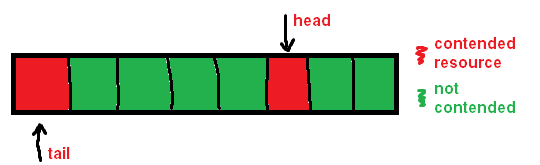
This sounds great and all, but how does cache coherence *actually happen in real life*? How is cache coherence implemented in hardware? Well, cores are hooked up in an on-chip network so they can all talk to each other. This interconnect can be implemented in a of topologies ranging from a shared bus to a crossbar switch or a ring. Over this interconnect, the cores pass messages to each other in protocols such as MOESI. At the end of the day however, the cores are going share some physical components. Whatever this contended resource is, they are going to have to take turns which slows things down.
So lock contention slows things down. For some high performance applications, programmers opt for lock-free programming techniques. How can we write a multi-threaded code without using locks?
Let's consider the simplest possible example. Thread 1 wants to pass some information (let's say, a single int value) to Thread 2. How does Thread 2 know when the value is ready? It might look like this:
| Thread 1 | Thread 2 |
| ----------- | ----------- |
| value = ?? | value = ?? |
| --- | --- |
| | while (ready != 1); |
| value = 123 | ... |
| ready = 1 | ... |
| | print(value)|
Wow amazing, inter-thread communication with no locks. This assumes, of course, that nothing happens out of order, and updates are globally immediately, a topic we will return to later.
Let's return to our original consumer-producer FIFO example. The producer puts new work items at the head of the FIFO, and the consumer eats them out of the tail. Notice how the two threads are using different parts of the FIFO---they aren't using the entire FIFO at once. Therefore, we don't need a lock to enforce an atomic operation over the whole FIFO. The operations of adding and removing from the FIFO can be lock-free, provided we do it carefully.
!lock free fifo diagram
Not all operations can be implemented in a lock-free manner. For example, if we wanted to count the number of occurrences of an element in a FIFO, or calculate a sum over all elements, this probably needs a lock over the entire FIFO.
Acquire and Release semantics
In our earlier example with the value and ready , we assumed that Thread 2 would not see ready == 1 until after the write value = 123 is . Otherwise, it might jump the gun and receive an uninitialized value for value.
In this example, ready = 1 has write-release semantics and the while (ready != 1); has read-acquire semantics. Basically these semantics enforce the order we expect: the write-release ready = 1 shouldn't be reordered before the other write, value = 123, and the read-acquire ready != 1 shouldn't be reordered before the other read, print(value).
In general, acquire semantics means the operation needs to happen before other operations; release semantics means the operation needs to happen after other operations. An easy way to remember it is to think of a traditional mutex: you acquire it before you do stuff, and release it once you're done.
But why do we need acquire and release semantics anyways? I thought you said we ha coherency to protect us from all that bad stuff.
3. Out-of-Order execution
We teach undergrads that the CPU just executes a linear instruction stream. This is not the case. Nowadays, high-performance processors, like those found in desktops, servers, and phones, are massively out-of-order to exploit instruction-le as much as possible. They perform all sorts of tricks to impro. These tricks include re-arranging the instruction stream, executing multple instructions (micro-ops really) simultaneously in parallel, speculati, register renaming, memory reordering, and store buffering. Although hardware designers try to hide the effects of these tricks from the programmer, they often crop up when writing code that depends on low-le, such as lock-free code.
I'll briefly highlight the ones that are most relevant to our pwnable:
Re-arranging the instruction stream
Suppose you have a sequence of instructions. The CPU doesn't care so much as to the order you feed it instructions, but moreso the data dependency chains among those instructions.
Here the processor really does not care that you put the add rbx, rax before the add rcx, rdx. The add with rcx and rdx doesn't depend on the value of rax, which has a long dependency chain of instructions needed to compute the final value. It will happily execute instruction 6 before instruction 5.
Store buffering
Suppose you have the following code. The CPU doesn't wait for the store to memory to actually finish, it just keeps track of this write in an internal store buffer until the write actually completes with the cache.
It can happily chug through this sequence of instructions without any stalls (assuming sufficient hardware resources). When it gets to instruction 5, even if the store hasn't yet completed, it will recall the written value to [rbx] from the load-store buffer.
Store buffering also means you can't ha races on the same memory location happen within the same processor due to out-of-order execution. The load-store buffer should serialize all of the transactions to a single cache line within a single processor. In other words, the store buffer is also maintaining the illusion of program ordering within a single cache line within a single core.
Memory reordering
OK, this is what we have been hinting at so far this whole time. Depending on the architecture, the processor might perform memory operations out-of-order. On weaker memory models, such as ARM, pretty much any operation (such as a load or a store) can get reordered with any other, excluding data dependencies. Meanwhile, x86 has an very rigid memory model, and pretty much the ONLY reordering that can happen is reordering older stores with newer loads (StoreLoad reordering).
For example, consider the example from before. Assume all live on different cache lines.
On ARM, the writes (1) and (2) can get reordered, so the write to ready is before the write to value. On Thread 2, this can cause the read to value (4) to happen before the written value 123 is . In other words, due to the re-ordering, Thread 2 will see an uninitialized value.
On x86, this kind of re-ordering is impossible. In fact, on x86 the memory model is so strong that stores are totally ordered---there is a single global One True Ordering for all stores. So this bug would not happen, e any memory barriers.
Now we are finally ready to tackle the nature of the original pwnable.
4. Race condition
We said earlier that the correctness of the pwnable's ring buffer is contingent on all operations happening in the correct order. Let's revisit the reader and writer-side code and think about how they interact.
The critical question here is: "What is stopping the reader side from reading stale (uninitialized) elements?" In theory, read should block if the buffer is empty. It does this by checking the global head against the value tail_local[^1]. Meanwhile, the writer thread only updates head *after* it writes the data to the backing buffer. As long as these two writes are not re-ordered, e should be fine.
[^1]: tail_local is stored in a register, so there is no possibility of races on it. Same with head_local.
Going back to what we learned about lock-free programming, here we can see that the write head = head_local (2) needs to ha semantics. But it doesn't; head is simply a int, and there's no barriers in the code to enforce this. On x86, we can get away with this because all stores are globally ordered, so the write (1) can ne after (2). However, on ARM, there's no guarantee that this order will be maintained without an appropriate memory barrier.
Checking in IDA Pro, we see that indeed there are no barriers:
So in theory, if the consumer thread is constantly consuming from the ring buffer in a tight loop while the producer thread adds a new element, this sequence of events could be possible:
1\. !double free sequence 2. !double free sequence
3\. !double free sequence 4. !double free sequence
5\. !double free sequence 6. !double free sequence
7\. !double free sequence
In this sequence of events, the ring buffer returned a pointer to the same object twice. Remember that diagram from earlier? Since now the user is able to control this object using two different references, this guarantees that a dangling pointer will exist at some point in the future. The attacker can then use the dangling pointer to do UAF.
!big race diagram
To trigger the race in practice, we'll send 20,000 new Requests all in quick succession, and hope that the consumer thread will read back one of the Requests twice. To tell if this has happened, we'll use an incrementing unique value for each Request's body. That way, if we see the same string twice in the results, then we'll ha proof that some undefined behavior happened. To code our exploit, we'll use pwntools as usual:
Getting the race to actually happen depends on the payload size, the processor, the current CPU load, the temperature of the device, the phase of the moon, etc. Such is life as an exploit de in 2021.
<p align="center"><a href=" src="./res/meme.png"></a></p>
Here's our script in action:
The output means that two results, #1768, and #1512, both refer to the exact same object! After the race, it drops us to an interactive mode we can manually play with. If we inspect the results:
To prove that they're definitely aliasing the same object, let's delete one of them and see what happens to the other one.
This conclusively proves that we can create dangling pointers with our aliased refs. Naturally, we can use this to double free, UAF, etc. Now what?
5. Heap exploitation tutorial
Binary exploitation is like putting together a puzzle. Like a chess player, an exploit de has many little "tactics" for each target. They piece together these indi techniques to form a larger strategy.
<p align="center"><img src="./res/jigsaw.png" width="50%"><br /></p>
Small manipulations, like filling or draining a thread-local allocator cache, or rearranging a free list, are examples of such so-called "tactics". You carefully combine many of these little operations to inch forwards in your o exploit strategy. The idea is that they give us an inch; we take a mile. One tiny bug leads to an o object; we need to amplify that to get stronger primiti we get what we need.
Let's get back to thinking concretely. In our buggy pwnable, we have the following situation after the race succeeds. What can we do with it?
- Double free'd chunks that got reallocated. As a result, two results refer to the same Request object.
- By results, we can read back the contents of an allocated chunk.
- By making a new job, we can allocate arbitrary size chunks and write (nearly) arbitrary contents there.
- By deleting results, control o' lifetime (free them whenever we want).
- No PIE: pointers in the main binary are constant between multiple executions. I.e., no ASLR on the pwnable itself, but libc, heap, and stack addresses are randomized.
Although it seems like we have a lot of control, it's no walk in the park. We need more powerful primitives to do anything meaningful. How do we get there?
Brainstorming a suitable exploit strategy
Let's work backwards.
First of all, assuming we had an arbitrary write (aka *write-what-where*), we still need to know *what* to write and *where* to write. For us, the win condition is reading the flag from disk. For challenges like this, the easiest way is to just launch a shell; i.e., system("/bin/sh"), then typing in cat flag. This is easy since it in only 1 function call: o any suitable[^2] function pointer is sufficient.
[^2]: For us, "suitable" means "the first argument is a string pointer and we can control the contents".
If we want to go down this route, we need to find an address for system we can call. Luckily, the main binary wasn't compiled with PIE, so it's always mapped at a known address. This makes things a lot easier for us. Still, since system isn't imported by the main binary, we need a libc leak so we can find its address in libc. Fortunately, the dynamic linker will place function pointers for resol in the main binary's .got.plt section. Those pointers are at a static address, so if we had an arbitrary read, we could get a libc leak (and system address) that way.
!.got.plt
As for where to write, since the binary is only partial RELRO, we can o .got.plt pointers. Alternatively, we can o the libc global free_hook, which is called whenever any chunk is freed[^3].
[^3]: You might wonder why such a functionality e in glibc. It's for tracing, profiling, instrumentation, etc. purposes. As an attacker, such functionalities are often interesting potential targets to keep in mind.
Attacking free_hook would be ideal for us since we can control the contents of the freed chunk: strdup gets called on our Request body, placing our contents into a new chunk, and the chunk gets freed when the Request is destroyed. If we can o free_hook with a pointer to system, then make a Request containing /bin/sh and destroy it, it should land us a shell.
Now we have a hazy outline of what our exploit will probably look like. In summary:
1. Get two buggy references that point to the same object (✔️)
2. ??? Get arbitrary read using buggy objects
3. Leak libc from .got.plt
4. Leak whate addresses we also happen to need
5. ??? Get arbitrary write
6. O free_hook
7. Call free("/bin/sh") by creating and deleting a Request with body /bin/sh
8. Done?
Fleshing out the exploit strategy
OK, so now we need to actually figure out how to get from some buggy objects to actually useful primitives. First, let's work on arbitrary read since that one is usually easier.
We can read back the contents of a Request object. Specifically its char *str pointer. If we could corrupt this pointer with controlled contents, we could read whate location we want. Thus, the question is how do we abuse our pair of buggy references to corrupt the underlying object in a useful way.
!how to uaf 1
Modern heap exploitation is all about carefully juggling the object lifetimes of objects in corrupted states. We can think of a reference to an object as a "capability" or "key" to do some operations on that object. Let's think about what we can do with these "keys".
With a "key", we can read the object as many times we want. But we can only free it once: the "key" gets destroyed in the process. Allocating new objects gives us new "keys".
What happens when we have a key, but the underlying object gets corrupted? Say, for example, through some undefined behavior or bug or whatever.
!how to uaf 2
In this case, although the object is corrupted, our key still allows us to read back the pointed data at a different location!
In general, what we need is to basically come up with a sequence of operations with these "keys" that will result in what we want.
Arbitrary read
As we know, the Request object is little more than a RAII char* wrapper. Having two aliased references to the same such object is a classic double free situation[^6]. Let me show you how we can upgrade this to arbitrary read.
[^6]: Ok, this is not technically a double free bug, but this situation is extremely common and it is pretty much iSoMoRpHiC to a double free. If you have a double free, you can just allocate the object twice to get this situation and vice versa.
We need to corrupt the Request object using one of the keys, while holding on to the other one, similar to our earlier example.
First, we allocate a new Request, with a body of size let's say 50. Why we do this will be clear in a minute.
!how to uaf 3
First, we free one of the keys. This frees (1) the original pointed string, and then (2) the Request object. Pay close attention to the free list.
!how to uaf 4
Now the other key is pointing to a freed chunk at the top of the freelist. If we allocated a new Request object right now, we'd get back the same chunk that we just freed. This is because the allocator services new requests from the freelist in LIFO order[^4]. Although that would change what the other key points to, it doesn't lead to memory corruption. We need to re-use that chunk as arbitrary data, rather than an object.
[^4]: To be more precise, the Request and underlying string are both 0x10 byte chunks. In glibc 2.31, these get freed to the tcache for 0x10-size chunks. If the tcache is full, they go to the 0x10-size fastbin. Tcaches and fastbins are both singly-linked lists that service new allocations in LIFO order.
That's where key #20001 comes in. The one we made in the beginning. Now, we free that key, putting a "dummy" chunk on the top of the freelist. Since its data is some large size, the data will get freed to some other size bin (for example 0x40). For ease of understanding, I've also color coded all the pointers.
!how to uaf 5
Now we allocate a new Request. When allocating a chunk to hold that Request's data, the allocator will return the same memory that the key #1768 points to. In other words, we can control what are the contents of its underlying object. Therefore, we will supply a fake Request object, with arbitrary pointer.
!how to uaf 6
Boom. Arbitrary read. And furthermore, if we want to read a new location, we can simply free key #20002 and reallocate it with a new pointer. That will *re*-smash the pointer of key #1768 which we can read back once again.
Here's the code for all of that:
Arbitrary write
Okay, now we ha read as well as whate we want. How do we get arbitrary *write*? It seems impossible given what we ha. We don't have a way to write contents back into the Request once we' it.
To solve this problem, we are going to have to abuse the allocator itself. So far, we've been playing with freelists. But how is this freelist actually implemented?
In glibc, when a chunk gets freed, the memory doesn't just chill out and sit idle. It cleverly re-uses the freed memory to actually store the free list's data. After all, the programmer is supposed to be not using that freed memory, right? 😉 More specifically, for chunks of size 0x10, this bin's free list is a singly-linked list.
Consider the following sequence of operations.
1. We free a chunk, and the allocator puts it at the top of the free list. Inside the now-free piece of memory, it puts a pointer to the next chunk in the free list. freelist -> chunk1 -> ...
2. Using some bug, we corrupt that "next chunk" pointer stored in the freed chunk, while keeping that chunk in the freelist. freelist -> chunk1 -> controlled
3. We allocate that corrupted chunk. freelist -> controlled
4. We allocate another chunk. freelist -> (empty)
As you can see, performing an attack like this would get malloc to return an *arbitrary memory location*. If that allocation was for our Request data, we could write whatever we want, whereever we want.
This isn't the only way to get arbitrary write out of glibc's malloc, but this is the one I will present. There are many other well-known attacks. I encourage you to explore them if you are curious.
In summary:
1. Find two results aliased to the same Request object (✔️)
2. Free one of the aliased Request refs and Use-After-Free (UAF) with the other ref (✔️)
3. Reallocate the chunk and corrupt the UAF ref's char *str pointer to achie read (✔️)
4. Use arbitrary read to leak addresses (libc and heap) (✔️)
5. Somehow get malloc to return an arbitrary pointer; make it return a pointer to libc's global free_hook
6. Use that allocation to o the contents of free_hook
7. Call free("/bin/sh") to get shell!
Tripping o :(
Here is the most obvious way to approach the "corrupt a freed chunk" problem:
1. Free key #1768. Now that chunk holds a "next chunk" freelist pointer.
2. Free the other key (#20002 in the diagrams), and reallocate it with some fake freed chunk that holds a fake freelist pointer. This smashes the "next chunk" freelist pointer.
3. Allocate chunks until we get the one that points to our arbitrary location.
Unfortunately, this does not work as you would expect.
:-(
If you read malloc.c, you'll quickly discover why exactly it doesn't work. In recent glibc editions, as an optimization, bins with small sizes like 0x10 have a front-end thread-local cache. This is to reduce contention on a global arena lock. This is the *tcache*. In glibc 2.31, there is a check that prevents you from freeing any chunk that is already in the tcache. That's the check responsible for the abort.
But as with many mitigations, there is always a meme to circumvent it. The meme here is that the tcache has a limited size. It actually only holds up to 7 chunks, and past that, chunks get freed directly to the underlying fastbin. Allocating chunks pulls from the tcache, unless it's empty. At that point, allocations are serviced from fastbins.
So if we just fill up the tcache with random junk, we can go play in the fastbin instead. But what good is the fastbin o? First of all, we can double free into fastbins[^5]. We can also free a chunk into a fastbin, then free it again into the tcache. The tcache won't see the other copy in fastbin. Second of all, fastbins are also singly-linked list, so it's easy to mess with.
[^5]: We can't free the same chunk immediately consecutively; this will trigger the fasttop double free abort. But we can also just meme around that check by freeing chunk A, then some random chunk B, then A again. So that check usually means nothing to us.
In that case, our play will look like this (e here is happening in the 0x10 bytes bin):
1. Fill up the tcache by freeing 7 random junk Requests (with large data) to it
2. Free key #1768 directly to fastbin.
3. Drain the tcache by allocating 7 Requests (with large data). Now the tcache is empty.
4. Free key #20002 to tcache. This won't abort this time, since the other copy of the chunk is in fastbin, not tcache.
5. Reallocate it with a fake fastbin "next chunk" pointer, smashing the contents of the freed chunk from step (2).
6. Do the rest of the exploit.
Apart from this, there's a few other minor hiccups due to sanity checks in malloc and free, but those can all be bypassed relatively easily as well. And now, we have our arbitrary write!
Here's the code:
Getting a shell
We're pretty much done at this point. Since we' the free_hook value, we just need to free some chunk that holds "/bin/sh".
And with that, we have a shell. And we can just type ls and cat flag.txt into it :-)
6. Conclusion
Whew, that was quite the journey. We audited the source code and felt defeated, learned about CPUs, then learned all about malloc internals, then we finally produced a working exploit. You can find the full exploit code here. I hope you enjoyed my Use After Free tutorial.
Thing is, most big targets nowadays are much harder than this. Chrome, Safari, Linux, XNU, all have much more hardening, mitigations, and checks than some plain old glibc heap note challenge. My personal recommendation is that Apple, Microsoft, Google, etc. stop adding them, because they make my job harder :-( But on the bright side, I guess if the job is harder, fewer people can do it, so that means supply and demand dictates that my salary will be higher <img style="height: 2em;" src="./res/thinknow.png">
Anyways, hope you learned something and make sure to Like Comment and Subscribe. You can also join my OnlyFans where I post pics of my cooking or support me on GitHub sponsors. bye
项目信息
开发语言:Python
Star 数:1389
技术要点
该项目属于CTF思路方向的开源资源,代码结构清晰,适合安全研究人员学习参考。项目围绕How to exploit a double free vulnerability in 2021. Use After Free for Dummies展开,提供了可运行的实现,对理解相关安全机制、工具原理与攻防技术具有较高的研究价值。
从技术实现角度看,此类项目的核心在于对底层原理的深入理解与工程化落地。开发者在研究过程中可以结合官方文档与社区讨论,梳理项目的初始化流程、核心模块职责与数据流转,逐步掌握其中的技术细节与设计思路。
使用与学习建议
1. 下载源码压缩包,解压到本地环境。
2. 根据项目类型准备对应的运行环境与依赖。
3. 按照 README 中的步骤完成配置与部署。
4. 在隔离的测试环境中运行验证,避免影响生产系统。
免责声明
本资源来源于开源社区,仅供安全研究、技术学习与合法授权范围内的攻防演练使用,请勿用于任何非法或侵害他人权益的用途。使用本项目产生的一切后果由使用者自行承担。
| 资源标题 | how-to-exploit-a-double-free - How to exploit a double free vulnerability in 2021 |
| 所属分类 | CTF思路 |
| 发布作者 | admin |
| 发布时间 | 2026-10-05 23:37:10 |
| 下载权限 | 免费下载 |
| 附件数量 | 2 个下载链接 |
| 浏览次数 | 445 |
| 讨论数量 | 0 |
| 主题状态 | 正常讨论中 |