 CTF思路
点击放大
seccomp-tools - Provide powerful tools for seccomp analysis
项目说明
![Downloads]()
![Gem ]()
![Build Status]()
![Maintainability]()
![Code Co]()
![API Docs]()
![MIT License]()
Seccomp Tools
Powerful tools for seccomp analysis.
This project is aimed primarily (but not exclusively) at analyzing seccomp sandboxes in CTF pwn challenges.
Some features are CTF-specific, but they're just as useful for analyzing real-world seccomp filters.
Features
* Dump - Automatically dumps seccomp BPF from executables.
* Disasm - Converts seccomp BPF to a human-readable format.
- With simple decompilation.
- With syscall names and arguments whene.
- Colorful!
* Asm - Makes writing seccomp rules as easy as writing code.
* Emu - Emulates seccomp rules.
* Explain - Summarizes a filter as a per-action policy (which syscalls are allowed/killed, and when).
* Audit - Scans a filter for weaknesses and escape routes (missing arch/x32 guards, dangerous syscalls, ...).
* Multi-architecture support.
Installation
A on RubyGems.org!
If compilation fails, try:
then install seccomp-tools again.
Command Line Interface
seccomp-tools
dump
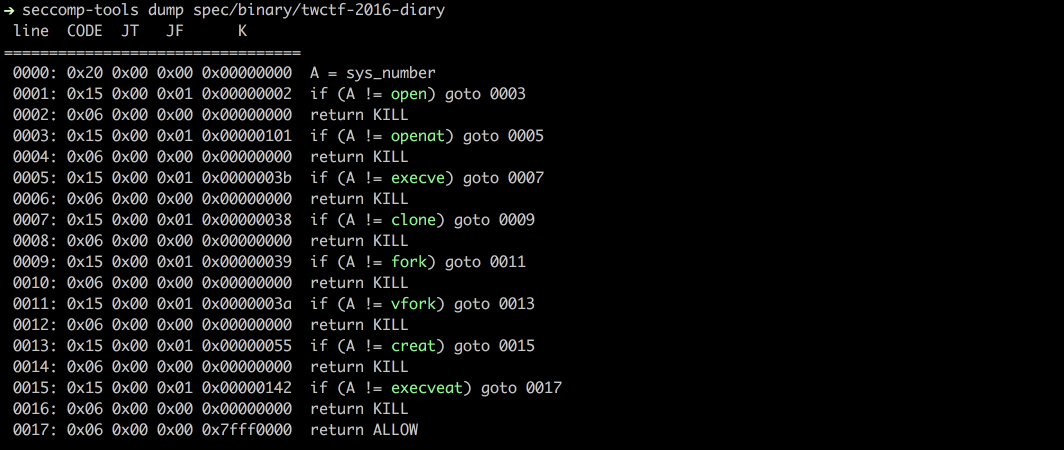
Dumps the seccomp BPF from an executable, using the ptrace syscall.
NOTE: the target executable is actually run, so be careful with untrusted binaries.
disasm
Disassembles raw seccomp BPF into a readable format.
asm
Assembles seccomp rules into raw bytes.
Useful when you want to write your own seccomp rules.
Supports jump labels and syscall names. See the examples below.
Since v1.6.0 [not released yet], asm has switched to a yacc-based parser, which allows a more flexible and intuiti!
The output of seccomp-tools disasm <file> --asm-able is valid input for asm:
Emu
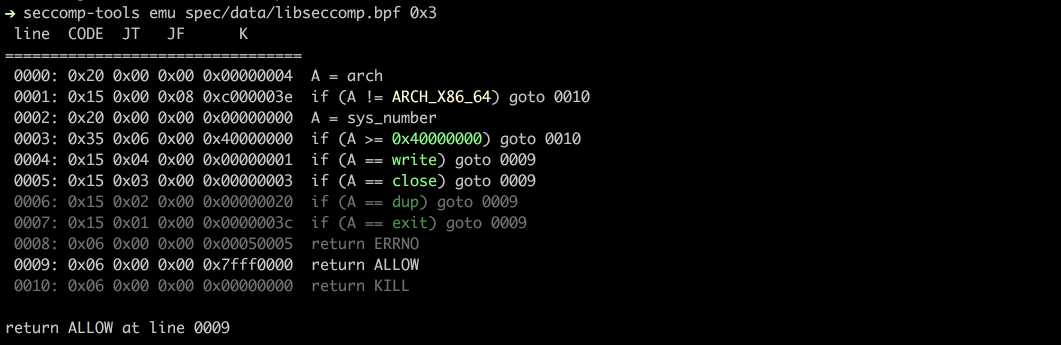
Emulates seccomp given sys_nr, arg0, arg1, etc.
Explain
Summarizes a whole filter as a per-action policy: which syscalls end in ALLOW, KILL, ERRNO, etc.,
and under what argument constraints. The input can be a dumped BPF file, an executable (its seccomp is
dumped first, like dump), or a running process via --pid.
A more in example - the 0CTF/TCTF 2023 "Nothing is True" filter, which has separate 32/64-bit
allowlists and argument checks on open, mmap and execve:
Audit
Scans a filter for weaknesses and likely escape routes - a missing architecture or x32 guard, a
permissi) default, equi gaps (e.g. execve blocked but execveat not),
an open/read/write chain, or dangerous syscalls reachable as ALLOW - and reports each with a
se. It runs on every supported architecture (architecture-specific quirks like amd64's x32 are
applied only where they exist), and takes the same input as explain (a BPF file, an executable, or--pid).
Auditing a denylist with several escape routes (the TokyoWesterns CTF 2016 "diary" filter):
Use --format json for CI or tooling:
Shell Completion
seccomp-tools completion <bash|zsh|fish> prints a completion script for the gi. Load it from your shell's startup file:
To avoid the startup cost of e it every time, write the script to the directory your shell loads completions from instead, e.g. seccomp-tools completion zsh > "${fpath[1]}/_seccomp-tools".
Screenshots
Dump
!dump
Emu
!emu
!emu
Supported Architectures
Pull requests adding support for more architectures are welcome!
De
I recommend using rbenv to manage your Ruby en.
Setup
-
$ gem install bundler-
$ git clone && cd seccomp-tools-
$ bundle installRun tests
$ bundle exec rake
I Need You
Any suggestions or feature requests are welcome!
Feel free to file issues or send pull requests.
And if you like this project, consider giving it a star :grimacing:
项目信息
开发语言:Ruby
Star 数:1141
技术要点
该项目属于CTF思路方向的开源资源,代码结构清晰,适合安全研究人员学习参考。项目围绕Provide powerful tools for seccomp analysis展开,提供了可运行的实现,对理解相关安全机制、工具原理与攻防技术具有较高的研究价值。
从技术实现角度看,此类项目的核心在于对底层原理的深入理解与工程化落地。开发者在研究过程中可以结合官方文档与社区讨论,梳理项目的初始化流程、核心模块职责与数据流转,逐步掌握其中的技术细节与设计思路。
使用与学习建议
1. 下载源码压缩包,解压到本地环境。
2. 根据项目类型准备对应的运行环境与依赖。
3. 按照 README 中的步骤完成配置与部署。
4. 在隔离的测试环境中运行验证,避免影响生产系统。
免责声明
本资源来源于开源社区,仅供安全研究、技术学习与合法授权范围内的攻防演练使用,请勿用于任何非法或侵害他人权益的用途。使用本项目产生的一切后果由使用者自行承担。
| 资源标题 | seccomp-tools - Provide powerful tools for seccomp analysis |
| 所属分类 | CTF思路 |
| 发布作者 | admin |
| 发布时间 | 2026-10-05 23:37:54 |
| 下载权限 | 免费下载 |
| 附件数量 | 2 个下载链接 |
| 浏览次数 | 388 |
| 讨论数量 | 0 |
| 主题状态 | 正常讨论中 |