 CTF思路
点击放大
like-dbg - Fully dockerized Linux kernel debugging environmen
项目说明
LIKE-DBG
![Code style: black]()
![Build Status: flake8]()
![Build Status: shellcheck]()
![Build Status: hadolint]()
![codecov]()
![License: MIT]()
![GitHub Release]()
LIKE-DBG (*LI*nux-*KE*rnel-*D*e*B*u*G*ger) aims at automating the boring steps when trying to set up a Linux kernel debugging en.
I set out to dive into kernel exploitation research and found existing solutions not usable enough.
Hence, this is an attempt at making all necessary pre-steps before one can e about diving into research as painless and fun as possible.
All steps from building a kernel, running it inside an emulated en, and attaching a debugger are transparently done inside docker containers to keep system requirements minimal.
Currently, there's a dedicated docker container for every of the following steps:
Caveats
As this project is in its early stages, I expect things to change rapidly, while also introducing breaking changes along the way.
Major points to improve on are:
x86_64 and arm64Features
On the upside, despite its early stages, a couple of useful features are already present:
- Minimal host system requirements due to dockerization of every step
- An easy to grasp
configs/user.ini config that allows highly customizable sessions- Or provide different configurations for different debugging setups via the command-line!
- CTF runner that's specifically designed to handle Linux kernel exploitation challenges
-
ctf/misc that houses some nifty scripts to aid in CTFs- Code quality measures:
- black formatter for python code
- flake8 linter for all python code
- shellcheck linter for shell scripts
- hadolint linter for the Dockerfiles
- Operating system agnostic, meaning it should run just fine on:
- Debian/Ubuntu
- Arch Linux/Manjaro
- Fedora
- Multi-arch:
x86_64, arm64- Choose between
gcc and clang to build the kernel- Configuration modes:
- generic-mode,
- syzkaller-mode,
- custom-mode, or
- provide a usable kernel config
- Fine-granular control to build from:
- Commit hash
- Release tag (e.g.: 5.10-rc)
- Major-Minor-Patch (e.g.: 5.10.77)
- Ability to automatically apply patch files
- Basic ability to add custom kernel modules
- Powered by debootstrap
- Automatic generation of file system that matches the kernels architecture
- Ability to customize:
- wanted packages in the file system
- the Debian release to base e on
- Powered by QEMU
- Customization of QEMU runtime options from within the
configs/*.ini files.- Powered by GDB (multiarch) with either
- GEF and GEF-extras, or
- pwndbg
- Allow users to specify GDB script in
io/scripts/gdb_script to allow a scenario-tailored debugging experienceRequirements
To get started, you have to ensure to have the following requirements set up in your system:
dockertmuxpython>=3.11poetry # <It is recommended to not run this as the root user, e.g. for testing purposes on a VPS.
It may work fine but in general I highly encourage creating a dedicated non-root user to put in the docker and sudo group!
Note: If you're using a custom TMUX config, make sure that your first pane starts at 0!
Optional
This section covers tools that are _not_ required to run LIKE-DBG but are nice to have and assist heavily when debugging or writing an exploit.
Setup
Inside like-dbg run poetry install
Configuration
Fine-tuning the kernel debugging experience is one of the goals of this project.
Currently, all tunable options are exposed in the two configuration files: configs/system.ini and configs/user.ini.
Some fields are recommended to not be altered as they're mainly for de reasons.
However, all the ones to customize the en to your needs should be self-explanatory as all of them are labeled with a brief comment.
Usage
Note: On first time usage run poetry install.
Once you're set with writing/adapting a configuration, the usage depends on your scenario.
The easiest way to get started, which is based on the configs/user.ini configuration is the following:
There exist 2 users for the automatically created filesystems:
root with no passworduser:userThis is intended so you can develop and exploit from either perspecti.
Extended Usage
Examples
The examples subdirectory houses samples on how LIKE_DBG may aid you in specific kernel debugging tasks.
Each example contains a dedicated README.md as well that contains the necessary information to reproduce the examples.
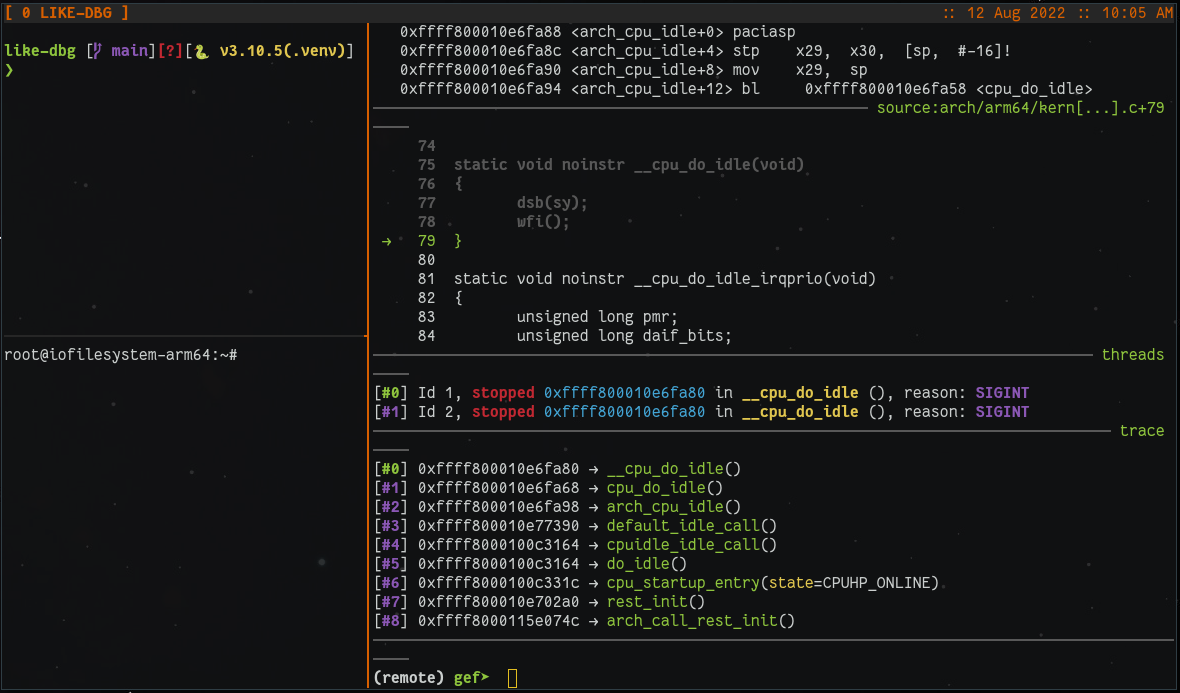
Showcase
!img/example.png
Hacking
The python code should be quite readable, so feel free to extend the project with your own ideas. All PRs are very much welcome :)!
Otherwise, feel free to create a feature-request issue or head over to the discussions page to brainstorm some cool new features!
PS: If you want to provide a logo, feel free to do so.
项目信息
开发语言:Python
Star 数:771
技术要点
该项目属于CTF思路方向的开源资源,代码结构清晰,适合安全研究人员学习参考。项目围绕Fully dockerized Linux kernel debugging environment展开,提供了可运行的实现,对理解相关安全机制、工具原理与攻防技术具有较高的研究价值。
从技术实现角度看,此类项目的核心在于对底层原理的深入理解与工程化落地。开发者在研究过程中可以结合官方文档与社区讨论,梳理项目的初始化流程、核心模块职责与数据流转,逐步掌握其中的技术细节与设计思路。
使用与学习建议
1. 下载源码压缩包,解压到本地环境。
2. 根据项目类型准备对应的运行环境与依赖。
3. 按照 README 中的步骤完成配置与部署。
4. 在隔离的测试环境中运行验证,避免影响生产系统。
免责声明
本资源来源于开源社区,仅供安全研究、技术学习与合法授权范围内的攻防演练使用,请勿用于任何非法或侵害他人权益的用途。使用本项目产生的一切后果由使用者自行承担。
| 资源标题 | like-dbg - Fully dockerized Linux kernel debugging environmen |
| 所属分类 | CTF思路 |
| 发布作者 | admin |
| 发布时间 | 2026-10-05 23:39:16 |
| 下载权限 | 免费下载 |
| 附件数量 | 2 个下载链接 |
| 浏览次数 | 203 |
| 讨论数量 | 0 |
| 主题状态 | 正常讨论中 |