剑庭安
首页
黑客安全首页全部安全栏目 黑客技术黑客技术、渗透测试、漏洞利用工具与教程 安全软件安全工具、扫描器、检测与审计软件 病毒分析恶意软件分析、样本、逆向与沙箱 CTF思路CTF 题目、writeup、解题思路与工具 防护思路防御技术、加固、检测响应与蓝队 红蓝攻防红队攻击模拟、蓝队对抗、攻防演练 漏洞知识库漏洞、CVE、PoC、EXP 与安全研究
逆向|反编译
PHP源码PHP 网站源码、程序、系统 APP源码安卓/iOS APP 源码 ASP源码ASP 网站源码与程序 NET源码.NET 网站源码与系统 小程序源码微信/支付宝小程序源码 Dedecms风格模板Dedecms 织梦风格模板 Empirecms风格模板EmpireCMS 帝国风格模板 Discuz商业模板/插件Discuz 商业模板与插件 WordPress主题/插件WordPress 主题与插件 其它源码、模板其它各类源码与模板 游戏源码游戏源码与引擎项目 加密货币源码加密货币、区块链、钱包、USDT/比特币相关源码与工具 手游源码手机游戏源码、服务端、客户端与引擎项目 传奇源码热血传奇、传奇世界、复古传奇等客户端/服务端/引擎源码 页游源码网页游戏、H5 游戏、浏览器游戏源码 端游源码电脑单机游戏、PC 网游客户端/服务端源码
最新万能免驱动支持所有型号打印机下载程序 日历天气老黄历 · 每天同步真实日期与天气
站长工具站长工具 自助开通会员浏览该分类 其他资源qtziy SEO工具SEO工具 站群源码站群源码 泛程序泛程序 蜘蛛模板蜘蛛模板 蜘蛛池蜘蛛池 外链工具外链工具
搜索 自助开通会员🔓 破甲 API
登录 注册
首页 分类列表 防护思路 PurpleSkjaldborg - Purple-te…
PurpleSkjaldborg - Purple-team threat modeling in the browser. Zero d 防护思路 点击放大
作者:admin 发布:2026-10-06

PurpleSkjaldborg - Purple-team threat modeling in the browser. Zero d

项目说明PurpleSkjaldborg<p align="center"> <img src="static/logo.png" alt="PurpleSkjaldborg Logo" width="280&q…
资源可下载 免费下载 0 条讨论
会员资源
开通会员后即可下载全部资源。
登录后开通会员
会员方案
383浏览量
0讨论
2下载链接
可下载资源状态
内容可验证
更新 2026-10-06
人工审核发布
评论区答疑

PurpleSkjaldborg - Purple-team threat modeling in the browser. Zero d

PurpleSkjaldborg - Purple-team threat modeling in the browser. Zero d

项目说明

PurpleSkjaldborg

<p align="center">
<img src="static/logo.png" alt="PurpleSkjaldborg Logo" width="280">
</p>

Purple-team threat modeling in the browser. Zero dependencies. One HTML file. Offense *and* defense on one canvas.

> *Skjaldborg* (Old Norse) — a shield wall formation where defenders interlock shields against attackers.
> This tool helps you build that digital shield wall.

---

<p align="center">
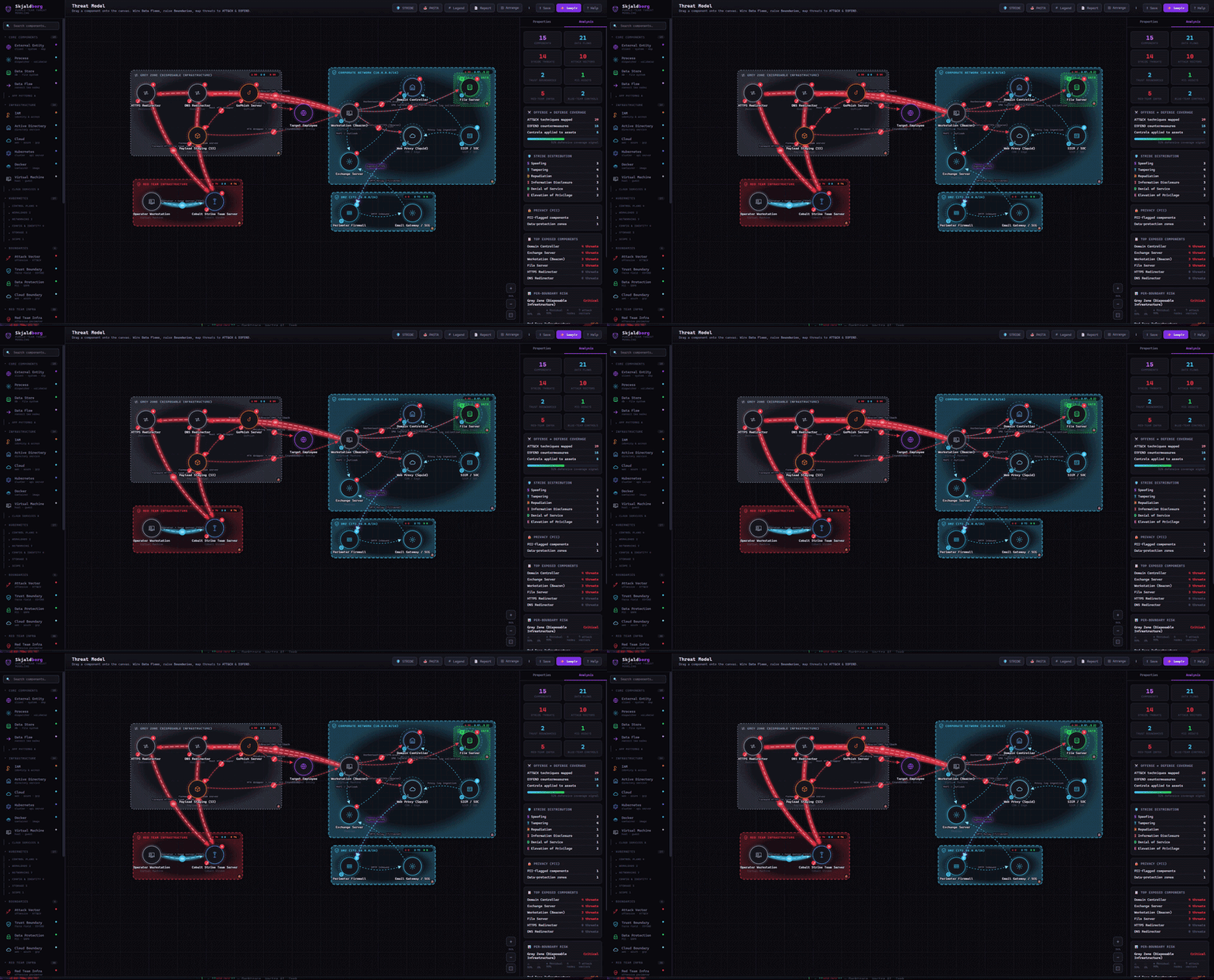
<img src="static/demo.gif" alt="PurpleSkjaldborg Demo" width="100%">
</p>

---

What Is This?

PurpleSkjaldborg is a threat modeling tool that combines red team attack paths with blue team defensi in a single diagram. It integrates four industry-standard frameworks:

| Framework | Role in Skjaldborg |
|-----------|-------------------|
| STRIDE | Threat categorization per element (Spoofing, Tampering, Repudiation, Info Disclosure, DoS, EoP) |
| PASTA | 7-stage risk-centric methodology mapped to can |
| MITRE ATT&CK | Ad techniques auto-mapped to Red Team nodes and attack edges — IDs link directly to official MITRE pages |
| MITRE D3FEND | Defensi auto-mapped to Blue Team shields and boundaries — IDs link directly to official MITRE pages |

---

Quick Start

The app loads an AD Attack Chain sample by default. Click Sample in the toolbar to explore all 7 built-in scenarios.

---

Features

Red Team Arsenal

  • C2 Frameworks — Cobalt Strike, Brute Ratel, Sliver, Havoc, ArachneC2, AdaptixC2

  • Phishing Infra — E, GoPhish, Tangled, PhishingClub

  • Pi & Tunneling — Ligolo-ng, Chisel, SSH tunnels, SOCKS proxies, dnscat2, iodine

  • Living off the Land — LOLBins, LOLDrivers, file transfer utilities

  • Auto ATT&CK — Every Red Team node ships with pre-mapped MITRE technique IDs

  • OpSec Ratings — Each tool gets an intrinsic OpSec level (1 Loud → 5 Very Quiet), in the inspector and on the canvas bust% badge
  • Blue Team Shields

  • EDR/XDR — CrowdStrike Falcon, Microsoft Defender, Elastic Security, SentinelOne and 15+ more

  • NDR — Darktrace, AI, ExtraHop, Corelight and more

  • Network Security — pfSense/OPNsense, Suricata, Squid, WAF, NAC

  • Cloud Security — Wiz, Prisma Cloud, CNAPP, CSPM, CASB, DLP

  • Hardening & Deception — ASR/GPO, Kyverno, HoneyPots/Decoys
  • > Blue tools attach as shields on assets (force-ring + D3FEND co), not floating boxes.

    Personas & Human Actors

    Model the people in your threat story — not just infrastructure. Persona nodes render as stick figures (not boxes) and carry human-centric properties instead of STRIDE/MITRE assessments:

  • Actor types — Employee, IT Admin, De, Executi / Contractor, plus security roles (Red Teamer, Blue Teamer) and a generic Threat Actor

  • Attacker profile *(Threat Actor & Red Teamer only)* — alias/handle, motto/quote, Intent (4 CIA-impact dimensions: 🕵️ Espionage · 💥 Destructive · ⚡ Disruptive · 💰 Cyber-Crime), Capability level (Script Kiddie → Nation-State), moti, sophistication, free-text Needs (goals) and Obstacles (where defenders can intervene)

  • Human risk profile *(non-attacker personas)* — 🎣 Social Engineering Susceptibility, 🧠 Security Awareness Level, and 💸 Fraud Exposure (Critical → Minimal, e.g. BEC / CEO-fraud payment authority)

  • ⭐ VIP / High-Value Target flag for Executives and IT Admins — surfaces whaling / BEC priority targets, shown with a gold star badge on the node

  • 🎭 Impersonated flag for non-attacker personas — marks an identity spoofed by an attacker (e.g. the "CEO" in a BEC lure); the persona glows red on the canvas

  • 🔑 MFA toggle on auth-capable personas — auto-syncs a D3FEND D3-MFA mapping

  • Reworked context menu — persona right-click menus adapt per type: intent quick-toggles for attackers; MFA, VIP, impersonated, and fraud-exposure cycling for human personas; free-mo toggle for all
  • Canvas &

  • Animated tunnel edges — Red glow for offensi, blue glow for defensive channels

  • Green glow on encrypted flows — Data flows with *Encrypted in Transit* enabled pulse with a green glow and dashed o

  • Freehand Trust Boundary — Click on the canvas to draw any polygon; press Esc to finalize. Rendered with smooth Catmull-Rom curves, classical threat-model style

  • Rectangular boundaries — Trust (blue), Privacy/PII (green), Cloud (gradient), Network (dashed), Red Team, Grey Zone, K8s Namespace, NetworkPolicy

  • Semantic Auto-arrange — One click organises nodes into 10 semantic zones: External · Network/DMZ · Corporate · Kubernetes · Cloud · IAM · Blue Team · Red Team · Grey Zone · Pi

  • Semantic context menus — Right-click items adapt to the component type: PII/classification for data stores, STRIDE flags per process type, pri flag for K8s pods, OpSec for red team, internet exposure for assets, and human-actor actions (intent, MFA, VIP, fraud exposure) for personas

  • Clickable MITRE IDs — Every ATT&CK and D3FEND chip opens the official MITRE technique page in a new tab

  • Zoom & pan — Scroll to zoom, drag background to pan
  • Node Badges (Can)

    Each node carries corner badges so you can read the threat posture at a glance without opening the inspector:

    | Badge | Position | Meaning |
    |-------|----------|---------|
    | 🌐 Globe | Top-center | Asset is internet-exposed |
    | Count pill | Top-right | ATT&CK / STRIDE technique count |
    | 🔒 / 🛡️ | Bottom-left | PII lock · Red sword · Blue shield |
    | ⚡ Ease score | Bottom-right | Ease of Attack score (0–100, color-coded) |
    | % Bust ring | Bottom-right | Red team only — detection bust likelihood |
    | Dashed ring | Outer ring | Red team detection risk color (green → red) |
    | 🔑 Key | Bottom-center | MFA enabled on an auth-capable node |
    | ⭐ Star | Top-right | Persona only — VIP / High-Value Target |
    | 💸 Cash | Bottom-left | Persona only — Fraud Exposure (color-coded by se) |
    | 🎭 Red glow | Whole node | Persona only — identity is impersonated by an attacker |

    Red Team OpSec & Detection

    Every red team node gets a live bust likelihood score that reflects how detectable it is by the blue team on the same canvas:

  • Intrinsic OpSec level (1–5) is assigned per tool type: LOLBins and CDN-fronted C2 are quiet (5), default Cobalt Strike profiles are loud (1–2)

  • D3FEND co is computed by scanning all blue team nodes and controls on the canvas for techniques that match the red team node's detection surface

  • Bust risk = detection co × OpSec dampener [1.0, 0.82, 0.65, 0.50, 0.40]

  • Can a color-coded dashed ring and a bust % badge (bottom-right)

  • Inspector panel shows the full breakdown: OpSec level pips, bust likelihood bar, detected-by list, and uncovered detection gaps
  • Ease of Attack

    Every non-red-team node gets an automatically computed Ease of Attack score (0–100):

    | Score | Label | Color |
    |-------|-------|-------|
    | 0–19 | Very Hard | 🟢 Green |
    | 20–37 | Hard | 🟡 Yellow-green |
    | 38–54 | Medium | 🟡 Yellow |
    | 55–71 | Easy | 🟠 Orange |
    | 72–100 | Critical | 🔴 Red |

    The score starts from a base value per node type and is adjusted automatically by:

  • Number of attack edges pointing at the node

  • Acti threat flags

  • Pri container flag

  • Security controls attached

  • D3FEND countermeasures mapped

  • Encrypted at Rest / Encrypted in Transit flows

  • ±5 manual fine-tuning buttons in the inspector
  • Data Classification (Stores & Databases)

    Click any data-holding node (Store, Bucket, DB, Cache, Secret, ConfigMap, Queue…) to access:

  • Classification level — Unclassified / 🟢 Public / 🔵 Internal / 🟡 Confidential / 🟠 Restricted / 🔴 Secret

  • Data categories — tag Personal (PII), Health (PHI), Financial (PCI), Biometric, Communications, Legal

  • 🔐 Encrypted at Rest toggle
  • All settings are accessible from both the inspector panel and the right-click context menu.

    Internet Exposure

    Flag any asset as reachable from the public internet:

  • 🌐 Globe badge appears on the node at 12 o'clock position (blue, distinct from all other badges)

  • Inspector toggle — 🌐 Exposed to Internet switch on every node

  • Context menu — Mark as internet-exposed / Remo exposure for all non-red-team, non-blue-team nodes

  • The built-in scenarios pre-annotate the correct nodes (firewalls, , email gateways, reverse proxies, phishing infra, cloud APIs, CI/CD platforms, ingress controllers…)
  • Multi-Factor Authentication (MFA)

    Flag MFA on any auth-capable asset or human persona:

  • 🔑 Key badge at the node's 6 o'clock position (emerald, non-o with other badges)

  • Inspector toggle and context-menu action on supported types (external, API, cloud, IAM, web app, AD, SIEM, firewall, and most personas)

  • Enabling MFA auto-maps the D3FEND D3-MFA countermeasure and lowers the Ease of Attack score; a missing MFA on an auth-capable node raises it
  • Analysis & Reporting

  • Per-boundary risk scoring — Attack surface co

  • STRIDE matrix — applicability grid for all elements

  • PASTA stages — 7-stage methodology walkthrough mapped to your diagram

  • Markdown report export — Full threat model document including STRIDE assessment, ATT&CK/D3FEND lists, PII assets, and data classification metadata

  • S — Rich self-contained image with:

  • - Node annotations (ease score, classification level, ATT&CK count, STRIDE flags, encryption status)
    - Right-side Analysis Panel with summary metrics, STRIDE bar chart, ATT&CK technique list, D3FEND co, data classification breakdown, red team OpSec assessment, and per-node ease breakdown
    - Embedded font, resolved CSS , grid removed
    - Zoom & pan — scroll to zoom, drag to pan, + / − / fit buttons
  • JSON import/export — Save and share full models with your team
  • ---

    Built-in Scenarios

    | Scenario | Kill Chain | Key Techniques |
    |----------|-----------|----------------|
    | AD Attack Chain | Phishing → LOLBins → Ligolo-ng pivot → Kerberoasting → ADCS abuse | DCSync, Golden Ticket, E AiTM, WireGuard VPN |
    | Cobalt Strike Beacon Drop | GoPhish campaign → Macro payload → Beacon C2 → Lateral mo | Malleable C2, DNS fallback, Kerberoasting, HTTPS egress |
    | K8s Cluster Compromise | RCE in pod → SA token theft → etcd dump → Cloud exfil | RBAC abuse, container escape, IRSA pivot, supply chain |
    | Cloud Identity Breach (Azure) | Consent phishing → OAuth token → Graph API → Key Vault | Entra ID takeover, MFA bypass, Managed Identity abuse |
    | Supply Chain Attack (CI/CD) | Malicious NPM dep → Runner RCE → Backdoored image → Prod | IRSA credential theft, ECR poisoning, ArgoCD deploy |
    | Ransomware (Double Extortion) | RDP brute-force → Cobalt Strike → DCSync → Exfil → GPO deploy | BYOVD EDR kill, rclone exfil, deletion |
    | Phishing & CEO Fraud (BEC) | OSINT → lookalike domain → spoofed "CEO" email → AP clerk → fraudulent wire → mule account | Impersonation (T1656), Financial Theft (T1657), DMARC/SPF bypass — *malware-free, human-centric* |

    All scenarios are pre-annotated with internet-exposed assets, STRIDE flags, ATT&CK/D3FEND techniques, PII zones, and security controls. The CEO Fraud scenario showcases the persona system — human actors with fraud exposure, social-engineering susceptibility, awareness levels, and a executive.

    ---

    Keyboard Shortcuts & Interactions

    | Action | Result |
    |--------|--------|
    | ? | Open Help panel |
    | Esc | Stop drawing flows · finalize freehand boundary · cancel tool · deselect |
    | Shift + click | Keep node/boundary tool armed (place multiple) |
    | Delete / Backspace | Delete selected element |
    | F2 | Rename selected element |
    | Double-click edge | Toggle attack ↔ data flow |
    | Right-click anything | Semantic context menu |
    | Scroll | Zoom |
    | Drag background | Pan |
    | Click flow tool → source → target | Draw edge; tool stays armed — keep wiring or press Esc |
    | Click Freehand Boundary → → Esc | Draw and save a polygon trust boundary |
    | Click MITRE ID chip | Open official MITRE technique page in new tab |

    ---

    Architecture

    Zero dependencies. No React, no D3, no build step. Opens in any modern browser, works offline.

    ---

    Philosophy

    Most threat modeling tools make you choose: either you model the attacker *or* you model the defenses. PurpleSkjaldborg lets you do both on the same can purple teams need both perspecti.

  • Attack paths and defenses rendered together expose gaps

  • Residual risk scoring quantifies where you're under-defended

  • Auto-mapped ATT&CK/D3FEND means you don't need encyclopedic MITRE knowledge

  • OpSec ratings and bust likelihood make red team detectability tangible

  • Ease of Attack scores gi a prioritized target list

  • Data classification surfaces which stores are highest-value targets

  • Internet exposure flags make the attack surface boundary explicit

  • Personas put the human attack surface on the canvas — social engineering, fraud exposure, and awareness alongside the technical kill chain

  • Sample kill chains let you start from realistic scenarios and adapt
  • ---

    Further Reading

  • Threat Modeling — Culture & Practice — Foundational concepts on STRIDE, PASTA, and integrating threat modeling into engineering workflows

  • MITRE ATT&CK — Ad tactics & techniques knowledge base

  • MITRE D3FEND — Defensi taxonomy

  • Incident Response Playbooks — Companion IR project
  • ---

    License

    MIT

    ---

    <p align="center">
    <b>PurpleSkjaldborg</b> — Build your digital shield wall.<br>
    <sub>Purple-Team Threat Modeling &middot; STRIDE &middot; PASTA &middot; ATT&CK &middot; D3FEND &middot; Personas &middot; OpSec &middot; Ease of Attack</sub>
    </p>

    项目信息

    开发语言:HTML

    Star 数:3

    技术要点

    该项目属于防护思路方向的开源资源,代码结构清晰,适合安全研究人员学习参考。项目围绕Purple-team threat modeling in the browser. Zero dependencies. One HTML file. Offense and defense on one canvas.展开,提供了可运行的实现,对理解相关安全机制、工具原理与攻防技术具有较高的研究价值。

    从技术实现角度看,此类项目的核心在于对底层原理的深入理解与工程化落地。开发者在研究过程中可以结合官方文档与社区讨论,梳理项目的初始化流程、核心模块职责与数据流转,逐步掌握其中的技术细节与设计思路。

    使用与学习建议

    1. 下载源码压缩包,解压到本地环境。

    2. 根据项目类型准备对应的运行环境与依赖。

    3. 按照 README 中的步骤完成配置与部署。

    4. 在隔离的测试环境中运行验证,避免影响生产系统。

    免责声明

    本资源来源于开源社区,仅供安全研究、技术学习与合法授权范围内的攻防演练使用,请勿用于任何非法或侵害他人权益的用途。使用本项目产生的一切后果由使用者自行承担。

    资源标题PurpleSkjaldborg - Purple-team threat modeling in the browser. Zero d
    所属分类防护思路
    发布作者admin
    发布时间2026-10-06 00:17:53
    下载权限 免费下载
    附件数量2 个下载链接
    浏览次数383
    讨论数量0
    主题状态正常讨论中

    本资源免费,登录后即可在本页「下载链接」区域获取全部附件。

    请在评论区留言说明具体链接,或联系作者补档。楼主更新后本页会同步最新的下载地址。

    请先阅读正文中的授权说明;未注明的默认仅限站内学习交流,禁止直接搬运到其他站点二次售卖。
    还没有讨论,快来抢沙发~
    登录 后才能参与讨论
    下载链接
    会员才能下载
    登录后开通会员
    同分类推荐
    暂无同类资源
    免费登录即可下载
    查看会员
    放大预览

    © 2026 剑庭安 - 网站开发定制 SEO 优化蜘蛛池代做 在线看手相算命. 保留所有权利。

    Powered by 酷像SEOv3.0

    网站地图 Sitemap.xml
    首页 全部分类 黑客安全 逆向|反编译 精品源码 站长工具自助开通会员其他资源SEO工具站群源码泛程序蜘蛛模板蜘蛛池外链工具创意乐园 搜索 会员服务 登录 注册