 防护思路
点击放大
digital-identity-protection-system - Cross-platform defensive security platform for ide
项目说明
DIPS | Digital Identity Protection System
<p align="center">
<img src="screenshots/dips-logo.svg" alt="DIPS logo" width="164">
</p>
!Python 3.11+
!License
!
!Beta
!Test Co
!Security Focused
!Windows
!Linux
!PySide6
!Reports
!Demo Mode
<p align="center">
<a href="#quick-start"><strong>Quick Start</strong></a> ·
<a href="#downloads"><strong>Downloads</strong></a> ·
<a href=" Release</strong></a> ·
<a href="examples/reports"><strong>Example Reports</strong></a> ·
<a href="#showcase-reel"><strong>Showcase Reel</strong></a> ·
<a href="#screenshots"><strong>Screenshots</strong></a>
</p>
<p align="center">
<img src="screenshots/github-social-preview.png" alt="DIPS product banner">
</p>
<table>
<tr>
<td ="top">
Local-first identity security for Windows and Linux.
DIPS is a defensi tool for operators, pri users, and engineers who want into identity exposure, credential hygiene, local privacy leaks, risky browser posture, phishing indicators, threat intelligence matches, and cross-module risk patterns without depending on a cloud-first workflow.
It combines a production-style Python CLI, redacted JSON and HTML reports, a configurable Digital Identity Risk Score, a PySide6 desktop dashboard, a persistent security timeline, and a plugin system for external security modules.
</td>
<td ="top" width="340">
<img src="screenshots/repo-typing-analyst.gif" alt="Animated SOC analyst typing at a workstation" width="320">
</td>
</tr>
</table>
> Defensi. DIPS does not exploit systems, weaponize findings, or decrypt protected browser .
Beta Access
DIPS is ready for a free early-access beta with stable core workflows and support-oriented diagnostics.
Recommended beta workflow:
dips doctor before the first scandips scan normally for e edips doctor --doctor-format json output when filing issuesProject Snapshot
Why DIPS
Key Features
dips doctor for operator support and beta rollout .Engineering Highlights
Build Journey
If you want to understand how DIPS was built step by step, see docs/de.md.
!DIPS de phases
It breaks the project into fi phases:
Showcase Reel
!DIPS showcase reel
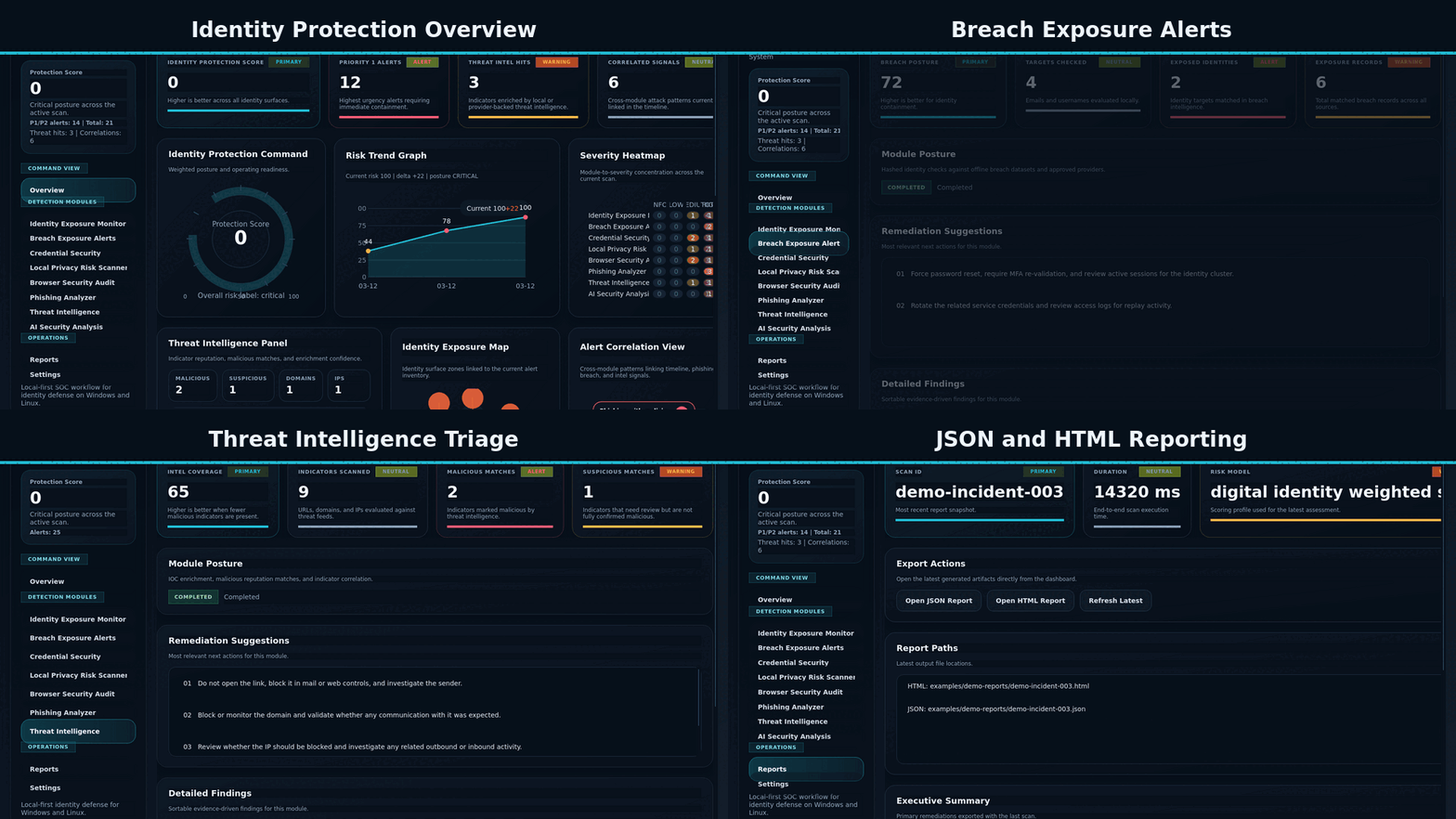
Screenshots
O dashboard:
!DIPS o dashboard
Risk score panel:
!DIPS risk score panel
Se distribution:
!DIPS se distribution
Security event timeline:
!DIPS security event timeline
Breach exposure alert view:
!DIPS breach exposure alert
Scan report view:
!DIPS scan report view
Identity exposure analysis:
!DIPS identity exposure dashboard
Threat intelligence panel:
!DIPS threat intelligence dashboard
More screenshot details are in screenshots/README.md.
Refresh the full screenshot set with:
Installation
Linux
Windows
Runtime-only desktop install:
Full installation guidance is in docs/installation.md.
Packaged release notes and downloadable assets live at Latest release.
Downloads
The repository now includes a direct download folder in downloads:
.deb installerIf you install the Debian package, the en with:
Quick Start
Run the example configuration:
Run a targeted fixture-backed scan:
Launch the dashboard:
Open an existing report in the dashboard:
The full operator quick start is in docs/quickstart.md.
Operational Readiness
Run the built-in en diagnostics:
Get JSON diagnostics for support or managed rollouts:
Use DIPS as an automation gate without changing the default scan workflow:
Operational guidance is in docs/operations.md.
Demo Mode
DIPS includes a safe synthetic demo mode for screenshots, GitHub presentation, and dashboard walkthroughs.
Generate the bundled demo reports locally:
Launch the dashboard with staged demo data:
Load the committed sample incident report directly:
Capture a screenshot in one step:
Bundled sample demo reports live in examples/demo-reports.
Example Reports
The repository also ships a curated example report pack in examples/reports.
Included artifacts:
Generate similar synthetic reports locally:
Generate real reports against your local en:
CLI Usage
Show help:
Core commands:
dips scan runs one full defensive scan and writes reports.dips watch performs repeated foreground scans and shows new or resol.dips show-config prints the merged effecti.dips doctor runtime health, writability, configured inputs, and plugin loading.dips dashboard launches the PySide6 desktop interface.Examples:
See docs/cli.md for the complete CLI guide.
Dashboard Usage
The dashboard is designed to feel like a defensive SOC product while still reusing the same local scan engine as the CLI.
Key panels:
Launch options:
Detailed workflow guidance is in docs/gui.md.
Reports
DIPS exports:
Each report includes:
Report structure details are in docs/reports.md.
Architecture Summary
How to read it:
Key layers:
dips.core: config, engine, logging, timeline, plugin runtime, and risk enginedips.scanners: built-in local defensidips.modules: ad enrichment modules such as breach, threat, and AI analysisdips.reporting: JSON and HTML exportersdips.gui and dips.ui_dashboard: desktop dashboard shell and public UI surfaceplugins/: local plugin root and example pluginDeep-di notes are in docs/architecture.md.
The Mermaid source of truth is in docs/architecture-diagram.mmd.
Repository Layout
| Path | Purpose |
| --- | --- |
| dips/core/ | scan orchestration, config, logging, timeline, plugin runtime, and risk scoring |
| dips/scanners/ | built-in local defensi |
| dips/modules/ | ad modules such as breach intelligence, threat intelligence, and AI analysis |
| dips/reporting/ | JSON and HTML report generation |
| dips/ui_dashboard/ | stable public dashboard surface |
| dips/gui/ | dashboard shell, state adapters, theme, and pages |
| config/ | defaults and example configuration files |
| examples/ | safe demo reports and usage-ready example flows |
| screenshots/ | curated GitHub and release |
| docs/ | operator, engineering, and release documentation |
| tests/ | automated regression, module, CLI, and dashboard co |
| plugins/ | example plugin and local plugin root |
Documentation index: docs/README.md
Documentation At A Glance
Testing
Install the contributor en:
Run the quality checks:
More de guidance is in CONTRIBUTING.md.
Release packaging guidance is in docs/releasing.md.
Documentation Map
Roadmap
The roadmap is organized around practical defensi growth rather than speculati sprawl. The goal is to keep DIPS local-first, pri, and useful to both indi operators and larger security teams.
Near-Term Priorities
Mid-Term Platform Expansion
Longer-Term Engineering Goals
For a more detailed milestone breakdown, see docs/roadmap.md.
Contribution Guide
Contributions are welcome if they keep the project defensi, and cross-platform.
Expected standards:
Start here:
If you want recruiter-facing or GitHub presentation copy for the project page, pinned repo slot, resume, or LinkedIn post, use docs/project-profile.md.
Security and Privacy Principles
DIPS is built around a local-first, defensi model. The tool is designed to impro without forcing users to trade away privacy just to understand their exposure.
Core principles:
Why this matters:
Full philosophy and rationale: docs/security-philosophy.md
Operational security guidance:
Ownership and Attribution
Copyright (c) 2026 Hackloi.
This repository includes an explicit LICENSE, NOTICE, and CITATION.cff file so the project authorship, attribution expectations, and preferred citation are in the repository itself.
Important:
License
MIT. See LICENSE.
项目信息
开发语言:Python
Star 数:1
技术要点
该项目属于防护思路方向的开源资源,代码结构清晰,适合安全研究人员学习参考。项目围绕Cross-platform defensive security platform for identity exposure detection, breach intelligence, phishing analysis, and privacy-risk reporting.展开,提供了可运行的实现,对理解相关安全机制、工具原理与攻防技术具有较高的研究价值。
从技术实现角度看,此类项目的核心在于对底层原理的深入理解与工程化落地。开发者在研究过程中可以结合官方文档与社区讨论,梳理项目的初始化流程、核心模块职责与数据流转,逐步掌握其中的技术细节与设计思路。
使用与学习建议
1. 下载源码压缩包,解压到本地环境。
2. 根据项目类型准备对应的运行环境与依赖。
3. 按照 README 中的步骤完成配置与部署。
4. 在隔离的测试环境中运行验证,避免影响生产系统。
免责声明
本资源来源于开源社区,仅供安全研究、技术学习与合法授权范围内的攻防演练使用,请勿用于任何非法或侵害他人权益的用途。使用本项目产生的一切后果由使用者自行承担。
| 资源标题 | digital-identity-protection-system - Cross-platform defensive security platform for ide |
| 所属分类 | 防护思路 |
| 发布作者 | admin |
| 发布时间 | 2026-10-06 00:28:15 |
| 下载权限 | 免费下载 |
| 附件数量 | 2 个下载链接 |
| 浏览次数 | 156 |
| 讨论数量 | 0 |
| 主题状态 | 正常讨论中 |