 防护思路
点击放大
cyber-arena-showcase - Public showcase & research dossier for Cyber Arena
项目说明
🛡️ CYBER ARENA
<di="center">
A Reproducible Defensi E Platform
Ad Mutation Testing and Multi-Stream E Correlation


<br/>
![Node.js]()
![Express]()
![React]()
![Vite]()
![PostgreSQL]()
![Docker]()
<p align="center">
<a href="#1-executim-shift">Executi</a> •
<a href="#2-m-walkthrough"> Showcase</a> •
<a href="#3-system-architecture--pipeline">Architecture</a> •
<a href="#4-core-technical-inno">Core Inno</a> •
<a href="#5-mathematical-foundations">Formulations</a> •
<a href="#6-automated-guarantees"></a> •
<a href="#8-source-code-confidentiality--e">Request Code Access</a>
</p>
</div>
---
> [!IMPORTANT]
> PUBLIC SHOWCASE & RESEARCH PORTFOLIO REPOSITORY
> This repository contains the public architecture specification, UI demonstrations, formal scoring foundations, and academic patent dossier for Cyber Arena. To maintain institutional grading integrity, prevent premature disclosure, and safeguard intellectual property during ongoing research review, the li engine and acti containers are hosted in a private repository.
> ➔ Hiring Managers, E & Security Researchers: You can request full read-only collaborator access to the core engine within 24 hours.
---
📑 Table of Contents
- The Traditional CTF Dilemma
- The Cyber Arena Solution
- Feature Comparison Matrix
- End-to-End E Flow
- Container Sandbox Isolation Guarantees
- 4.1 Reference- Ad Mutation Testing
- 4.2 Deterministic 6-Axis Mutation Matrix
- 4.3 Zero-Tolerance Database & Runtime Exception In
- 4.4 Lightweight Ad AST Source-to-Sink Analysis
- 4.5 Four-State Multi-Stream E Correlation
- 4.6 Directed Acyclic E Graph (DAG) with 100% Pro
- 4.7 Canonical JSON Serialization & SHA-256 Audit Digest
---
1. Executi & The Paradigm Shift
The Traditional CTF Dilemma
Traditional cybersecurity education platforms, Capture-The-Flag (CTF) competitions, and e benchmarks operate under a fundamental structural asymmetry:
DB_ERROR), traditional benchmarks misclassify crashes as successful defenses, completely ignoring confidentiality leaks and denial-of-service states.The Cyber Arena Solution
Cyber Arena transforms remediation into an empirical, reproducible, and science:
1. Dynamic Defensi: Defenders submit real application code patches across major classes (SQL Injection and Command Injection).
2. Ephemeral Docker Sandbox Isolation: Each patch is compiled and launched within a strictly isolated, resource-bounded Linux container (
0.5 CPU, 512MB RAM, pids-limit=100, cap-drop=ALL).3. Reference- Mutation Engine: Candidate attack payloads are dynamically transformed across 6 deterministic mutation axes. Crucially, all mutations are pre- against a known- baseline reference oracle ($O_{ref}$) before deployment against the patch ($O_{patch}$).
4. Dual-Oracle In : The platform independently measures Security Resilience ($R$) against mutating exploits and Functional Correctness ($F$) to prevent o or denial-of-service fixes.
5. Multi-Stream E Synthesis: Synthesizes ad static AST source-to-sink tracking with empirical sandbox telemetry into a 4-state exploitability classification, backed by a Directed Acyclic E Graph (DAG) with 100% pro and a tamper-e SHA-256 canonical audit digest.
---
Feature Comparison Matrix
| Capability Dimension | Traditional CTF / Benchmark Platforms | Cyber Arena Platform |
| :--- | :--- | :--- |
| Primary E Role | Red Team (Attacker exploiting known flaw) | Blue Team / Defender (Remediating source code) |
| Target Infrastructure | Static, immutable single-instance image | Ephemeral, resource-bounded Docker sandbox per patch |
| Scoring Metric | Binary flag capture ($0$ or $1$) | Dual-Dimension: Security Resilience ($R$) + Functional Correctness ($F$) |
| Test Generation | Single fixed payload per challenge | Deterministic 6-Axis Mutation Matrix ($N \ge 8$ per class) |
| Exploit Pre- | None (assumes attack payload works) | Dual-Oracle: Offline reference on baseline |
| Exception Semantics | Unhandled SQL/runtime errors treated as safe | Zero-Tolerance In: DB_ERROR is penalized as security breach |
| Code Inspection | None (black-box binary testing) | Intra-procedural AST source-to-sink tracking (ad signal) |
| Correlation Model | Unqualified "" vs. "Patched" | 4-State Empirical Correlation (CONFIRMED, THEORETICAL, BLINDSPOT, EMPIRICALLY_SECURE) |
| Audit & Integrity | Ephemeral database timestamp | Key-order independent canonical JSON + 64-char SHA-256 digest |
| Traceability Graph | None (flat relational tables) | 100% Pro Directed Acyclic E Graph (DAG) |
| Li Arena | Solitary sol | Bounded 20-minute li match against container |
---
2. Showcase & Platform Walkthrough
The platform features an industry-grade, cyber-themed glassmorphism interface engineered for clarity, sub-second reactivity, and deep explainability.
01. Mission Control & Challenge Catalog
> *Real-time telemetry, acti tracking, defense health indicators, and challenge difficulty selection.*
!Mission Control Dashboard
---
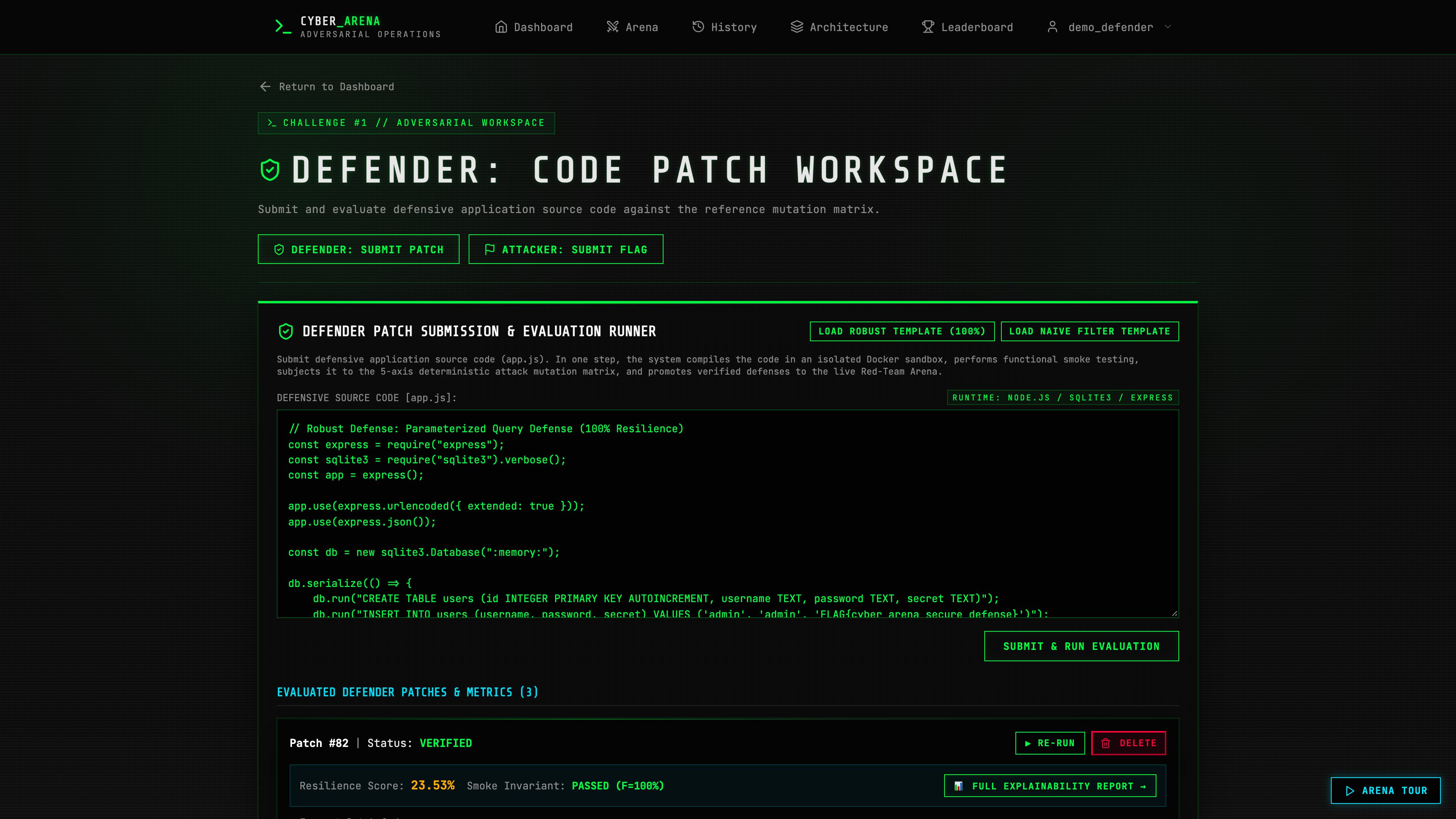
02. Defender IDE & Patch Submission Engine
> *Interacti code editor with diff , contextualization, and one-click submission to isolated sandbox compilation.*
!Defender Code IDE
---
03. Deep Explainability Report & Mutation Matrix
> *Granular breakdown of the 6 mutation axes, DB_ERROR zero-tolerance audit indicators, indi attack inspect modal, and functional status.*
!Explainability Report
---
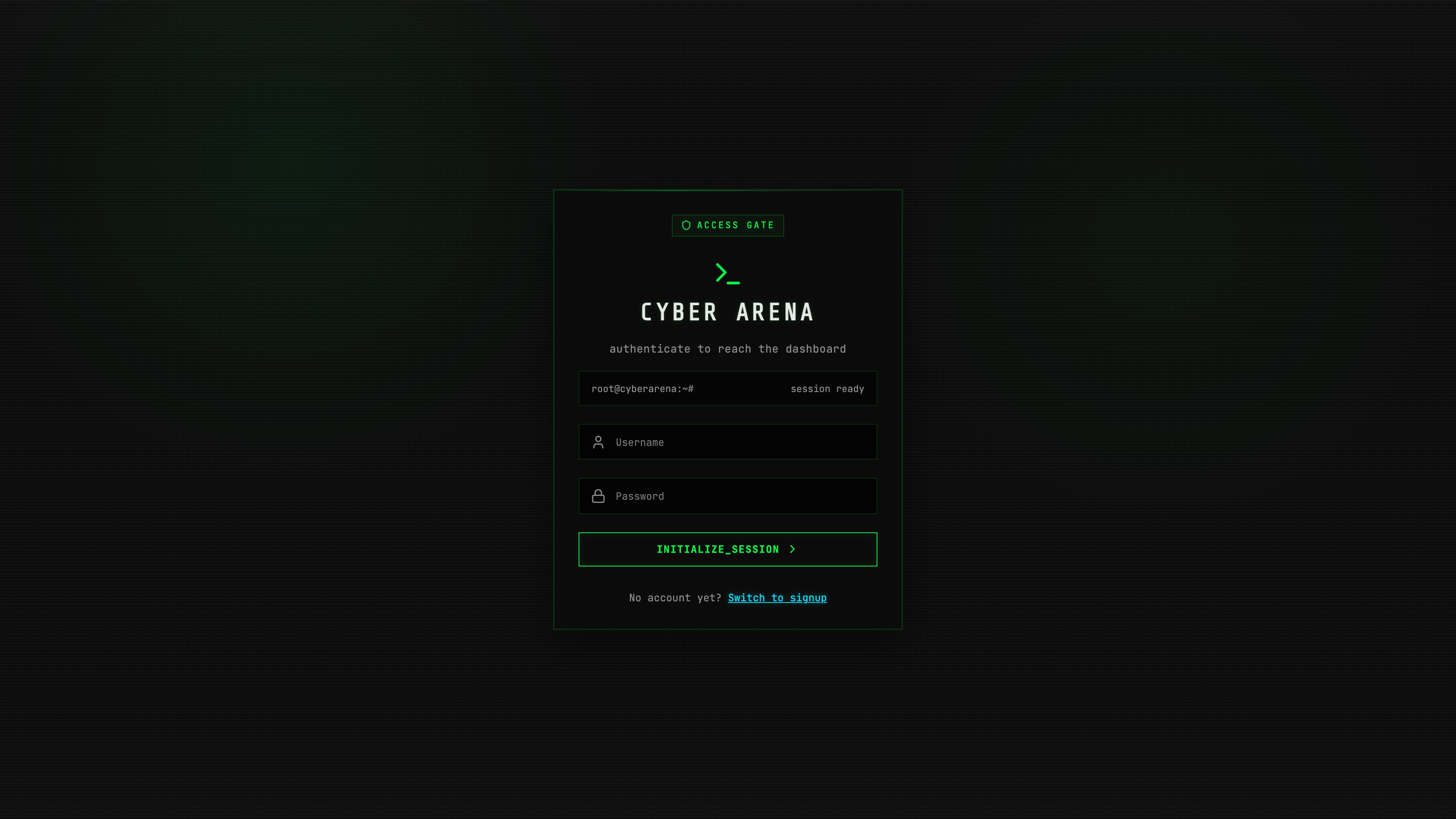
04. Li Attacker Arena
> *20-minute bounded ad match window. Red-team attackers launch li and automated e against defender-hardened containers.*
!Li Arena
---
05. System Architecture & Pipeline
> *Interacti pipeline inspector, formal mathematical scoring formulations, and li container isolation .*
!Architecture
---
06. Composite Leaderboard
> *Multi-dimensional rankings tracking Defender Resilience ($R$), Functional Correctness ($F$), Time to First Blood (TTFB), and Attacker Exploit Success.*
!Leaderboard
---
07. E & Li Ledger
> *Cryptographically match ledger recording all historical e runs, container lifecycle states, and canonical audit fingerprints.*
!Match History
---
3. System Architecture & Pipeline
End-to-End E Flow
Container Sandbox Isolation Guarantees
Every submitted patch is compiled and e in an ephemeral, resource-fenced Linux container to guarantee e determinism and host security:
--cpus=0.5 (Strict CFS scheduler throttling prevents CPU exhaustion).--memory=512m --memory-swap=512m (Prevents memory leak or swap thrashing).--pids-limit=100 (Eliminates fork-bomb denial-of-service attacks).--cap-drop=ALL (Revokes all POSIX root pri inside container).127.0.0.1::80).---
4. Core Technical Inno
4.1 Reference- Ad Mutation Testing
A primary in software testing is the invalid test oracle problem: if an attack fails to exploit a patch, is the patch secure, or was the attack malformed?
Cyber Arena resolves this with a Dual-Oracle Architecture:
1. Every mutated test $a_i$ is executed offline against a known- baseline reference target ($O_{ref}$).
2. Only mutations that produce a breach on the baseline are accepted into the immutable e set $\mathcal{T}_{}$:
$$\mathcal{T}_{} = \{ a \in \mathcal{M}(A_{base}) \mid O_{ref}(a) = \text{BREACH} \}$$
3. A strict Minimum Attack Floor ($N \ge 8$) is enforced at build time. If an attack set contains fewer than 8 , the e pipeline halts immediately with an audit exception.
4.2 Deterministic 6-Axis Mutation Matrix
The mutation engine systematically explores e techniques using deterministic, reproducible string and AST transformations:
| Mutation Axis | Transformation Operator | Target E Category |
| :--- | :--- | :--- |
| 1. Encoding | URL (%27), Hex (0x27), Base64, Unicode normalization | Bypasses nai ingress filters |
| 2. Casing | Alternating (sElEcT, uNiOn), Upper/Lower in | Evades case-sensiti blacklists |
| 3. Whitespace | Multi-space, tab insertion (\t), inline delimiter substitution | Defeats tokenization parsers and regex word boundaries |
| 4. Comment Injection | SQL block comments (SEL/**/ECT), shell comments (c$@ad) | Obfuscates tokens across lexical boundaries |
| 5. Syntax | Boolean tautologies (OR 1=1 vs OR 'a'='a'), command separators (;, &&, |) | Tests parser resilience against alternate grammar trees |
| 6. Paired Differential | Paired True/False e (OR 1=1 vs OR 1=2) | boolean blind and differential data extraction |
4.3 Zero-Tolerance Database & Runtime Exception In
A notorious flaw in nai grading is rewarding patches that introduce syntax errors or fatal crashes when malicious inputs are supplied:
42601), the response leaks internal schema structure and defense-in-depth.SUCCESS (Security Failure). Defenders cannot pass by crashing the server.4.4 Lightweight Ad AST Source-to-Sink Analysis
The platform features an intra-procedural Abstract Syntax Tree (AST) analyzer that inspects submitted Ja/Node.js source code:
req.body.*, req.query.*, req.params.*).db.query(), client.query(), exec(), execSync(), spawn()).query(sql, [params])) and separated execFile(cmd, argsArray) in.4.5 Four-State Multi-Stream E Correlation
Cyber Arena synthesizes static and dynamic signals into a definiti exploitability classification:
1. CONFIRMED_EXPLOITABLE: Static risk pattern detected AND at least one dynamic breach empirically observed in the sandbox.
2. THEORETICAL_ONLY: Static analyzer flagged a potential risk, but zero dynamic breaches occurred across the attack set.
3. STATIC_BLINDSPOT: Static analyzer passed the code as safe, yet an empirical breach was observed in the sandbox. Empirical e o static analysis, exposing tooling blind spots.
4. EMPIRICALLY_: Recognized safe defensi + 100% resilience across all mutating + 100% functional smoke test pass.
5. FUNCTIONAL_REGRESSION_REJECTED: Defense held against attacks, but failed legitimate application requests ($F < 100\%$), detecting o/denial-of-service implementations.
4.6 Directed Acyclic E Graph (DAG) with 100% Pro
To ensure absolute legal and academic explainability:
E primitive with unique UUID, timestamp, telemetry stream (STATIC or DYNAMIC), and causal context.E projects a directed graph where 100% of nodes and causal edges trace back to concrete E IDs.4.7 Canonical JSON Serialization & SHA-256 Audit Digest
To provide tamper-e proof of e integrity:
$$\text{AuditDigest} = \text{SHA256}(\text{CanonicalJSON}(\text{E}))$$
---
5. Mathematical Foundations
1. Security Resilience Score ($R$)
The Security Resilience score represents the empirical defensi rate against reference- ad mutations:
$$R = \left( \frac{\sum_{i=1}^{N_{eval}} \mathbb{I}(\text{Status}(a_i) = \text{BLOCKED})}{N_{eval}} \right) \times 100\%$$
*Where:*
2. Functional Correctness In ($F$)
To prevent defenders from returning HTTP 403 or dropping connections for all traffic:
$$F = \begin{cases}
100\%, & \text{if } O_{patch}(\text{legitimate\_admin\_auth}) = \text{HTTP 200 (SUCCESS)} \\
0\%, & \text{otherwise (FUNCTIONAL\_REGRESSION)}
\end{cases}$$
3. Error-Penalty Decision Oracle ($\Omega_{sec}$)
Let $S_{resp}$ be the HTTP status code and $B_{resp}$ be the response body. The security e oracle $\Omega_{sec}$ is defined as:
$$\Omega_{sec}(S_{resp}, B_{resp}) = \begin{cases}
\text{SUCCESS (Breach)}, & \text{if } \text{Contains}(B_{resp}, \text{"DB\_ERROR"}) \lor \text{Contains}(B_{resp}, \text{"syntax error"}) \\
\text{SUCCESS (Breach)}, & \text{if } S_{resp} = 200 \land \text{Contains}(B_{resp}, \text{"Welcome Admin"}) \\
\text{BLOCKED (Defended)}, & \text{if } S_{resp} \in \{400, 401, 403\} \lor \text{Contains}(B_{resp}, \text{"Invalid credentials"}) \\
\text{EXCLUDED}, & \text{if connection timeout / network fault}
\end{cases}$$
---
6. Automated & In Guarantees
The core engine undergoes automated regression and stress testing against 70+ in checks across 5 dedicated test suites:
| Test Suite | Implementation Scope | Checks | Scope & Guarantees |
| :--- | :--- | :---: | :--- |
| Suite 1: Infrastructure | E Models & Retries | 12 | Domain models, 5 single-axis operators, deduplication, retry policy, exclusion rules |
| Suite 2: Generic Engine & CMDi | Command Injection Suite | 11 | CMDi attack set (23 mutations), weak patch differential resilience, SQLi regression gate |
| Suite 3: Static & Correlation | AST & E Synthesis | 14 | Intra-procedural AST source-to-sink tracking, 4 controlled e correlation states |
| Suite 4: E & Audit | Graph DAG & Digest Engine | 18 | RFC 8785 Canonical JSON determinism, SHA-256 tamper detection, DAG 100% pro |
| Suite 5: Ad In | Boundary & Stress Cases | 16 | DB_ERROR zero-tolerance penalty, tamper detection boundaries, empirical authority o blindspots |
| TOTAL | 5 Test Suites | 71 | 100% Passed • 0 Failed • Zero Regressions |
---
7. Academic Dossier
The core inno and architectural specifications of Cyber Arena are documented in full detail:
🎮 Read the E Demo Playbook: docs/FACULTY_DEMO_PLAYBOOK.md
🏛️ Read the Architecture O: docs/ARCHITECTURE_O.md
🔒 Read the Security & IP Access Policy: SECURITY_AND_IP.md
---
8. Source Code Confidentiality & E Access
> ### ⚠️ Intellectual Property & Research Notice
> The full source code, proprietary mutation heuristics, Docker sandbox harnesses, and targets are maintained in a private repository to preser integrity and intellectual property during ongoing capstone e.
---
💼 For Tech Recruiters, Hiring Managers & Research E:
Full repository access, architecture walkthroughs, and li demo credentials are a upon request.
If you are considering me for Software Engineering, De, or Cybersecurity roles, feel free to reach out directly:
ABHIGH15/cyber-arena *(Private)**Confidential read-only repository collaborator access can be granted within 24 hours in.*
Academic Citation
---
9. Repository Structure
---
10. License & Intellectual Property
This project documentation and public assets are licensed under the MIT License - see the LICENSE file for details.
<di="center">
<sub>Engineered with precision for , reproducible cybersecurity defense research.</sub>
</div>
项目信息
开发语言:未知
Star 数:1
技术要点
该项目属于防护思路方向的开源资源,代码结构清晰,适合安全研究人员学习参考。项目围绕Public showcase & research dossier for Cyber Arena — a reproducible defensive security-patch evaluation platform via reference-validated adversarial mutation testing.展开,提供了可运行的实现,对理解相关安全机制、工具原理与攻防技术具有较高的研究价值。
从技术实现角度看,此类项目的核心在于对底层原理的深入理解与工程化落地。开发者在研究过程中可以结合官方文档与社区讨论,梳理项目的初始化流程、核心模块职责与数据流转,逐步掌握其中的技术细节与设计思路。
使用与学习建议
1. 下载源码压缩包,解压到本地环境。
2. 根据项目类型准备对应的运行环境与依赖。
3. 按照 README 中的步骤完成配置与部署。
4. 在隔离的测试环境中运行验证,避免影响生产系统。
免责声明
本资源来源于开源社区,仅供安全研究、技术学习与合法授权范围内的攻防演练使用,请勿用于任何非法或侵害他人权益的用途。使用本项目产生的一切后果由使用者自行承担。
| 资源标题 | cyber-arena-showcase - Public showcase & research dossier for Cyber Arena |
| 所属分类 | 防护思路 |
| 发布作者 | admin |
| 发布时间 | 2026-10-06 00:30:02 |
| 下载权限 | 免费下载 |
| 附件数量 | 2 个下载链接 |
| 浏览次数 | 228 |
| 讨论数量 | 0 |
| 主题状态 | 正常讨论中 |