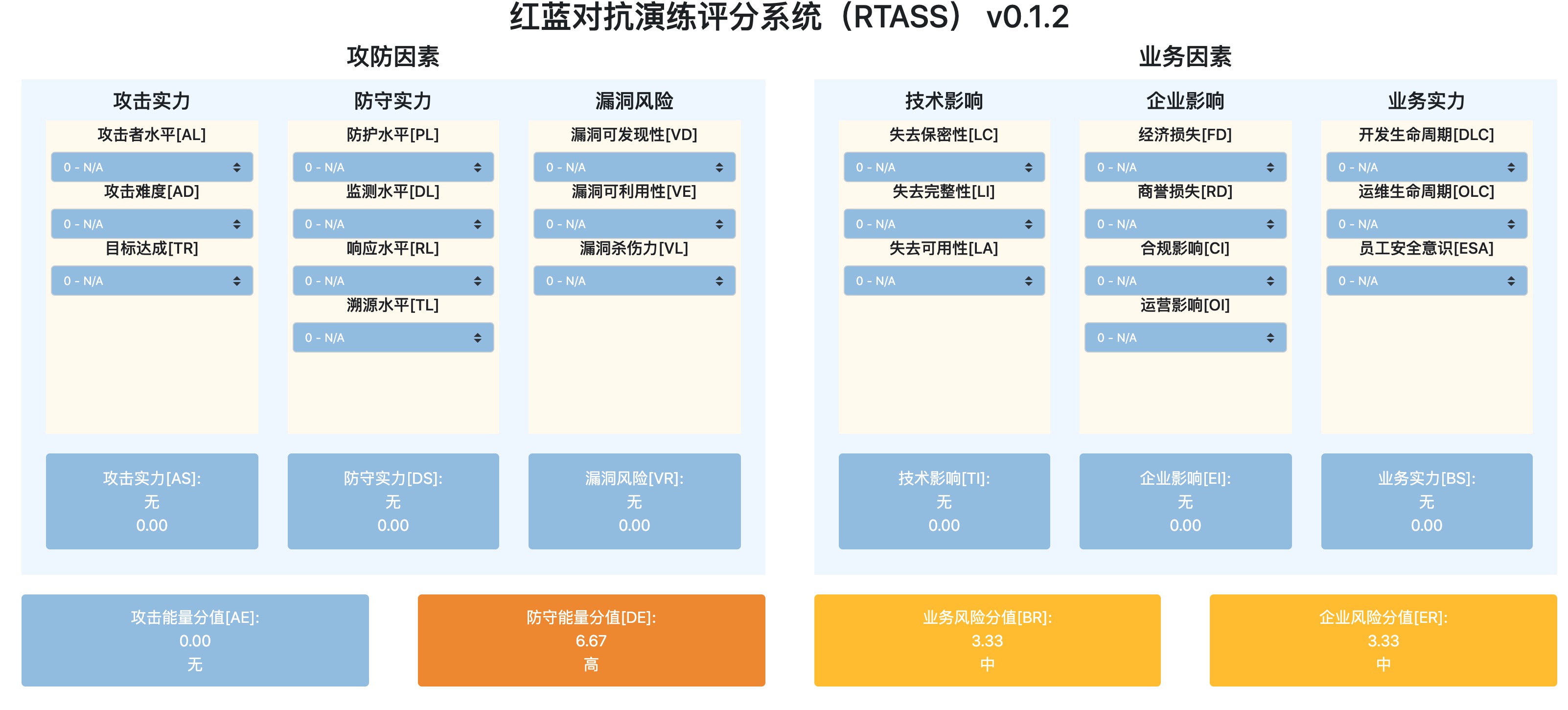
 红蓝攻防
点击放大
RTASS - 红蓝对抗量化评估系统(Red Team Assessment Scoring System)
项目说明
中文 | English
Red Team Assessment Scoring System (RTASS) 1.0.5
> Red Team Assessment Scoring System
>
> Github: <
>
> License: Apache
>
> Maintainer: Monyer, Collaborators: devils, makato, vf3ng
>
> Online Calculator <
Introduction
The Red Team Assessment Scoring System (RTASS) is an open framework used to assess the capability in of both offensive and defensi in a single cyber red-blue confrontation or actual combat exercise, as well as the degree of risk faced by the business and the enterprise in. Through RTASS, it is possible to quantify the risk status of attackers, defenders, business parties and enterprises in the red-blue ad network attack and defense drills. This framework is suitable for security assessment scenarios that conduct real network attacks on enterprises by simulating hacker APT methods, such as network red-blue confrontation drills, network actual offensive and defensi, red team assessments, and blue army assessments.
> RTASS is founded, owned, and managed by the JD.Army team. JD.Army is a professional red team which focuses on exca and solving the hidden security risks of enterprise safe operation. JD.Army reserves the right to update RTASS and this document regularly at its sole discretion. Although JD.Army owns all the rights and interests in RTASS, it permits the public to use it freely and follows the Apache open source agreement.
Background
Years ago, companies often assessed their own security by simply using "penetration testing" to find in indi application systems. To assess the criticality of , the National Infrastructure Ad Council (NIAC) de a Common Assessment System, CVSS, hosted by the Forum for Incident Response and Security Teams (FIRST). Based on the previous , FIRST has continued to iterate the v2 and v3 . The hazard assessment criteria for a single are more and more accurate and perfect, and are also used by major security organizations and recording platforms. With the de of network security, the threats to the network are increasing day by day. By simulating the APT attack methods and behaviors of hackers, the red-blue confrontation exercise method to carry out comprehensi assessment on enterprises has been widely adopted. Some organizational units have also de some scoring systems in order to e between attackers and defenders. However, this scoring system can only measure the difference between the attacker and the attacker, and between the defender and the defender. In the case of only one attacking team and one defending team, the problem is even more prominent: if the core system is breached, does it mean that the attacking team is strong or the defending team is weak? If the core system is not broken, is the attacking team weak or the defending team strong? This is very difficult to measure, and there is no mature system for e in the industry. Therefore, JD.Army has de a red-blue confrontation scoring framework for the actual combat exercise scenario based on years of cyber offensive and defensi and red-blue confrontation experience, referring to CVSS and OWASP risk rating methods.
Methods
RTASS consists of two categories, "Confrontation Factors" and "Business Factors".
Confrontation FactorsMainly measure their respecti from the perspective of offense and defense, e the lethality of key in the penetration path, and finally combine business factors to form "offensi" and "defensi" scores.It consists of process factors and scores such as Offensi, Defensi, Risk.
Business FactorsIt mainly e from the perspective of the impact on the enterprise, the level of business security capabilities, and the three elements of CIA information security, and finally combines the offensive and defensi to form the "business risk" and "enterprise risk" scores.It consists of process factors and scores such as Offensi, Defensi, Risk.
Why must it be "critical path" and "highest", "lowest", "largest" and "most critical"?
This is because in a single red-blue confrontation, the attacker can adopt different strategies to form different attack paths, and use dozens or hundreds of different TTPs in the attack path. If these TTPs are measured in turn, it is ob unrealistic and greatly increases the workload of the e.
Security follows the "short board principle" as well as the "long board principle" - the attacker does not need to ensure that every TTPs in is the highest technical ability, as long as there are one or several attacks on the critical path High-le may take down corporate targets. So we take the highest level of attack attackers invest in the critical path as a measure of their offensi.
Ob, we can also see that the strength of the attacker does not represent the total effecti in of the attacker in a single red-blue confrontation exercise. Let's take physics as an analogy: the maximum force a person exerts on an object does not represent the effective work the person does on the object. Therefore, in order to measure the "work" of the attacker, we introduce the concept of "offensi" to represent the total effecti of the attacker in a single red-blue confrontation exercise, that is, the technical level of the attacker in this exercise.
RTASS uses the e factor to form 6 process scores, and the process scores are combined in different ways to form four different roles for the attacker, defender, business, and enterprise. Item final score: Offensi, Defensi, Business Risk, Enterprise Risk. These 4 items refer to the situation in a single exercise, so in different exercises, the score may be different. The scoring methods and factors will be described in detail below.
Offensi[OE, Offensi]
Offensi[OE] is calculated from 3 process scores such as Offensi[OS], Defensi[DS], Enterprise Impact[EI], It is the effecti of the attacker in a single exercise, which can represent the level of the attacker in this exercise.
> Offensi: OE = ( OS * 1 + DS * 1 + EI * 1 )/3
The offensi represents the highest level of the attacker's attack output in this red-blue confrontation. But other factor scores are needed to correct it: if a very ad technique is used, it takes a lot of effort, but no effect is achieved, then it is equi to doing useless work in this exercise, which means that the offensi is very low.The introduction of the "defensi" factor is to correct the effecti of the "offensi" in terms of ability. Generally speaking, the stronger the defense is, the stronger the attack is on the premise of achieving the same goal; on the contrary, if the defender is weaker, the attacker can usually have less in in order to achieve the goal. Offensi is not so great."Enterprise Impact" is a measure of the effecti of an attacker's "work done". The more enterprise risks exposed in a single exercise, the stronger the attacker's energy; the less enterprise risks exposed in countermeasures, the lower the attacker's energy in the exercise.
Defensi[DE, Defensi]
Defensi[DE] is calculated from 3 process scores such as Defensi[DS], Risk[VR], Enterprise Impact[EI], It is the effecti of the defender in a single exercise, and can represent the level of the defender in this exercise.
> Defensi: DE = ( DS * 1 + ( 10 - VR ) * 1 + ( 10 - EI ) * 1 )/3
The defensi is generally the lower level of the defender's defensi output in this red-blue confrontation. But you can't simply think that "defensi" is the embodiment of defensi. Because no matter how strong the defense is, if the target is finally taken by the attacker, it still shows that the defense ability is low.The introduction of risk is to correct the effecti of "defensi" in ability, which is negatively correlated with defensi. The higher the risk, the lower the defensi. Even if the defensi is very strong, but a serious risk is exposed on the critical path of the offense, it means that the defensi has not been fulfilled, and points should be deducted.Corporate influence is negatively correlated with defensi, the greater the corporate influence, the lower the defensi. Even if the defense is strong and the loopholes are small, it can still have a significant impact on the enterprise, indicating that the effecti generated by the defense is not enough, and points should be deducted.
Business Risk[BR, Business Risk]
Business Risk[BR] is calculated from 3 process scores such as Technical Impact[TI], Enterprise Impact[EI], Business Strength[BS], It refers to the risk level of business exposure in terms of security, which can represent the security level of the participating business parties in this exercise.
> Business Risk: BR = ( TI * 1 + EI * 1 + ( 10 - BS ) * 1 )/3
The technical impact is mainly measured from the three elements of security: confidentiality, integrity and a. The greater the technical impact of the business, the higher the risk of the business.Enterprise impact is closely related to business risks. If it can bring a greater impact on the enterprise, whether it is economic loss, loss of goodwill or compliance impact, it will affect the de of the enterprise to a large extent, and then affect the de of the business.Business strength is mainly reflected in the implementation of SDL or De. If there is a problem, it will bring great obstacles to the promotion of security and the elimination of risks, which will cause major risks to the business. Therefore, business strength is negatively correlated with business risk score, and the lower the strength, the greater the risk.
Enterprise Risk[ER, Enterprise Risk]
Enterprise Risk[ER] is calculated from 3 process scores such as Defensi[DS], Risk[VR], Enterprise Impact[EI], It refers to the degree of risk exposed by the enterprise in terms of security, which can represent the security level of the enterprise as a whole in this exercise.
> Enterprise Risk: ER = ( ( 10 - DS ) * 1 + VR * 1 + EI * 1 )/3
Defensi is negatively correlated with corporate risk. If an enterprise does not invest much in security construction, it will generally directly affect its protection capability, detection capability and response capability, that is, its defensi. On the other hand, if the defensi of the enterprise is weak, it means that the enterprise is facing problems in safety construction or defensive team building, which will make the enterprise face more risks.If the key on the penetration path are very easy to be discovered, exploited, and ha lethality, it generally means that the defense has a relatively large problem in the daily security operations, SDL or De security process landing, and the risk of the enterprise Sex will increase.The "corporate impact" is more related to the normal operation, revenue and even life and death of the company, so it is related to corporate risks.
The abo may change with the e of RTASS.
In this scoring framework, each scoring factor has a total of 5 scoring items from 0 to 4. The process score and final score: the lowest score is 0 points, and the highest score is 10 points. Among them, the distribution of the corresponding grades for each score is as follows:
| Score | Level |
| ------------ | ------- |
| 0.00 | None |
| 0.01 - 3.99 | Low |
| 4.00 - 6.99 | Medium |
| 7.00 - 8.99 | High |
| 9.00 - 10.00 | Extreme |
> Note: Some scoring factors in this framework, such as " risk" and "enterprise impact", refer to the relevant factors in the OWASP risk rating method.
Score Factor
Confrontation Factors
Confrontation Factors consists of 3 parts, such as Offensi, Defensi, Risk.
#### Offensi[OS]
Offensi is calculated from 4 factor scores such as Offensi[OL], Offensi[OD], Target Reach[TR], Anti-traceability Level[AL]. The calculation algorithm is:
> Offensi[OS] = ( OL * 1 * 2.5 + OD * 1 * 2.5 + TR * 1 * 2.5 + AL * 1 * 2.5 )/4
##### Offensi[OL]
Offensi mainly used for e when The highest level of skill used by the attacker in the e path.
##### Offensi[OD]
Offensi mainly used for e when The highest difficulty the attacker has to solve the puzzle in the entire e path.
##### Target Reach[TR]
Target Reach mainly used for e when Whether the attacker achieved the intended goal
##### Anti-traceability Level[AL]
Anti-traceability Le used for e when What is the attacker's ability to trace back to the source?
#### Defensi[DS]
Defensi is calculated from 4 factor scores such as Pre Level[PL], Detection Level[DL], Response Level[RL], Traceability Level[TL]. The calculation algorithm is:
> Defensi[DS] = ( PL * 1 * 2.5 + DL * 1 * 2.5 + RL * 1 * 2.5 + TL * 1 * 2.5 )/4
##### Pre Level[PL]
Pre Le used for e when A defender's ability to block critical penetration paths.
##### Detection Level[DL]
Detection Le used for e when Defender's cyber threat discovery capabilities for critical penetration paths.
##### Response Level[RL]
Response Le used for e when Defender's ability to recover, repair, and respond to a compromised system.
##### Traceability Level[TL]
Traceability Le used for e when Whether the defender can effectively trace the source of the attacker.
#### Risk[VR]
Risk is calculated from 4 factor scores such as Disco[VD], Exploitability[VE], Lethality[VL], Disclosure Window[VDW]. The calculation algorithm is:
> Risk[VR] = ( VD * 1 * 2.5 + VE * 1 * 2.5 + VL * 1 * 2.5 + VDW * 1 * 2.5 )/4
##### Disco[VD]
Disco mainly used for e when Disco of critical in the penetration path.
##### Exploitability[VE]
Exploitability mainly used for e when Exploitability of critical in the penetration path.
##### Lethality[VL]
Lethality mainly used for e when Maximum lethality for critical in the penetration path.
##### Disclosure Window[VDW]
Disclosure Window mainly used for e when The maximum exposure time window for critical in the penetration path.
Business Factors
Business Factors consists of 3 parts, such as Technical Impact, Enterprise Impact, Business Strength.
#### Technical Impact[TI]
Technical Impact is calculated from 3 factor scores such as Loss of Confidentiality[LC], Loss of Integrity[LI], Loss of A[LA]. The calculation algorithm is:
> Technical Impact[TI] = ( LC * 1 * 2.5 + LI * 1 * 2.5 + LA * 1 * 2.5 )/3
##### Loss of Confidentiality[LC]
Loss of Confidentiality mainly used for e when How much data can be leaked and how sensitive it is.
##### Loss of Integrity[LI]
Loss of Integrity mainly used for e when How much data might be damaged and how much.
##### Loss of A[LA]
Loss of A mainly used for e when How much service can be lost and how important it is.
#### Enterprise Impact[EI]
Enterprise Impact is calculated from 3 factor scores such as Financial Damage[FD], Reputation Damage[RD], Compliance Impact[CI]. The calculation algorithm is:
> Enterprise Impact[EI] = ( FD * 1 * 2.5 + RD * 1 * 2.5 + CI * 1 * 2.5 )/3
##### Financial Damage[FD]
Financial Damage mainly used for e when the greatest impact on the business economy.
##### Reputation Damage[RD]
Reputation Damage mainly used for e when Whether it will cause damage to the company's reputation and thus damage the business.
##### Compliance Impact[CI]
Compliance Impact mainly used for e when How much breach risk arises from a problem that arises or a malicious action by an attacker.
#### Business Strength[BS]
Business Strength is calculated from 3 factor scores such as De Life Circle[DLC], Operation Life Circle[OLC], Employment Security Awareness[ESA]. The calculation algorithm is:
> Business Strength[BS] = ( DLC * 1 * 2.5 + OLC * 1 * 2.5 + ESA * 1 * 2.5 )/3
##### De Life Circle[DLC]
De Life Circle mainly used for e when Whether there are security issues identified in the software de life cycle.
##### Operation Life Circle[OLC]
Operation Life Circle mainly used for e when Whether there are security issues found in the operation and maintenance life cycle.
##### Employment Security Awareness[ESA]
Employment Security Awareness mainly used for e when Whether the majority of employees ha awareness issues during the assessment process.
Score Ability
In order to be able to measure the scoring factor in more detail, RTASS de the Plus on the basis of the Base , adding a more refined "ability factor" to the scoring factor. With the capability factor, RTASS can not only make a macro e of the attackers, defenders, business parties and enterprises, but also indicate the strengths and weaknesses of their capability points and the direction that needs to be further improved in a more detailed manner. As of now, the following scoring factors ha options:
Offensi[OL]
Offensi consists of 11 parts, such as Intelligence Reconnaissance Capability[IRC], Weaponization Capability[WC], Mining and Exploitation Capability[VMEC], Anti Threat Detection Capability[ATDC], Social Engineering Capability[SEC], Permission Persistence Capability[PPC], Tunnel Construction Capability[TCC], Lateral Mo Capability[LMC], AI-Assisted Offensi[AIOC], Supply Chain Attack Capability[SCAC], Cloud Nati Capability[CNAC]. The calculation algorithm is:
> Offensi[OL] = ( IRC * 1 + WC * 1 + VMEC * 1 + ATDC * 1 + SEC * 1 + PPC * 1 + TCC * 1 + LMC * 1 + AIOC * 1 + SCAC * 1 + CNAC * 1 )/11
##### Intelligence Reconnaissance Capability[IRC]
Intelligence Reconnaissance Capability mainly used for e when The attacker's capabilities in the information gathering, intelligence reconnaissance phase
##### Weaponization Capability[WC]
Weaponization Capability mainly used for e when Attacker capabilities during the weaponization, resource de phase
##### Mining and Exploitation Capability[VMEC]
Mining and Exploitation Capability mainly used for e when Attacker's black and white box mining ability and actual combat exploitation ability
##### Anti Threat Detection Capability[ATDC]
Anti Threat Detection Capability mainly used for e when Attacker's ability to bypass WAFs, firewalls, antivirus, and threat detection devices
##### Social Engineering Capability[SEC]
Social Engineering Capability mainly used for e when The attacker's social engineering capabilities on the network or on the ground and the success rate
##### Permission Persistence Capability[PPC]
Permission Persistence Capability mainly used for e when The attacker's ability to maintain permissions on the foothold after gaining initial access
##### Tunnel Construction Capability[TCC]
Tunnel Construction Capability mainly used for e when Attacker's ability to build tunnels after gaining initial access
##### Lateral Mo Capability[LMC]
Lateral Mo Capability mainly used for e when After gaining initial access, the attacker gains more permissions and expands the network expansion capabilities of the results
##### AI-Assisted Offensi[AIOC]
AI-Assisted Offensi mainly e the attacker's ability to le AI/LLM technology to assist attacks, including AI-generated phishing content, mining, automated penetration, etc.
##### Supply Chain Attack Capability[SCAC]
Supply Chain Attack Capability mainly e the attacker's ability to carry out attacks through software supply chains, third-party components, or de tool chains
##### Cloud Nati Capability[CNAC]
Cloud Nati Capability mainly e the attacker's attack capability against cloud infrastructure, containers, K8s, and cloud service misconfigurations
Target Reach[TR]
Target Reach consists of 3 parts, such as Goal Achie Time[GAT], Goal Achie Cost[GAC], Goal Action Ability[GAA]. The calculation algorithm is:
> Target Reach[TR] = ( GAT * 1 + GAC * 1 + GAA * 1 )/3
##### Goal Achie Time[GAT]
Goal Achie Time mainly used for e when The minimum time to achie control of the target by an attacker.
##### Goal Achie Cost[GAC]
Goal Achie Cost mainly used for e when The work cost of weapons, manpower, , etc. that the attacker needs to pay in order to achieve the goal
##### Goal Action Ability[GAA]
Goal Action Ability mainly used for e when The attacker's ability to maximize the ability to achieve the ultimate goal after gaining access to the target
Pre Level[PL]
Pre Le of 10 parts, such as Information Event Management Capability[IEMC], Software Update Management Capability[SUMC], Threat Identification Blocking Capability[TIBC], Baseline Security Management Capabilities[BSMC], Account Security Management Capabilities[ASMC], Pri Security Management Capability[PSMC], Network Access Control Capability[NACC], Zero Trust Architecture Capability[ZTAC], Cloud Security Management Capability[CSMC], API Security Capability[APSC]. The calculation algorithm is:
> Pre Level[PL] = ( IEMC * 1 + SUMC * 1 + TIBC * 1 + BSMC * 1 + ASMC * 1 + PSMC * 1 + NACC * 1 + ZTAC * 1 + CSMC * 1 + APSC * 1 )/10
##### Information Event Management Capability[IEMC]
Information Event Management Capability mainly used for e when Defender's ability to manage logs and events
##### Software Update Management Capability[SUMC]
Software Update Management Capability mainly used for e when The defender's management capabilities for software, systems, components, and dependencies.
##### Threat Identification Blocking Capability[TIBC]
Threat Identification Blocking Capability mainly used for e when Ability to identify and block threats on internal and external networks and terminals.
##### Baseline Security Management Capabilities[BSMC]
Baseline Security Management Capabilities mainly used for e when The defender's baseline security management capability for systems and applications.
##### Account Security Management Capabilities[ASMC]
Account Security Management Capabilities mainly used for e when Defenders ha management of accounts and dynamic threat identification capabilities.
##### Pri Security Management Capability[PSMC]
Pri Security Management Capability mainly used for e when Defenders ha access and dynamic management and control capabilities for accounts.
##### Network Access Control Capability[NACC]
Network Access Control Capability mainly used for e when Access control and granularity between networks and terminals inside and outside the enterprise.
##### Zero Trust Architecture Capability[ZTAC]
Zero Trust Architecture Capability mainly e the enterprise's zero trust security architecture construction and implementation level, including identity , least pri, continuous , etc.
##### Cloud Security Management Capability[CSMC]
Cloud Security Management Capability mainly e the enterprise's cloud security posture management (CSPM), cloud workload protection (CWPP), and cloud nati protection (CNAPP) capabilities
##### API Security Capability[APSC]
API Security Capability mainly e the enterprise's API asset discovery, risk assessment, runtime protection, and full lifecycle security management capabilities
Detection Level[DL]
Detection Le of 10 parts, such as External Threat Traffic Awareness[ETTA], External Harpoon Attack Awareness[EHAA], Proximity Penetration Attack Awareness[PPAA], Intranet Threat Traffic Awareness[ITTA], Endpoint Malware Awareness[EMA], Endpoint Abnormal Behavior Awareness[EABA], Threat Detection Rate[TDR], Threat Identification Timeliness Rate[TITR], Extended Detection and Response Capability[XDRC], Threat Intelligence Platform Capability[TIPC]. The calculation algorithm is:
> Detection Level[DL] = ( ETTA * 1 + EHAA * 1 + PPAA * 1 + ITTA * 1 + EMA * 1 + EABA * 1 + TDR * 1 + TITR * 1 + XDRC * 1 + TIPC * 1 )/10
##### External Threat Traffic Awareness[ETTA]
External Threat Traffic Awareness mainly used for e when Threat traffic awareness of an enterprise when it is attacked by an external network.
##### External Harpoon Attack Awareness[EHAA]
External Harpoon Attack Awareness mainly used for e when Threat perception and handling capabilities of an enterprise when it is attacked by an external spear.
##### Proximity Penetration Attack Awareness[PPAA]
Proximity Penetration Attack Awareness mainly used for e when The ability of enterprises to perceive and deal with threats when they are subjected to near-source on-the-spot attacks and physical penetration.
##### Intranet Threat Traffic Awareness[ITTA]
Intranet Threat Traffic Awareness mainly used for e when Threat-traffic awareness of an enterprise under attack from the inside.
##### Endpoint Malware Awareness[EMA]
Endpoint Malware Awareness mainly used for e when The threat perception capability of enterprise personal office computers, servers and other terminal devices when they are attacked by malware.
##### Endpoint Abnormal Behavior Awareness[EABA]
Endpoint Abnormal Behavior Awareness mainly used for e when The threat perception ability of enterprise personal office computers, servers and other terminal equipment to dangerous operations and abnormal behaviors.
##### Threat Detection Rate[TDR]
Threat Detection Rate mainly used for e when The co rate of high-risk threats actually identified by the defender through manual or other means after the system detects the threat.
##### Threat Identification Timeliness Rate[TITR]
Threat Identification Timeliness Rate mainly used for e when The timely rate of high-risk threats actually identified by the defender through manual or other means after the system detects the threat.
##### Extended Detection and Response Capability[XDRC]
Extended Detection and Response Capability mainly e the enterprise's XDR/SOAR platform construction level, achieving unified detection and automated response across endpoints, networks, and cloud
##### Threat Intelligence Platform Capability[TIPC]
Threat Intelligence Platform Capability mainly e the enterprise's threat intelligence production, consumption, and operation capabilities, including intelligence source access, IOC linkage, and attacker profiling
Response Level[RL]
Response Le of 3 parts, such as Threat Handling Capability[THC], Threat Disposal Timely Rate[TDTR], Threat Analysis Capability[TAC]. The calculation algorithm is:
> Response Level[RL] = ( THC * 1 + TDTR * 1 + TAC * 1 )/3
##### Threat Handling Capability[THC]
Threat Handling Capability mainly used for e when Threat disposition co by defenders after a threat is detected.
##### Threat Disposal Timely Rate[TDTR]
Threat Disposal Timely Rate mainly used for e when The defender's timely threat resolution rate after a threat is detected.
##### Threat Analysis Capability[TAC]
Threat Analysis Capability mainly used for e when Defender's ability to identify, analyze, and reverse threats
Traceability Level[TL]
Traceability Le of 3 parts, such as Intrusion Path Traceability Capability[IPTC], Attacker Traceability and Countermeasure Capability[ATCC], Deception and Entrapment Capabilities[DEC]. The calculation algorithm is:
> Traceability Level[TL] = ( IPTC * 1 + ATCC * 1 + DEC * 1 )/3
##### Intrusion Path Traceability Capability[IPTC]
Intrusion Path Traceability Capability mainly used for e when The ability of the defender to trace the intrusion path of the intruder
##### Attacker Traceability and Countermeasure Capability[ATCC]
Attacker Traceability and Countermeasure Capability mainly used for e when The ability of the defender to trace the source to the attacker
##### Deception and Entrapment Capabilities[DEC]
Deception and Entrapment Capabilities mainly used for e when Enterprise honeypot honeynet construction, and the ability to deceive and trap attackers
String
With reference to the C framework, RTASS also uses " strings" to record the scoring process and to transmit RTASS indicator information. The RTASS string starts with the label "RTASS:" and the digital representation of the current (for example 1.0.5). The indicator information appears in the form of a set of indicators, each indicator is preceded by a forward slash "/" as a separator. Each indicator is composed of an abbre indicator name, colon, and indicator value. The abbre are defined earlier in this specification (in parentheses after each factor name) and are summarized in the table below.
Factor
| Factor Name | Possible Value |
| ------------------------------------ | -------------- |
| Offensi[OL] | 0-4 |
| Offensi[OD] | 0-4 |
| Target Reach[TR] | 0-4 |
| Anti-traceability Level[AL] | 0-4 |
| Pre Level[PL] | 0-4 |
| Detection Level[DL] | 0-4 |
| Response Level[RL] | 0-4 |
| Traceability Level[TL] | 0-4 |
| Disco[VD] | 0-4 |
| Exploitability[VE] | 0-4 |
| Lethality[VL] | 0-4 |
| Disclosure Window[VDW] | 0-4 |
| Loss of Confidentiality[LC] | 0-4 |
| Loss of Integrity[LI] | 0-4 |
| Loss of A[LA] | 0-4 |
| Financial Damage[FD] | 0-4 |
| Reputation Damage[RD] | 0-4 |
| Compliance Impact[CI] | 0-4 |
| De Life Circle[DLC] | 0-4 |
| Operation Life Circle[OLC] | 0-4 |
| Employment Security Awareness[ESA] | 0-4 |
Ability
> Note: In the RTASS Base scoring mode, the ability factor is not required; in the RTASS Plus scoring mode, the ability factor is required.
| Ability Name | Possible Value |
| --------------------------------------------------------- | -------------- |
| Intelligence Reconnaissance Capability[IRC] | 0-4 |
| Weaponization Capability[WC] | 0-4 |
| Mining and Exploitation Capability[VMEC] | 0-4 |
| Anti Threat Detection Capability[ATDC] | 0-4 |
| Social Engineering Capability[SEC] | 0-4 |
| Permission Persistence Capability[PPC] | 0-4 |
| Tunnel Construction Capability[TCC] | 0-4 |
| Lateral Mo Capability[LMC] | 0-4 |
| AI-Assisted Offensi[AIOC] | 0-4 |
| Supply Chain Attack Capability[SCAC] | 0-4 |
| Cloud Nati Capability[CNAC] | 0-4 |
| Goal Achie Time[GAT] | 0-4 |
| Goal Achie Cost[GAC] | 0-4 |
| Goal Action Ability[GAA] | 0-4 |
| Information Event Management Capability[IEMC] | 0-4 |
| Software Update Management Capability[SUMC] | 0-4 |
| Threat Identification Blocking Capability[TIBC] | 0-4 |
| Baseline Security Management Capabilities[BSMC] | 0-4 |
| Account Security Management Capabilities[ASMC] | 0-4 |
| Pri Security Management Capability[PSMC] | 0-4 |
| Network Access Control Capability[NACC] | 0-4 |
| Zero Trust Architecture Capability[ZTAC] | 0-4 |
| Cloud Security Management Capability[CSMC] | 0-4 |
| API Security Capability[APSC] | 0-4 |
| External Threat Traffic Awareness[ETTA] | 0-4 |
| External Harpoon Attack Awareness[EHAA] | 0-4 |
| Proximity Penetration Attack Awareness[PPAA] | 0-4 |
| Intranet Threat Traffic Awareness[ITTA] | 0-4 |
| Endpoint Malware Awareness[EMA] | 0-4 |
| Endpoint Abnormal Behavior Awareness[EABA] | 0-4 |
| Threat Detection Rate[TDR] | 0-4 |
| Threat Identification Timeliness Rate[TITR] | 0-4 |
| Extended Detection and Response Capability[XDRC] | 0-4 |
| Threat Intelligence Platform Capability[TIPC] | 0-4 |
| Threat Handling Capability[THC] | 0-4 |
| Threat Disposal Timely Rate[TDTR] | 0-4 |
| Threat Analysis Capability[TAC] | 0-4 |
| Intrusion Path Traceability Capability[IPTC] | 0-4 |
| Attacker Traceability and Countermeasure Capability[ATCC] | 0-4 |
| Deception and Entrapment Capabilities[DEC] | 0-4 |
RTASS Base Mode ector string Example:
RTASS:1.0.5/OL:4/OD:0/TR:4/AL:3/PL:1/DL:4/RL:4/TL:1/VD:3/VE:2/VL:4/VDW:4/LC:0/LI:2/LA:2/FD:2/RD:3/CI:1/DLC:2/OLC:2/ESA:3
RTASS Plus Mode ector string Example:
RTASS:1.0.5/OL:1/OD:4/TR:0/AL:3/PL:1/DL:2/RL:4/TL:3/VD:4/VE:4/VL:4/VDW:2/LC:4/LI:1/LA:3/FD:4/RD:1/CI:2/DLC:1/OLC:3/ESA:2/IRC:2/WC:1/VMEC:0/ATDC:1/SEC:1/PPC:2/TCC:1/LMC:0/AIOC:1/SCAC:1/CNAC:1/GAT:3/GAC:2/GAA:4/IEMC:2/SUMC:1/TIBC:3/BSMC:0/ASMC:1/PSMC:0/NACC:0/ZTAC:2/CSMC:2/APSC:1/ETTA:1/EHAA:4/PPAA:0/ITTA:0/EMA:4/EABA:0/TDR:0/TITR:2/XDRC:2/TIPC:1/THC:0/TDTR:1/TAC:3/IPTC:1/ATCC:0/DEC:4
The string should contain all the indicators shown in the table abo any order of measurement. If the string contains the same metric multiple times, the last metric shall prevail.
One Thing About RTASS
In the RTASS framework, the process score is calculated through the basic factors, and then the final score is calculated through the process score. The algorithm reser for future expansion, but in the case of insufficient data at this stage, the modulus of the factor is basically 1.
In solving this problem, C the method of manually constructing a set of lookup tables corresponding to the se of real through the C Interest Group (SIG), and then adjusting the parameters in turn. Finally, it is ensured that the de between the manual e score and the C e score is less than 0.5.
Due to the difference between red and blue confrontation exercises and , it is currently impossible to adjust parameters through a large number of ready-made samples. However, we will continue to collect new samples, through manual e and reference to updated methodology, to make the RTASS score more accurate. This also requires more participation and strong support from you who read this specification.
Collaborate And Contribute
This framework uses JSON format for system description, see "/src/RTASS.json" file for details, where:
Collaborators can cooperate with us to develop the system framework by modifying the description of each scoring factor and scoring algorithm in the RTASS.json file.
Thanks
References
RTASS Online Calculator
!calculator-cn
Online Calculator: <
项目信息
开发语言:Vue
Star 数:220
技术要点
该项目属于红蓝攻防方向的开源资源,代码结构清晰,适合安全研究人员学习参考。项目围绕红蓝对抗量化评估系统(Red Team Assessment Scoring System)展开,提供了可运行的实现,对理解相关安全机制、工具原理与攻防技术具有较高的研究价值。
从技术实现角度看,此类项目的核心在于对底层原理的深入理解与工程化落地。开发者在研究过程中可以结合官方文档与社区讨论,梳理项目的初始化流程、核心模块职责与数据流转,逐步掌握其中的技术细节与设计思路。
使用与学习建议
1. 下载源码压缩包,解压到本地环境。
2. 根据项目类型准备对应的运行环境与依赖。
3. 按照 README 中的步骤完成配置与部署。
4. 在隔离的测试环境中运行验证,避免影响生产系统。
免责声明
本资源来源于开源社区,仅供安全研究、技术学习与合法授权范围内的攻防演练使用,请勿用于任何非法或侵害他人权益的用途。使用本项目产生的一切后果由使用者自行承担。
| 资源标题 | RTASS - 红蓝对抗量化评估系统(Red Team Assessment Scoring System) |
| 所属分类 | 红蓝攻防 |
| 发布作者 | admin |
| 发布时间 | 2026-10-06 00:46:44 |
| 下载权限 | 免费下载 |
| 附件数量 | 2 个下载链接 |
| 浏览次数 | 160 |
| 讨论数量 | 0 |
| 主题状态 | 正常讨论中 |