 红蓝攻防
点击放大
Agent-Loop-Skills - Loop until it's better — drop-in agentic loops (au
项目说明
<di="center">
agent-loop-skills
Loop until it's better — drop-in agentic loops, packaged as open-standard Agent Skills.
Autoresearch · scientific writing · data analysis · code/SQL/prompt optimization · red/blue/purple-teaming —
each a *generic, reusable loop* you bind to your own task at in time, that iterates
against a real signal until the work is actually better.
![Agent Skills: open standard]()

!status: experimental


![Stars]()
<br/>
<!-- abo demo: a real run, not a mockup -->
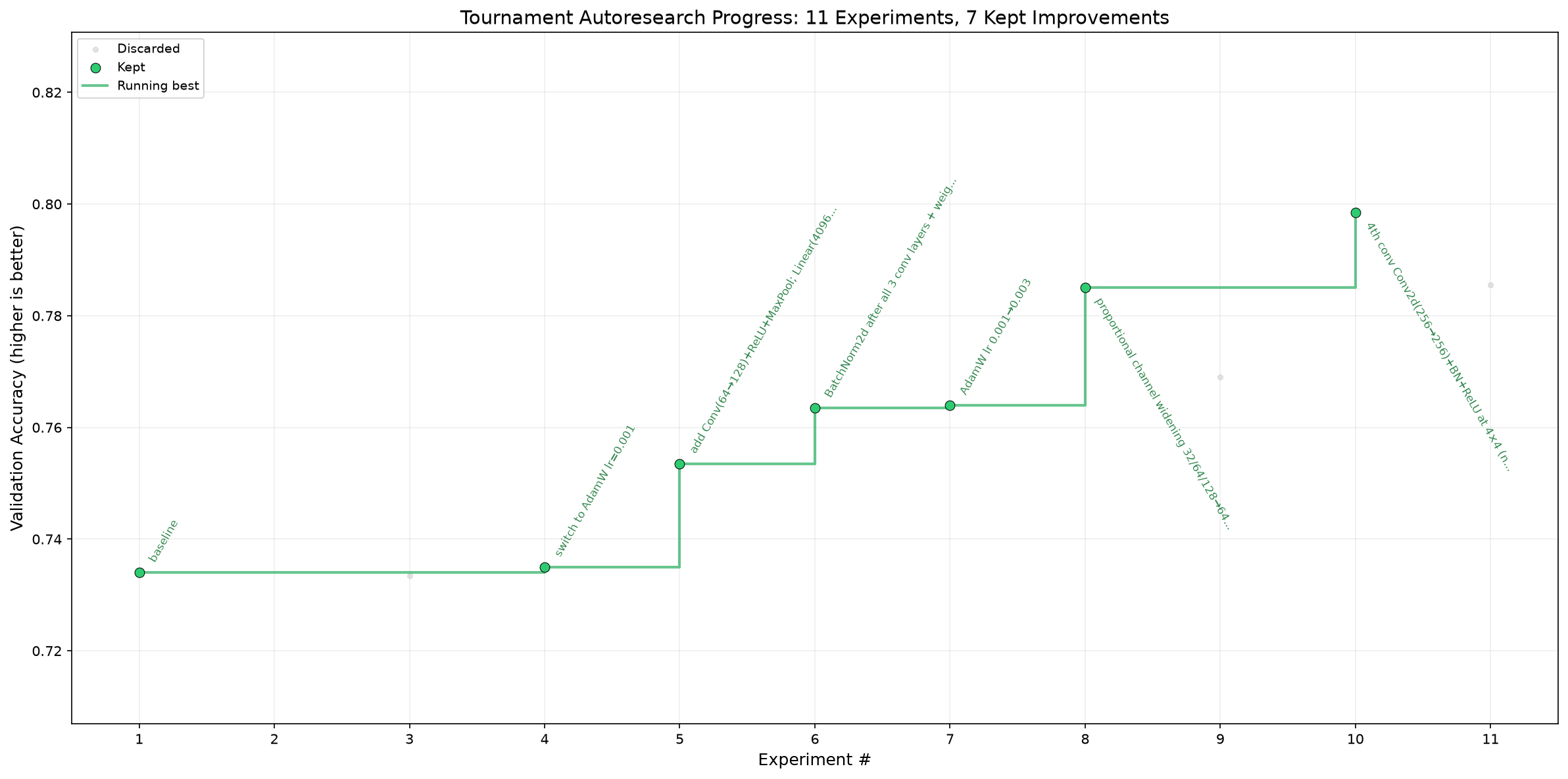
<img src="assets/tournament-autoresearch.png" alt="tournament-autoresearch improving a CIFAR-10 model from 0.734 to 0.798 over 11 iterations" width="820">
<sub><b>A real run.</b> The <code>tournament-autoresearch</code> loop on a CIFAR-10 model under a fixed 5-epoch budget —
competing agents propose a change each step, a self-calibrating judge keeps the winners (green) and discards the regressions (gray):
<code>0.734 → 0.798</code> , hands-off, 7 of 11 kept. Full ledger: <a href="showcase/tournament-autoresearch/results.tsv">showcase/tournament-autoresearch</a>.<br/>
<i>Far from SOTA by design — a deliberately tiny CNN at 5 epochs on a laptop GPU (Apple MPS). The demo is the loop's decision-making, not the absolute accuracy.</i></sub>
</div>
---
Why loops-as-skills
Two ideas collided in late 2025, and this repo lives in the o:
Markdown + a little YAML that an agent loads *only when relevant* — "maybe a bigger deal than MCP …
throw in some text and let the model figure it out"
(Simon Willison). One
SKILL.md now runs across~30 hosts (Claude Code, Codex, Cursor, …).
prompt;
Geoffrey Huntley's Ralph is, "in its purest form, a Bash loop." Agents
get most of their power not from one cle but from iterating against feedback.
This repo makes the loop *be* the skill. Instead of task-specific skills, each entry is a generic loop —
*program · artifact · feedback signal · run ledger · termination* — that you bind to your task at in
time. Paste your goal; the loop proposes a change, runs it in your en, scores it on a real
signal (tests, latency, a metric, a calibrated judge), keeps it only if it's better, logs it, and repeats.
> The honest part: unsupervised agent loops are famous for spinning forever and confidently shipping
> garbage — at 90% per-step accuracy, a 5-step chain fails ~40% of the time. Every loop here is
> : an objecti signal decides each step and an explicit termination
> condition ends it. That discipline — not autonomy for its own sake — is the point. (See
> Limitations.)
How a loop works
Every loop decomposes into the same fi — program (SKILL.md), artifact slot
(what's improved), feedback signal (what drives the next step), run ledger (append-only log), and
termination (when to stop). Skills ship zero hea: your code (a torch trainer, a SQL
database, a dataset) runs in *your* en via a bound run command; the skill shells out and reads the
result. Multi-role loops use spawn-or-degrade — real isolated subagents on Claude Code, the same roles
inline elsewhere.
Install
Any one of these installs all the loops:
Claude Code — plugin marketplace (add once, then install):
Loops install namespaced as agent-loops:<name> (e.g. agent-loops:karpathy).
Any Agent-Skills host — the standard installers:
Manual — clone, then copy the loops into your host's skills dir (pick the line for your host):
Then just describe your task — the host loads the matching loop. Research loops also call the sharedliterature-search skill; installing e puts it alongside them, and any
loop degrades gracefully (to WebSearch) if it's absent.
Loops in action
Most skill repos tell you what a skill *is*. Here's what these loops actually *do* — real Sonnet runs,
full ledgers in showcase/.
🧑⚖️ tournament-autoresearch — competing ideas, a self-calibrating judge
<n> agents pitch competing changes each step; a judge critiques them, picks one, runs it, and recalibratesby comparing its *predicted* * gain. On a CIFAR-10 SmallCNN under a fixed 5-epoch budget it
climbed 0.734 → 0.798 , keeping 7 of 11 changes and re all 4 that regressed —
escaping the plateaus a single-thread loop gets stuck on. *(That's the run charted up top.)*
→
showcase/tournament-autoresearch🔬 ml-autoresearch — analysis-first, every change traced to a cause
This loop reads *inside* each run — gradient flow, dead neurons, the loss curve — and grounds the next
change in that e rather than guessing: *"FC grad 57% conv 3.3% — severe imbalance; 54% dead
neurons"* → add BatchNorm; *"cosine schedule fixed the epoch-3 dip entirely (monotonic!), +0.033"*. It also
reverts what hurts (augmentation, o LR). The point isn't a leaderboard number — it's that
every accepted change has a measured reason behind it. →
showcase/ml-autoresearch📊 data-analysis — findings with a number behind every one
Hypothesis → , stdlib-only. On a planted dataset it surfaced 3 real findings and correctly refuted 2,
with effect sizes matching ground truth and no hallucinations: *enterprise order value
184.90 vs 109.16 (Cohen's d = 2.13)*, *mobile return rate 32.8% vs 8.2% (RR 4.0)* — and it re a
plausible-but-wrong claim once it spotted a mobile confound. →
showcase/data-analysis<details>
<summary><b>More real runs</b> — optimize-loop, research-proposal, red-team, power-analysis…</summary>
| Loop | What the run did |
|---|---|
| optimize-loop | Correctness-gated speedup: a SQLite query 1,131.75 ms → 1.055 ms (~1,073×), result-set hash matching baseline on every kept iteration; in *code* mode cut cyclomatic complexity 23 → 15 (nesting 7 → 3) with 13/13 tests green. |
| research-proposal | ScholarE a proposal against the literature; Judge + Reviser iterated grade 45 → 84 (soundness 2→4, contribution 1→4) over 5 rounds. |
| scientific-figure | Same ImageNet top-1-accuracy bar-chart brief, with the loop: a single call truncated the y-axis at 50% and used non-paper numbers; the loop every value against the arXi, flagged GoogLeNet's borrowed top-1, and iterated 80 → 96 (PASS). |
| red-team | Against a nai filter, surfaced all 5 planted weaknesses (case bypass, leetspeak, spacing, synonyms, o) — 39 bypasses + 6 o — with a one-line root-cause fix each. |
| power-analysis | Solved n = 100/group for 80% power , fixed all 6 flaws, and emitted a full pre-registration. |
| research-question | Sharpened 5 vague drafts → 3 strong questions (≥75), with real web novelty checks pi already-answered questions toward the open sub-problem. |
</details>
The loops
† = multi-role (real subagents on Claude Code, inline elsewhere). Browse any folder for its SKILL.md.
<details open>
<summary><b>Autoresearch</b> — iterate on an ML artifact against a metric</summary>
| Loop | Why you'd reach for it |
|---|---|
| karpathy | The minimal baseline — propose, train, keep-if-better, loop. A faithful nod to Karpathy's autoresearch. |
| ml-autoresearch † | Analysis-first: diagnoses each run and grounds the next change in e. A literature dial adds paper-grounded changes. |
| exploratory-autoresearch | Forces broad exploration via a temperature/swing scheduler — escapes hill-climbing one idea forever. |
| tournament-autoresearch † | Competing changes judged each step by a self-calibrating judge. |
| dueling-autoresearch † | Two approaches race the same metric in parallel and borrow ideas across lanes. |
| alpha-evolve † | Population-based e (MAP-Elites + islands, diff-mutate, cascade-eval). |
</details>
<details>
<summary><b>Literature & writing</b> · <b>Data</b> · <b>Code & optimization</b> · <b>Security</b> · <b>Other</b> (click to expand)</summary>
Literature & writing
| Loop | Why you'd reach for it |
|---|---|
| literature-search | Shared toolchain (not a loop): paper discovery, snippets, citation-graph, full-text o Scholar + arXiv. |
| literature-survey | Builds a saturating e/contradiction matrix of sources × claims. |
| research-question | Sharpens a vague topic into strong, novel, feasible research questions. |
| hypothesis-gen † | Generates and literature-vets a pool of research hypotheses. |
| research-proposal † | Grades a proposal against the literature (ScholarEval) and revises until it passes. |
| scientific-writer † | Specialist judges + an independent peer-re critique a draft; a writer revises until the score clears a bar. |
| scientific-figure † | A generator drafts a publication figure from your data/brief; an ad critic grades it against a fixed rubric — both can consult the literature (S2/arXiv) — and the two iterate until it's paper-ready. |
Data
| Loop | Why you'd reach for it |
|---|---|
| data-analysis | Hypothesis → discovery; every finding backed by a reproduced number at a meaningful effect size. |
| anomaly-in | Diagnoses the cause of a known anomaly by forming, testing, and eliminating candidates. |
| claim- | Ad a results draft's claims against the underlying data. |
| tabular-cleanup | Cleans a messy table to an inferred data contract with deterministic checks. |
Code & optimization
| Loop | Why you'd reach for it |
|---|---|
| optimize-loop | E with a pluggable correctness gate + minimized metric — refactor code (tests green + complexity↓) or speed up SQL (identical results + latency↓). |
| prompt-optimize | E a prompt against a user-supplied scoring command (a black-box oracle). |
| plan-loop † | Refines a prompt into an executable plan — first-principles decomposition → PR-sized tasks (deps, tests, subtasks) → a principal-engineer critique loop; emits plan.md + a tasks.json. |
| swe-loop † | Executes plan-loop's tasks.json task-by-task — an Engineer subagent writes the code (source only), a QA subagent authors the tests + grades a strict simplicity/readability rubric (tests only); they loop until the task's tests pass, regression stays green, and quality holds, then commit. |
Security — authorized testing only
| Loop | Why you'd reach for it |
|---|---|
| red-team | Ad loop-until-dry that surfaces distinct failure classes of a system you own. |
| blue-team | The defensi — closes a failure catalogue's classes under a regression gate, then opens a PR. |
| purple-team † | Orchestrates red → blue → re- until a fresh attack pass stays dry; opens a PR with the patch set. |
Other
| Loop | Why you'd reach for it |
|---|---|
| power-analysis | Sizes and pre-registers a two-arm experiment to hit a target statistical power. |
</details>
Compatibility
Skills (a SKILL.md the model invokes) work broadly across the open standard. A loop **dispatching a
subagent from a role file at runtime** is confirmed only on Claude Code — elsewhere multi-role loops (†)
run their roles inline (still correct, just serial). Single-agent loops run fully e.
| Host | Skills | Loop-dispatched subagents |
|---|:--:|---|
| Claude Code | ✅ | ✅ real, isolated, parallel — |
| Claude Agent SDK | ✅ | ✅ |
| Codex CLI · Cursor | ✅ | ➖ inline |
| Hermes · Antigravity · Pi · OpenClaw | ✅ *(reported)* | ➖ inline |
Full, citation-backed matrix and the precise "why subagents are Claude-Code-only" reasoning:docs/compatibility.md. Off Claude Code, don't rely on parallel subagent isolation.
Compose with other skill collections
These are self-contained, open-standard skills, so they coexist with any other collection — install both into
the same skills dir and use them together. For example alongside
K-Dense scientific-agent-skills:
They install as sibling folders (Claude Code namespaces each plugin; other hosts load all and pick bydescription). A loop's analysis step can invoke any other installed skill — the same mechanism the research
loops use to call literature-search.
Roadmap
Loops are most useful when they're honest about what's next. PRs on any of these are very welcome:
blue-team (thedefensi) and
purple-team (find → fix → re-), with the pullrequest as the communication interface to the target's owner.
sandbox/ e committed for every loop, so anyone can reproduce a run end-to-end.delegate_task) so multi-role loops getreal isolation beyond Claude Code.
See open issues and grab agood first issue.
Status & limitations
!status: experimental
Experimental — expect breaking changes. Pin a if you need stability.
Non-goals (deliberate scope, not missing features): these are human-supervised loops, not
fully-autonomous agents; not a model or runtime (bring your own host); not domain-exhaustive — for a
very custom workflow, fork a loop, that's what they're for.
Contributing — and a note on open source 💜
I love open source, and this repo is built to be added to. **You don't need to be an expert and you don't
need to write code** — a sharper description, a new loop, a bug report, or a pasted run transcript all make
it better. New loops are welcome, and so are wild ideas.
Start with CONTRIBUTING.md and the authoring rubric indocs/skill-authoring-rules.md; grab agood first issue. Be kind, have
fun, and if a loop helped you, a ⭐ genuinely helps others find it.
Pro / credits
karpathy — a faithful adaptation of Andrej Karpathy's autoresearch program-as-skill idea.alpha-evolve — a simplified, ML-bent re-creation of AlphaEvolve(Novikov et al., 2025, arXiv:2506.13131) +
OpenEvolve.
research-proposal — its ScholarE faithfully reimplementsScholarEval (arXiv:2510.16234).
K-Dense
scientific-agent-skills.Repo layout
<di="center">
⭐ If looping until it's better is your kind of fun, star it and send a loop.
<a href="
<img src=" width="600" alt="Star History">
</a>
</div>
项目信息
开发语言:Python
Star 数:173
技术要点
该项目属于红蓝攻防方向的开源资源,代码结构清晰,适合安全研究人员学习参考。项目围绕Loop until it's better — drop-in agentic loops (autoresearch, scientific writing, data analysis, code/SQL/prompt optimization, red-teaming) as open-standard Agent Skills. Verification-gated; native on Claude Code, portable across Codex, Cursor & other Skills hosts.展开,提供了可运行的实现,对理解相关安全机制、工具原理与攻防技术具有较高的研究价值。
从技术实现角度看,此类项目的核心在于对底层原理的深入理解与工程化落地。开发者在研究过程中可以结合官方文档与社区讨论,梳理项目的初始化流程、核心模块职责与数据流转,逐步掌握其中的技术细节与设计思路。
使用与学习建议
1. 下载源码压缩包,解压到本地环境。
2. 根据项目类型准备对应的运行环境与依赖。
3. 按照 README 中的步骤完成配置与部署。
4. 在隔离的测试环境中运行验证,避免影响生产系统。
免责声明
本资源来源于开源社区,仅供安全研究、技术学习与合法授权范围内的攻防演练使用,请勿用于任何非法或侵害他人权益的用途。使用本项目产生的一切后果由使用者自行承担。
| 资源标题 | Agent-Loop-Skills - Loop until it's better — drop-in agentic loops (au |
| 所属分类 | 红蓝攻防 |
| 发布作者 | admin |
| 发布时间 | 2026-10-06 00:48:08 |
| 下载权限 | 免费下载 |
| 附件数量 | 2 个下载链接 |
| 浏览次数 | 431 |
| 讨论数量 | 0 |
| 主题状态 | 正常讨论中 |