 红蓝攻防
点击放大
cyberful - Cyberful is an open-source AI Red Team for discove
项目说明
<p align="center">
<img src=".github/assets/cyberful-readme-logo-clean-v1.png" alt="Cyberful" width="720" />
</p>
Cyberful: The Open-Source AI Red Team.
![CI]() ![npm ]()  ![Documentation]() ![skills.sh]()
For authorized pentests, code audits, and bug bounty research.
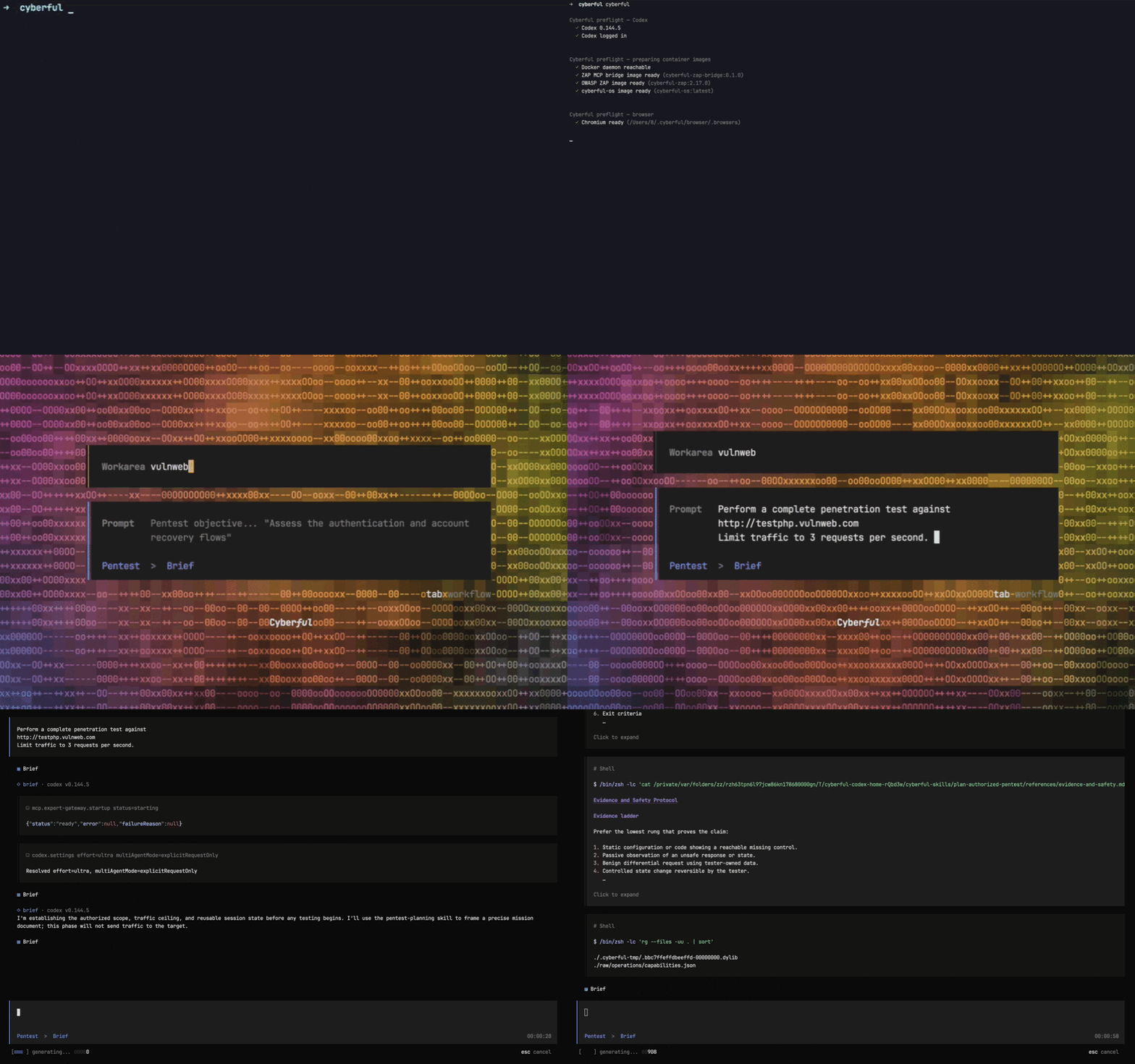
Cyberful is an AI Red Team. In other words, it is your security research laboratory that uses a multi-agent system to orchestrate 316 cybersecurity tools, including 203 command-line applications and commands such as Nmap, Metasploit, and Nuclei, alongside ZAP and Ghidra.
In short, hypothesis workers map attack surfaces, test exploit paths, and impact in isolation. Then, a deterministic control plane enforces scope and preser. Finally, only independently reproduced reach reports. This applies to penetration testing, code audits, and bug bounty hunting.
*(i) Documentation:* installation, workflows, configuration, architecture, and security runtimes are documented at cyberful.ai/open-docs.
<p align="center">
<img src=".github/assets/cyberful-demo.gif" alt="Cyberful running an authorized penetration test" />
</p>
Why Cyberful
Cyberful exists to democratize cybersecurity: to make ad security work understandable, inspectable, and usable by more de, researchers, maintainers, and smaller teams. Democratization does not mean unrestricted automation or lower standards; findings remain e, independently , and tied to the engagement that authorized them.
Getting started
Cyberful requires Node.js 18 or newer, npm, Docker, and a configured model provider.
1. Install Cyberful.
2. Choose or create a folder that will serve as your cybersecurity laboratory.
3. Create a settings.yaml based on example.settings.yaml, then authenticate the configured provider.
4. Start Cyberful and select a workflow.
For complete fresh-machine instructions on macOS, Linux, and Windows, follow Your first penetration test.
To keep model inference on your own machine, follow Local inference.
Requirements
To install through npm and run a release:
ZAP, Ghidra, Python, Ruby/Bundler, nati and fuzzing, managed Firefox/Marionette, Xvfb/X11 clipboard testing, archi, and the offensi are included in the runtime image. Before a li AgentRun starts, an ephemeral pri HTTPS canary that curl/OpenSSL, Git, Requests/pip, Node, and Ruby/Bundler can traverse the real ZAP proxy with the attested engagement CA; it ne the target or Internet. Brief then installs and attests the engagement's host-scoped rate limit and mandatory public request headers in ZAP before numbered target-profile preflight. After each accepted Pentest or Bug Bounty phase, the host records a best-effort passive ZAP checkpoint filtered to obser whose hostname is authorized by the finalized policy; non-web engagements make no checkpoint ZAP call or wait, and collection ne handoff. Cyberful embeds its pinned hardened agent-browser fork and prepares an isolated compatible Chrome for agent-controlled browsing, so it ne access to a personal browser profile. Docker Compose is not required.
See What you need for the supported host platforms, release architectures, provider setup, and source de requirements.
Build and test
From the repository root:
make build resolves the current official ATT&CK releases once, and indexes the three domains, and embeds the resulting snapshot in every standalone binary. Source launches such as make run ne ATT&CK; they use the snapshot left by the latest successful build and report DATASET_UNA when none is a.
Source de requires Bun 1.3.14, Node.js 24 with npm, Python 3.10+, and Docker. See the contributing guide for the complete build, test, runtime, and release workflow.
Configuration and local state
Cyberful creates a secret-free settings.yaml in the launch directory. It defines pro, models, fallback routing, delegation, trusted instructions, and the progressi budget; provider credentials stay in Cyberful's protected credential store or named en . See Agent pro and fallback and .en.
Workareas li work/<name>/ and session logs under logs/session-logs/. They can contain sensiti. Ne workareas, transcripts, browser profiles, ZAP or Ghidra state, generated reports, credentials, or tokens.
The first local engagement also prepares the release-pinned C in the foreground. Before downloading, Cyberful checks an explicit path, the managed pointer, orphan snapshots, and a source checkout's fixed dist/c directory; selecting an orphan repairs the missing pointer atomically. Release 2026.08.05 downloads about 5.18 GiB only when no local candidate exists, expands to about 24.47 GiB, requires approximately 31 GiB of additional free space during installation, and shows download and acti progress on stderr. Later startups reuse the local snapshot without a network update check.
Start a specific headless workflow with cyberful run --workflow bug-bounty --workarea <name> "<objective>". Add --format json for the redacted coding-agent stream, inspect durable or attached state with cyberful session inspect, and supervise an attached TUI with cyberful session watch. The public cross-agent skill and full control-room contract are documented in Cyberful Skill: How to integrate cyberful in your coding agent. Resume an existing session with cyberful run --continue or cyberful run --session <id>; session lifecycle, steering, approvals, reports, and cleanup are covered in Sessions, configuration, and reports.
Documentation
Support Cyberful
Lo? Give us a ⭐ on GitHub!
Acknowledgements
Cyberful builds on the incredible work of open-source projects like Pi, OpenTUI, the Cyberful agent-browser fork and its upstream project, Chromium, OWASP ZAP, Ghidra, and the MITRE ATT&CK knowledge base. Huge thanks to their maintainers!
License and responsible use
Cyberful is released under the GNU Affero General Public License v3.0 only (AGPL-3.0-only). Use it only on systems and source you are authorized to assess. You are responsible for scope, authorization, legal compliance, and safe operation.
项目信息
开发语言:TypeScript
Star 数:132
技术要点
该项目属于红蓝攻防方向的开源资源,代码结构清晰,适合安全研究人员学习参考。项目围绕Cyberful is an open-source AI Red Team for discovering, exploiting, verifying, and remediating vulnerabilities.展开,提供了可运行的实现,对理解相关安全机制、工具原理与攻防技术具有较高的研究价值。
从技术实现角度看,此类项目的核心在于对底层原理的深入理解与工程化落地。开发者在研究过程中可以结合官方文档与社区讨论,梳理项目的初始化流程、核心模块职责与数据流转,逐步掌握其中的技术细节与设计思路。
使用与学习建议
1. 下载源码压缩包,解压到本地环境。
2. 根据项目类型准备对应的运行环境与依赖。
3. 按照 README 中的步骤完成配置与部署。
4. 在隔离的测试环境中运行验证,避免影响生产系统。
免责声明
本资源来源于开源社区,仅供安全研究、技术学习与合法授权范围内的攻防演练使用,请勿用于任何非法或侵害他人权益的用途。使用本项目产生的一切后果由使用者自行承担。
| 资源标题 | cyberful - Cyberful is an open-source AI Red Team for discove |
| 所属分类 | 红蓝攻防 |
| 发布作者 | admin |
| 发布时间 | 2026-10-06 00:51:02 |
| 下载权限 | 免费下载 |
| 附件数量 | 2 个下载链接 |
| 浏览次数 | 477 |
| 讨论数量 | 0 |
| 主题状态 | 正常讨论中 |